
The York Imperial Apple
Written by Alli Davis in the Marking Time category and the Fall 2024 issue Topics in this article: apples, Jonathan Jessup, Pennsylvania Historical Marker Program, York County, York Imperial Apple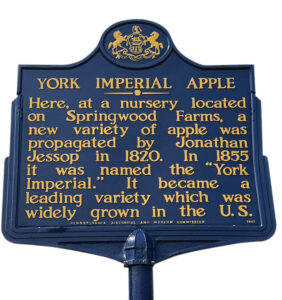 Apple picking is a popular fall activity across Pennsylvania, as many orchards offer customers the chance to pluck the fresh fruit directly from their trees. Pennsylvania ranks fourth among states in apple production, growing 400 million to 500 million pounds a year. Fruit production — especially apples — has been a strong agricultural staple in the Keystone State since the late 18th century, specifically in York and Adams counties.
There’s a certain “antique apple” that has been propagated for more than 200 years and is still used in a variety of commercial apple products. You probably won’t find it in a grocery store, but you may come upon it at farmers markets and roadside fruit stands.
The York Imperial apple was developed by Quaker nurseryman Jonathan Jessop in the 1820s on his Springwood Farm, near York, part of which is now the site of Apple Hill Medical Center. Jessop, a clockmaker, engineer and entrepreneur, shared a love of apple growing with his mother. He received seedlings from an apple tree on the nearby farm of John Kline in Hellam Township. These seedlings came from a particular tree that had produced apples that kept all winter on the ground under a blanket of snow. Jessop used grafts of this tree to develop a new long-lasting variety.
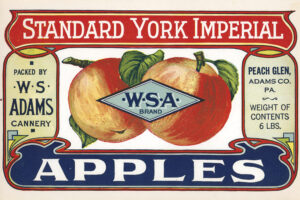
Crate label for WSA brand Standard York Imperial Apples, 1920s.
Crisp, juicy, sweet and tart, the York Imperial has a quirky, lopsided shape and is typically red with yellow or greenish streaks and specks. The variety quickly gained popularity as an all-purpose apple for baked goods, applesauce, cider, juice, dried slices, preserves and jams, and eating fresh. It grows well even in stony soils and keeps well in root cellars, lasting into April or May, becoming sweeter tasting over time. This gave the apple its original name, Jonathan’s Fine Winter. Renowned horticulturalist Andrew Jackson Downing dubbed it the “Imperial of Keepers” in the 1850s, which led to its current name.
To this day, the York Imperial is still grown commercially, specifically for applesauce and apple juice for such brands as Musselman’s and Lucky Leaf. It has been continuously one of the top 10 bestselling apple varieties.
The Pennsylvania Historical Marker for the York Imperial was dedicated on April 5, 1948, and is located along South George Street near Monument Road, 2 miles south of York.
Alli Davis is the coordinator of the Pennsylvania Historical Marker Program.