
The Historic National Road
Written by Pamela Reilly in the Wish You Were Here category and the Winter 2024 issue Topics in this article: Addison Toll House, Braddock's Road, Fayette County, highways, National Road, Somerset County, toll houses, Washington County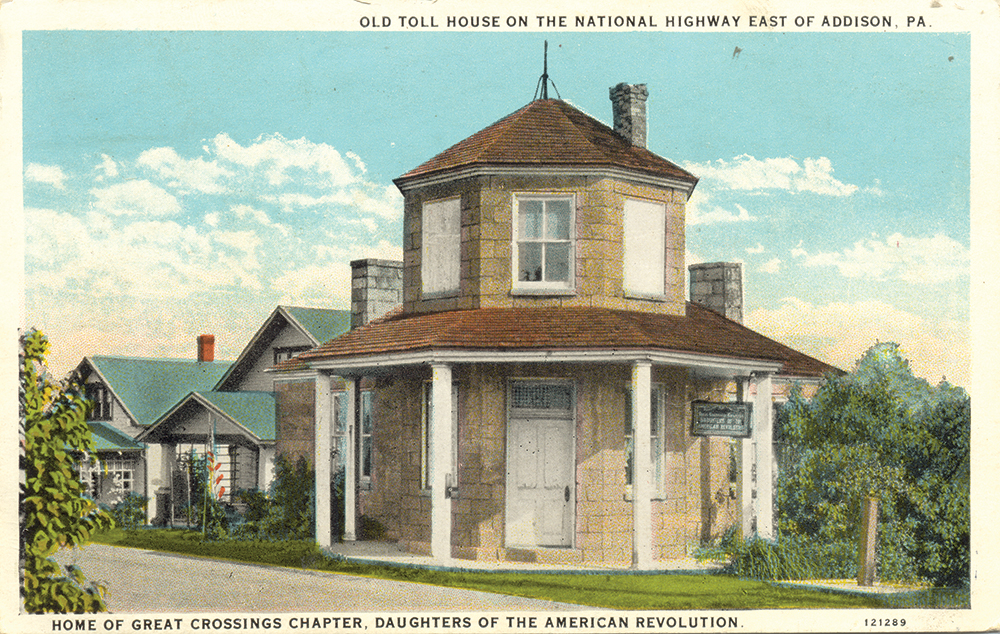
Distinctive seven-sided toll houses like the one shown on this early 20th-century postcard marked the route of the National Road in southwestern Pennsylvania. The National Road was the first highway planned and funded by the federal government and was intended to connect the East Coast with the country’s western frontier by opening a route through the Allegheny Mountains.
Construction of the National Road began in 1811 in Cumberland, Maryland, to help travelers moving west from the port of Baltimore to the Ohio River. It was planned to run along existing paths, including the military roads constructed by British regulars and Virginia militia led by Gen. Edward Braddock in 1755 as they made their way west toward Fort Duquesne at the beginning of the French and Indian War. In Pennsylvania, the National Road covers 90 miles, sometimes over steep mountains through Somerset, Fayette and Washington counties.
The National Road was built by private contractors with a workforce that included Irish immigrants. By 1818 it was open to traffic from Cumberland, Maryland, through Pennsylvania to Wheeling, West Virginia. In the 1830s, when federal funding ceased, it extended across three more states — Ohio, Indiana and Illinois — and more than 600 miles to reach Vandalia, Illinois. The federal government gave the states ownership of the road, so each was responsible for collecting tolls for road maintenance.
The impact of the National Road was enormous as it opened a travel route for settlers moving west and spawned towns and villages along its path. Taverns, hotels, stables and blacksmith shops sprang up to provide needed services for travelers, stagecoaches and wagons. Although travel on the road declined in the mid-19th century as a result of the expansion of railroads, it revived in the early 20th century with the advent of automobile touring.
In Pennsylvania, the National Road had six heptagonal, or seven-sided, toll collection houses spaced 15 miles apart, but only two survive: the stone toll house pictured here near Addison in Somerset County and another known as Searights Toll House in Fayette County. Across the state border in Maryland, the LaVale Toll Gate House, with a similar heptagonal design, remains standing. The polygonal shape of these buildings follows a common vernacular form of the late 18th and early 19th centuries, brought to Pennsylvania by English, Welsh and Scots Irish settlers and employed in the construction of one-room octagonal schools in the eastern part of the state.
The two-story heptagonal tower design of the National Road toll houses made them easily identifiable to travelers and the attached square sitting room and fireplace provided living quarters for toll collectors. Sturdy iron gates once stood across the road at each tollhouse to enforce the collection of tolls.
The Addison Toll House, known as the Peterburg Toll House when it was built in 1835, is located just north of the Mason–Dixon Line and was thus the first toll house encountered by travelers entering Pennsylvania from Maryland as they headed west on the National Road. Tolls of varying amounts for livestock, riders on horseback, coaches, carts, sleighs and wagons were collected on the road until 1906, after which the toll houses fell into disuse.
In the early 20th century, the Daughters of the American Revolution (DAR) took an interest in educating travelers about the history of the National Road, erecting bronze tablets along its route and installing 12 identical monuments called “Madonnas of the Trail” to honor the strength and spirit of pioneer mothers. One of those DAR-funded statues was erected in Pennsylvania at Beallsville in Washington County.
In the late 1940s the Great Crossing Chapter of the DAR purchased the Addison Toll House from the state, intending to commemorate its history and restore the building for community use. A Pennsylvania Historical Marker was erected there in 1947, noting the preservation and restoration of the toll house by the DAR. It was listed in the National Register of Historic Places in 1978 as the Petersburg Toll House and is also a contributing building in the National Register–eligible Addison Historic District along the original route of the National Road, which was later bypassed with the construction of modern U.S. Route 40.
The historic significance of the National Road has been recognized in a variety of ways. In 1976 it was honored as a Historic Civil Engineering Landmark by the American Society of Civil Engineers. It also was designated as a National Scenic Byway and an All-American Road by the U.S. Department of Transportation in 2002. The Pennsylvania Department of Conservation & Natural Resources lists it as a Heritage Corridor, one of the state’s 12 heritage areas. The Pennsylvania State Historic Preservation Office funded research studies of the National Road, resulting in a 1995 National Register multiple-property listing for historic resources along its route in Pennsylvania.
Pamela W. Reilly is a historic preservation specialist in the Pennsylvania State Historic Preservation Office.