
The Burning of Pennsylvania Hall
Written by Richard Saylor in the Our Documentary Heritage category and the Winter 2025 issue Topics in this article: abolitionism, African Americans, civil rights, John G Watmough, Joseph Ritner, Pennsylvania Anti-Slavery Society, Pennsylvania Hall, Pennsylvania State Archives, Philadelphia, riots, Samuel Webb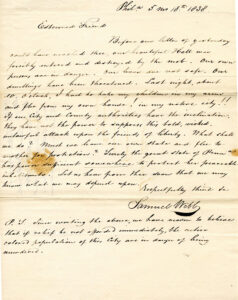 The Pennsylvania State Archives holds a small cache of letters related to an episode in the early 19th-century struggle for Black civil rights in the commonwealth, the burning of Pennsylvania Hall. The letters were written by victims of the crime, the mayor and high sheriff of Philadelphia, and the attorney general of Pennsylvania.
Although Pennsylvania had passed the Gradual Abolition Act in 1780, racial conflicts erupted in Philadelphia by the 1830s, as free Blacks were now in competition for jobs, causing resentment among working class whites. These sentiments again boiled over when Pennsylvania Hall was built by the Pennsylvania Anti-Slavery Society as a venue for abolitionist and other reform lecturers. Officially opened on May 14, 1838, on the corner of Sixth and Haines streets, it was the first building in the United States constructed predominantly for the use of abolitionists. Three days later, it was surrounded by an angry mob.
Samuel Webb, a member of the Board of Managers of the Pennsylvania Hall Association, wrote to Gov. Joseph Ritner for help that same day: “The Pennsylvania Hall, which on the second of this week we dedicated to “Liberty,” is surrounded by a furious mob. We have consulted the officers of our city. They declare themselves unable to protect us in the rights which they admit are clearly our own.”
The mob attacked the hall and burned it to the ground that night. “Pennsylvania Hall is in flames having so I learn been fired by a mob which obtained possession of it during the evening,” Pennsylvania Attorney General William B. Reed wrote to Ritner that same night. “I think it my duty to recommend that you immediately issue your Proclamation offering a very liberal reward for the discovery and conviction of the perpetrators of this outrage. . . . Promptitude is essential.”
The next day, Samuel Webb wrote an emotional letter to Ritner concerning what had happened the night before: “Our beautiful Hall was forcibly entered and destroyed by the mob. Our own persons are in danger. Our lives are not safe. Our dwellings have been threatened. Last night, about 10 o’clock, I had to take my children in my arms and flee from my own house! In my native city!!” In a postscript, Webb cautioned, “Sincen writing the above, we have reason to believe that if relief be not afforded immediately, the entire colored population of this city are in danger of being murdered.”
The rioting did not end there. Also on May 18, a mob attacked Philadelphia’s Orphan Asylum, a shelter for Black children. “I was shocked and grieved as much at the apathy manifested by the large mass of citizens who calmly witnessed these scenes, as at the conduct of the lawless mob who put all restraint human and divine at defiance,” John G. Watmough, high sheriff of Philadelphia, wrote to Ritner on May 24. “The means which the Laws placed at my disposal proved vain and futile. . . . If the Freeman resists the appeal of his own constituted authorities to preserve the peace and order of society no matter under what impulse, the great experiment in favour of Civil Liberty and human rights made in the formation of our government, falls to the ground.”
Several arrests of alleged rioters were made, but no trials were held. On May 30, Pennsylvania Hall’s Board of Directors resolved to sue Philadelphia County for the police’s failure to protect it from the mob, seeking damages of $100,000. City officials responded by claiming that the abolitionists had provoked the riot by the “promiscuous intermingling indoors and out of blacks and whites.” The case would drag on until 1841, and payment was not made until 1845, when the Pennsylvania Supreme Court finally granted the owners of Pennsylvania Hall an award of $27,943.82. Despite the dangers, the abolitionist movement continued to expand throughout Pennsylvania in the antebellum period.
The letters relating to the burning of Pennsylvania Hall are preserved at the State Archives in Record Group 26.1: Department of State, Office of the Secretary of the Commonwealth, Attorney General’s Correspondence.
Richard C. Saylor is an archivist for the Pennsylvania State Archives and author of the award-winning book Soldiers to Governors and numerous articles on military, political and sports history.