Revolutionary Things: Objects from the Collection
Written by Curtis Miner in the Features category and the Winter 2026 issue Topics in this article: 1st Pennsylvania Regiment, American Revolution, bald eagles, battle flags, Benjamin Franklin, Betsy Ross, Bicentennial Wagon Train Pilgrimage, cannon, Centennial International Exhibition of 1876 (Centennial Exposition), Charles Thomson, Charles Weisgerber, Committee of Safety, Conestoga wagon, decorative arts, E. Clinton and Company, George Washington, Liberty Bell, Marquis de Lafayette, material culture, Matthew S. Quay, military uniforms, muskets, powder horns, quilts, State Museum of Pennsylvania, Thomas Robinson, United States Bicentennial, Whiskey Rebellion, William Barton, William Huckel, William ThompsonMassachusetts has the Boston Tea Party, Bunker Hill and the Shot Heard Round the World; Virginia can lay claim to Mount Vernon, Monticello and Yorktown; and New Jersey and New York bore the brunt of the fighting in the conflict. But few if any of the original 13 colonies can compete with Pennsylvania in terms of the sheer concentration of people, places and things associated with the nation’s founding — from the signing of the Declaration of Independence and the ringing of the Liberty Bell to the creation (story) of the nation’s first flag and a host of indelible images from that chapter in American history.
It would be difficult to visualize the American Revolution without conjuring Emanuel Leutze’s iconic 1851 painting Washington Crossing the Delaware or William B.T. Trego’s somber March to Valley Forge, first exhibited at the Pennsylvania Academy of the Fine Arts in 1883. America, per the claim on a 1990s license plate, really did start in Pennsylvania.
Pennsylvania also has been central to preserving and interpreting that history. Two of the most visited Revolutionary War national parks are located in the commonwealth: Independence National Historical Park, centered around the Liberty Bell and the old Pennsylvania State House (now known as Independence Hall); and the sprawling 3,500-acre Valley Forge National Historical Park in nearby Montgomery and Chester counties. In 2024, the two parks combined attracted 4.6 million visitors. Add to that the network of state, county and local historic sites — from the Pennsylvania Historical & Museum Commission’s Brandywine Battlefield Park to the cluster of properties, especially in southeastern Pennsylvania, where “George Washington slept” — and one finds enough of the real thing to satisfy even the most dedicated Rev War history nerd.
Another way in which Pennsylvania’s role in the American Revolution is told and remembered is through ts militaria, paintings, decorative arts and ephemera — what museums and scholars refer to collectively as material culture. The interest in memorializing and preserving Pennsylvania’s revolutionary story began almost as soon as the war ended. Framed and three-dimensional objects — both authentic and fabricated — were an important means for containing and conveying that collective memory. Those objects have taken many different forms and come in many shapes and sizes, from mere locks of hair — albeit from the famous noggin of George Washington — to battle-scarred regimental flags and fullsize replicas of the Liberty Bell.
To help mark the nation’s 250th anniversary this year, The State Museum of Pennsylvania in Harrisburg has organized a special exhibition titled Revolutionary Things: Objects from the Collections. On view in Gallery A of The State Museum through July 2026, the approximately 3,000-square-foot exhibition highlights more than 140 objects from the museum’s permanent collection that together tell the story of how Pennsylvania has memorialized its revolutionary past through objects collected and preserved by the state’s official history museum. Some of the objects on display have a documented history of use from the Revolutionary War and its times. Others reflect the ways in which later generations of Pennsylvanians remembered, imagined and celebrated the nation’s founding and the Keystone State’s central role in it. Of equal interest is the story behind the artifacts — how they came into the commonwealth’s possession and what that in turn reveals about the role of individual Pennsylvanians, and the PHMC to whom they have been entrusted, in preserving this national history in the “birthplace of freedom.”
Relics
Revolutionary Things features a number of artifacts that were saved and preserved because of their known — or sometime purported — history of use in the American Revolution. Some of the artifacts are associated with well-known historical figures or battles. Others are related to individuals about whom we know very little — often anonymous and otherwise unremarkable Pennsylvanians who were tied to an extraordinary time.
Photo, The State Museum of Pennsylvania
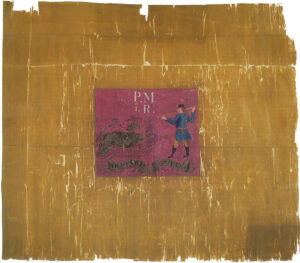
1st Continental Regiment Flag
Among the most important of commonwealth-owned relics are the Revolutionary War–era flags that were carried by Pennsylvania regiments during the war. The State Museum is fortunate to have in its collection the 1st Continental Regiment flag, better known as the Thompson Rifle Battalion Flag, or Thompson Flag.
Records confirm that this standard was carried by the 1st Pennsylvania Regiment of the Continental Line between 1776 and 1783. The 1st Continental Regiment itself formed in 1775, initially under the command of Col. William Thompson of Carlisle. In 1777, the unit was renamed the Pennsylvania Regiment. The flag was believed to have been made in Lancaster County in 1776.
The 1st Pennsylvania Regiment became one of the most renowned and respected units in the Continental Army. The regiment took part in battles at New York, Trenton, Princeton, Brandywine, Germantown, Monmouth and other locations. Evidence indicates that the 1st Pennsylvania was with Gen. George Washington when he crossed the Delaware River for a surprise attack on Hessian troops in Trenton in December 1776 and when he encamped at Valley Forge in the winter of 1777–78.
The painted scene in the center of the Thompson Flag shows a hunter trying to trap and subdue a tiger with a net. The Latin motto beneath that scene reads “Domari Nolo,” which translates as “I refuse to be subjugated.” The image has commonly been interpreted as a metaphor for America’s struggle against British authority.
After the war, the flag was passed down through the family of the unit’s last commander, Col. Thomas Robinson. In 1876, Secretary of the Commonwealth Matthew Quay purportedly saw the flag on display at the Centennial Exhibition in Philadelphia and in 1879 managed to purchase the relic from Robinson’s living descendants. Quay, who would later go on to become a U.S. senator, subsequently donated the flag to the commonwealth. It has been part of The State Museum’s collections since 1906.
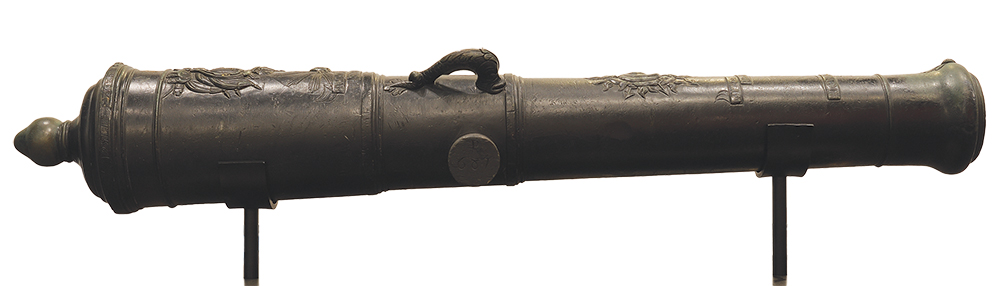
L’Embuscade Cannon
French-supplied artillery like this brass cannon were considered critical to America’s success in fighting the better-equipped British army. Like most 4-pounders procured from the French, this cannon was rebored to accept the more common 6-pounder balls used by British and American troops.
Photo, The State Museum of Pennsylvania
According to records, this field gun was one of several so-called “Lafayette cannons” acquired by Pennsylvania from Virginia after the war and brought to Harrisburg, where they served as a memorial to Pennsylvania’s role in the American Revolution. When the Marquis de Lafayette (1757–1834) visited Harrisburg as part of his 1825 tour of the United States, the cannons were fired in salute to the “hero of the Revolution.” At the time, the French general was said to have identified the cannons as having been used at Yorktown.
As these weapons have been referred to as Lafayette cannons, it seems reasonable to conclude that Lafayette procured them on behalf of the Continental Army. He was after all the most notable French supporter of the American cause, leaving France in 1777 to become an aide-de-camp to Washington, fighting alongside American troops. In Pennsylvania, Lafayette was wounded at the Battle of Brandywine and encamped with Washington’s army at Valley Forge. It seems unlikely, however, that the French nobleman personally secured and delivered these arms to American forces. They were probably procured directly from the French government. France sent many munitions to the Continental Army, which lacked the resources and technology to forge its own cannons — this despite Pennsylvania being the center of the American iron industry at the time.
Four other French-made cannons from this period still reside in the collections of PHMC and can be seen on display at Fort Pitt, Brandywine Battlefield Park, and Washington Crossing Historic Park.
Committee of Safety Musket
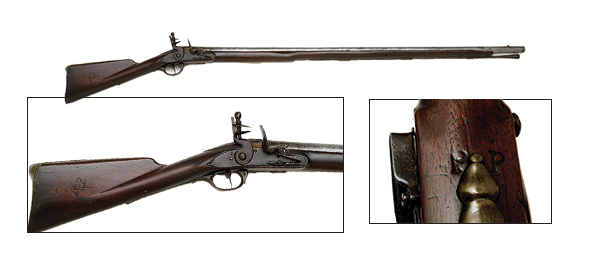
On June 30, 1775, the Pennsylvania Assembly authorized the creation of the Committee of Safety to provide for the defense of the province. Among the prominent group of Pennsylvanians named to the committee was Benjamin Franklin (1706–90), who was also chosen as its president. Under Franklin’s direction, Pennsylvania’s Committee of Safety undertook the fortification of defenses in and around Philadelphia, which was thought to be especially vulnerable to attack from British ships. Another objective of the committee was to amass military stores that might be used against the British, including firearms. These later became known as “safety muskets” for that reason.
Photos, The State Museum of Pennsylvania
The State Museum acquired this circa 1770 musket from a private collector in 1980. Although the musket seems largely indistinguishable from other firearms of the period, what makes it special and important is the inscription on it: “PP,” which is widely believed to stand for “Province of Pennsylvania.” At the time of its acquisition, museum staff noted that there were fewer than 10 such marked and authenticated Committee of Safety muskets in existence.
Powder Horn
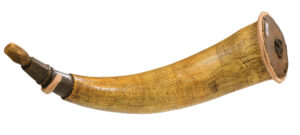
Another object in The State Museum’s collection that has been documented to the American Revolution is an inscribed powder horn associated with the Continental Army’s unsuccessful 1775 invasion of Quebec.
Photo, The State Museum of Pennsylvania
Powder horns were an essential part of a soldier’s weaponry, and as the old aphorism cautions, the gunpowder needed to fire muskets and other firearms needed to be kept dry. Cow’s horns proved ideal for that purpose, because they are hollow, durable and waterproof. The horns are also soft enough to be carved and inscribed. That fact explains why many powder horns were decorated, generally by their owner and often to document their history and use in battle.
Photo, The State Museum of Pennsylvania
An outline of a five-sided fort appears on one side of the circa 1775 powder horn in the museum’s collection. Next to that illustration is an inscription, “GOT O / QUEBACK FOT / FITE IT IF CAN TAKE / IT,” which suggests that it was likely carried during the failed invasion of Quebec. A second inscription on the horn identifies its owner and the maker — ”MORRILL WHITE HIS HONRN MADE / BY JOHN SMITH SANBORN IN KENSINGTO.” Research confirms that an individual by that name lived in Kensington, New Hampshire.
Revolutionary Era Uniform Coat
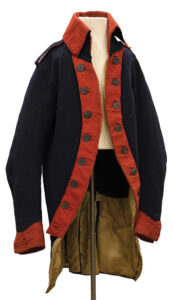
This blue-and-red wool uniform coat is one of the earliest examples of military dress in The State Museum’s collection. Its original owner, Henry Felty (1758–1836), is documented to have served with the York County militia during the Revolutionary War, but this particular coat, on closer inspection, does not conform to uniform patterns of the war years. The cut and style are more consistent with Army uniforms made shortly after the war.
Felty continued to serve until 1799, so he likely wore this coat at the end of his military service. The coat is a reminder that uniforms worn during the war were unlikely to survive as they would have been used until they fell apart.
George Washington’s Hair
Photo, The State Museum of Pennsylvania
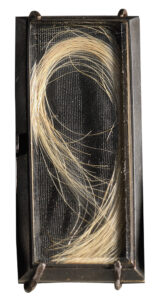
George Washington (1732–99) was a Virginian through and through, but Pennsylvania held a special place for him: He started his military career here during the French and Indian War; in the Revolutionary War, he famously crossed the Delaware River from Pennsylvania in 1776, fought in the Philadelphia Campaign in 1777, and subsequently encamped with his forces at Valley Forge that winter; and he ended his long career in public service here, having resided in Philadelphia for seven out of eight years as the new nation’s first president. Not surprisingly, The State Museum has a number of collections associated with Washington, but perhaps the most personal, and most interesting, are two strands of hair that are documented to have been plucked from the head of the “Father of His Country.”
By today’s norms, saving locks of hair seems like a curious practice. But in the 1700s and 1800s, hair from the deceased was considered a common form of memorial. That was especially true if the owner had achieved the kind of fame and reverence that was accorded to individuals such as Washington. Of the two strands, one comes with what was intended to be a letter of authenticity. The writer testifies that the strands contained therein were “cut from the head of the illustrious and immortal Washington in 1797 on his last visit to Philad.” — a clear reference to Washington’s service as president at the end of his second term.
The other example is encased inside a cloth bracelet, which was a common means for mounting and displaying hair strands. Both examples were acquired by the museum in the early 1900s.
Photo, The State Museum of Pennsylvania
Washington Medals
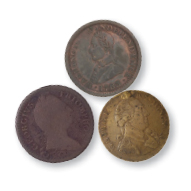
The earliest medals in The State Museum’s political history collection bear the likeness of George Washington, although it would be a misnomer to categorize these objects as political: In the late 1700s, the practice of striking medals or coins to promote candidates for political office, including president, was still a few decades off. Three of the museum’s four Washington medals were made to commemorate the 1783 Treaty of Paris, which officially ended the war and recognized the sovereignty of the newly formed United States. Although Washington had not yet been elected the country’ s first president — that would come six years later in 1789 — the medals still feature General Washington’s now unmistakable visage. One is inscribed “Georgius Triumpho,” which translates to “Triumphant George.”
A fourth medal, which dates to 1793, was struck to mark Washington’s second inauguration as president — another historic event that took place in Philadelphia. “Success to the United States,” a reference to Washington’s wish that God would grant the new nation prosperity and continued unity, is inscribed on the reverse side.
Photo, The State Museum of Pennsylvania
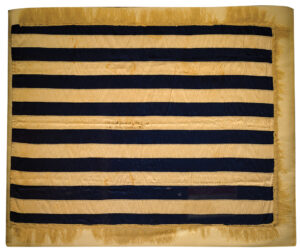
Whiskey Rebellion Flag
Almost 20 years after independence from British rule, a group of western Pennsylvania farmers challenged the authority of the United States. This flag from the museum’s permanent collection is part of that post-Revolutionary story.
An individual identified as William Huckel is documented to have carried this flag as part of a militia organized under the command of President George Washington to put down the farmers’ rebellion. The loosely organized rebels refused to pay a tax on whiskey and took up arms against federal revenue collectors. Historians consider it to be the nation’s first test of federal authority. The Whiskey Rebellion is also the only time in American history when a sitting U.S. president led troops into battle.
The marking in the center of the cotton flag reads, “This quilt was used by Wm. Huckel in the Western Expedition 1794.” The flag is based on the field of the 1st Cavalry flag of Philadelphia and includes one stripe for each of the 15 states that composed the new nation at that time. Records indicate that Huckel served with a state militia based in Philadelphia.
Representations and Replicas
After the American Revolution, Pennsylvanians turned to paintings and other decorative arts and crafts to depict people, events and symbols from the nation’s founding. Many of these have strong Pennsylvania connections.
In its collections, The State Museum is fortunate to have many examples of the wide variety of forms and materials used to capture and convey Pennsylvania’s role in that historic moment — everything from objects and canvases depicting George Washington, Betsy Ross and the bald eagle to full-scale replicas and miniature souvenirs of the Liberty Bell — probably the most widely reproduced and commodified symbol of the American Revolution.
Photo, The State Museum of Pennsylvania
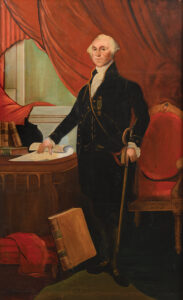
George Washington Full-Length Portrait
Little is known about this painting of George Washington, but it was rumored to have nearly perished in a fire at the Old State Capitol.
The full-length portrait shows Washington standing in front of a red upholstered chair and next to a desk with a partially unscrolled document. The painting appears to be largely based on Gilbert Stuart’s famous 1796 Landsdowne Portrait. At least a few details seem to be borrowed from a popular engraving from the 1840s that depicted Washington delivering his first inaugural address. An inscription in the lower left corner of the canvas reads “C. Hinkley,” presumably the signature of artist Cornelius T. Hinkley (1820–1857).
The painting was said to have hung for many decades in the Senate Chamber of the first Pennsylvania State Capitol, better known as the “Hills Capitol,” after the architect who designed it, Stephen Hills (1771–1844). The Hills Capitol served as Pennsylvania’s seat of government from 1822 until 1897, when a fire consumed the structure and reduced the building to “a smoldering mass of debris.” According to accounts at the time, this painting is one of the few objects that survived.
After it was recovered from the fire, the painting fell into private hands and seems to have disappeared from public view. In the late 1970s, the portrait resurfaced in an antique shop in Alexandria, Virginia, where it was purchased by Robert and Ada Brandegee of Pittsburgh. In 1981, the Brandegees donated the painting to The State Museum.
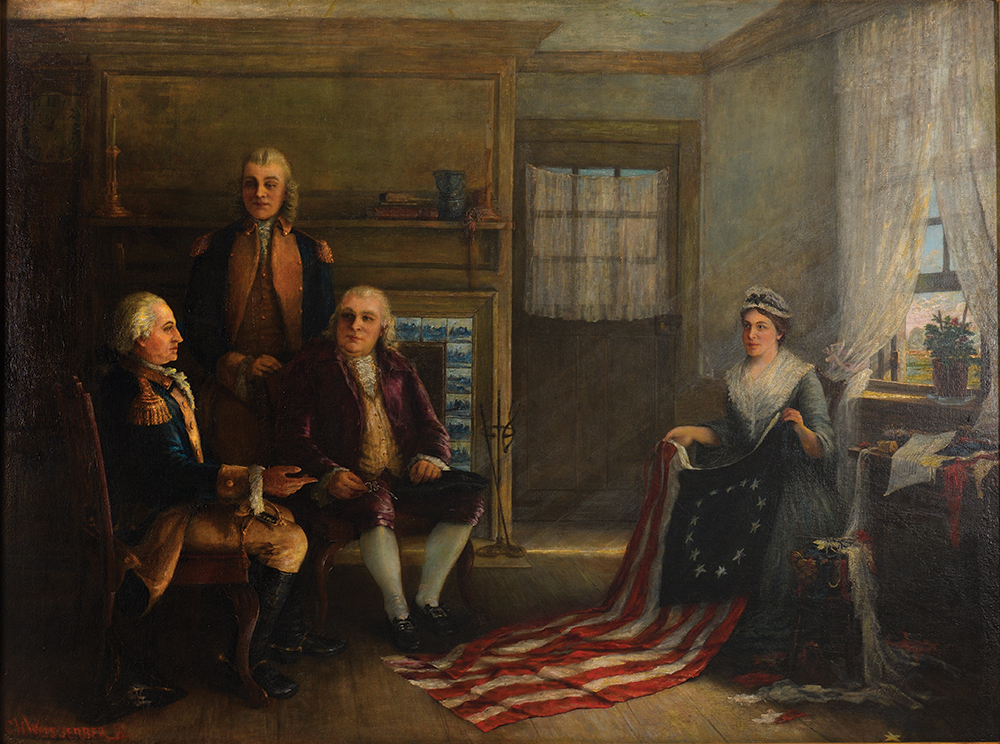
Birth of Our Nation’s Flag
The story — and many historians today would say myth — of Betsy Ross (1752–1836) and the first American flag owes its popularity to this painting by Philadelphia artist Charles Weisgerber (1856–1932).
Up until the 1890s, Betsy Ross’ story — largely attested to by her family only — was little known outside of Pennsylvania. That changed when Weisgerber’s monumental painting went on display at the World’s Fair in Chicago in 1893.
Photo, The State Museum of Pennsylvania
Weisgerber had been inspired to paint Betsy Ross and her supposed first rendition of the Stars and Stripes after wandering past the building in Center City that had once housed her upholstery shop. The completed painting was first unveiled to the public at the fair and displayed prominently along with the original Liberty Bell inside the Pennsylvania Building. There, Weisgerber’s painting became an added draw for the more than 27 million people who visited the fair, the first world’s fair hosted since the Centennial Exhibition in 1876.
Weisgerber went on to sell more than 10 million prints of his painting. Reproductions of Birth of Our Nation’s Flag appeared on classroom walls and in history textbooks across the nation. Weisgerber continued to paint, but Betsy Ross remained his passion, and he dedicated the rest of his life to preserving her legacy. The artist used proceeds from print sales and a crowdfunding campaign to purchase Ross’ upholstery shop, which he managed and lived in with his family until his death.
The painting was donated to The State Museum in 2001 by Weisgerber’s heirs.
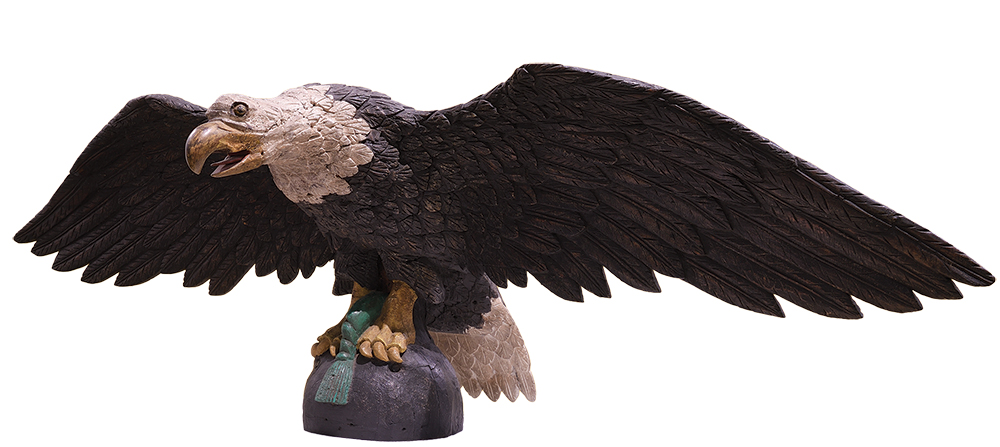
Carved American Eagle
The bald eagle is not exclusive to Pennsylvania, but it owes its elevation to national symbol — after it first made its debut on the Great Seal of the United States in 1782 — to two Pennsylvanians.
Photo, The State Museum of Pennsylvania
In May 1782, Pennsylvania native William Barton (1754–1817) was appointed to the third of three committees that had been authorized by the Continental Congress to devise a design for the official national seal. Two previous committees had failed to come up with an acceptable design. Enter Barton, who in addition to being a lawyer was also an expert in heraldry. That, combined with artistic talent, inspired him to produce a design that finally received approval. At the center of Barton’s rendering was an eagle with wings “displayed.” It took another Pennsylvanian, Charles Thomson (1729–1824), secretary of the Continental Congress, to suggest that Barton’s golden eagle, common to the heraldry of many European countries, be replaced with the American bald eagle.
After Congress adopted this design on June 20, 1782, the bald eagle quickly began to appear on official documents, currency, flags, public buildings and other government-related items. But it found its way on folk and commercial objects as well. One of the more compelling bald eagle–inspired artifacts in The State Museum’s collection is a large, polychrome, wood-carved bald eagle that is documented to have stood at the entrance to the Eagle Hotel in Waterford, Erie County, in the early 1800s. The hotel was located near historic Fort LeBoeuf, which Washington visited in 1753 in an effort to expel the French.
The bald eagle is depicted perched on a rock with what some believe to be a green lobster between its talons. Its textured wings span an impressive 7 feet.
Photo, The State Museum of Pennsylvania
1964–65 World’s Fair Liberty Bell
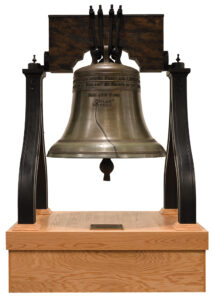
For one week in 1965, visitors to the New York World’s Fair could ring the Liberty Bell. Not the actual Liberty Bell, but a 2,500-pound bronze replica, specially cast at the Paccard Foundry in Annecy-le-Vieux, France.
The full-scale replica debuted as part of the fair’s Pennsylvania Week in June 1965, after which it remained on view in the Pennsylvania Pavilion until the fair’s closing in October. Photographs from the period show Boy Scout troops from Pennsylvania stationed around the bell.
The bell was a big draw for the remaining months of the World’s Fair. It had been made possible, and funded, by a group that called itself “100,000 Pennsylvanians for the Promotion of Economic Growth” — a nonprofit support group formed as part of Gov. William Scranton’s administration to promote economic growth and all things Pennsylvania. In 1967, officials from the group donated the replica to the recently opened William Penn Memorial Museum (now The State Museum of Pennsylvania) in Harrisburg.
In 1990, the Pennsylvania Department of General Services restored the bell. The museum eventually relocated it from the plaza to just outside the building’s south entrance on North Street, where it conveniently greeted school groups as they discharged from their buses for field trips. This past year, the bell was again conserved and refurbished and brought inside for its current display in Revolutionary Things.
Remembrances Past
Pennsylvania was at the center of two major celebrations marking the anniversary of the nation’s founding: The Centennial in 1876 and the Bicentennial in 1976. Both events left behind a considerable trail of material culture — not surprising given the sheer volume of mementos and souvenirs that both celebrations generated. But the material these celebrations churned out represents more than just the commodification of the nation’s anniversary; they also testify to Pennsylvania’s pivotal role in the American Revolution, its subsequent emergence as an industrial powerhouse, and its continued relevance as the nation’s “keystone” state.
The Centennial
On May 10, 1876, more than 100,000 people converged on Philadelphia’s Fairmount Park for opening-day ceremonies of the International Exhibition of Arts, Manufactures, and Products of the Soil and Mine, better known as the Centennial Exhibition, or the Centennial Exposition. Over the next six months, the exhibition attracted nearly 10 million visitors — one out of every five Americans.
More than just a commemoration of the nation’s founding, the exhibition — the first major world’s fair held in the United States — featured 200 specially made buildings and grounds that sprawled out over 285 acres. Thirty-seven countries and 26 of the nation’s 37 states participated.
Going to the Centennial became something of a right of passage for many Americans and offered both education and entertainment. The admission ticket, which cost 50 cents or about $15 in today’s money, would have granted the bearer access to most of the exhibition’s displays and buildings, although visitors wishing to climb up a ladder inside the newly completed right arm and torch of the future Statue of Liberty did pay an extra fee for that experience.
Photo, The State Museum of Pennsylvania
E. Clinton & Co. Brush Display
Held just a decade after the end of the Civil War and set against a rapidly changing world in which the United States was emerging as an economic force, the Centennial offered an opportunity to unify the nation and show off its ingenuity and manufacturing might. The Centennial today is probably best remembered for its trade show quality — hundreds of exhibits spread out across dozens of buildings.
Many new products and innovations, including Alexander Graham Bell’s telephone, the Remington typewriter, and early electric lights, made their debut at the Centennial. The biggest draw seems to have been the outsized Corliss Steam Engine. But well-established companies also used the Centennial to advertise their wares to a broad American public.
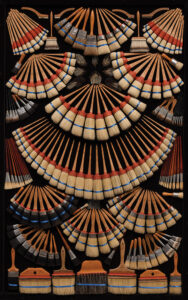
Philadelphia-based E. Clinton & Co., which had been founded in 1840, created these display boards for the Main Exhibit Building to show off their range of brushes for personal and commercial use. They were one of hundreds of companies with booths in the various exhibition halls.
Centennial displays were evaluated by an international team of judges and were awarded medallions. In presenting a medallion to Clinton & Co., judges noted the “superior quality, skill and fitness” of their products and declared the Philadelphia-based manufacturer to be one of the finest brush makers in the world. Pennsylvania-based companies garnered more medals than any other state.
This original display was eventually acquired by a private collector. After it was featured in a special exhibition at the Smithsonian Institution in 1976, museum staff from The State Museum asked if the owner would be willing to donate the display to the museum because of its Pennsylvania connection. The display was subsequently crated and shipped to the museum for its collections in 1991.
Photo, The State Museum of Pennsylvania
38-Star Flag
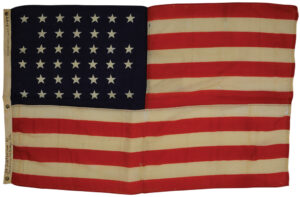
Then as now, fairgoers to the Centennial purchased souvenirs to memorialize the experience. The Centennial especially revived interest in patriotic symbols, which along with fairground images were imprinted on just about everything, from dishes and mugs to scarves and fans. American flags were especially popular souvenirs, both the historic 13-star banner and the newer 38-star flag.
Colorado had not yet been admitted to the Union as the 38th state by May 1876, but the flag anticipated the new nation’s continued expansion. This particular flag was patented in 1870, even though the 38-star flag was not formally adopted until July 4, 1877. American flag makers routinely took out patents on new flag designs, often years before the federal government formally adopted a new flag to reflect the current number of states.
The inscription at the top of this flag indicates that it was presented to R.G. Fletcher, a Titusville businessman, at the time of the Centennial.
Photo, The State Museum of Pennsylvania
Centennial-Inspired Crazy Quilt
Along with renewing interest in national symbols, the Centennial also exposed Americans to cultural influences and design styles from around the world. The Japanese Pavilion was especially popular among fairgoers, providing many attendees with their first-ever glimpse of Japanese architecture and decorative arts.
Historians also credit the Japanese Pavilion with inspiring a fad that has been forever intertwined with Victorian America: the crazy quilt. Characterized by irregular shapes and asymmetrical designs that are common in Japanese design, the quilts were sometimes called Japanese patchwork or puzzle patchwork. The new quilts were a sharp departure from prevailing quilt styles to that point.
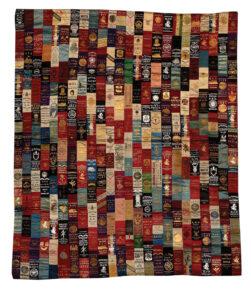
The State Museum is fortunate to have many examples of Pennsylvania-made crazy quilts that were inspired by this craze. Perhaps one of the most interesting is a crazy quilt that was made entirely out of convention ribbons dating from 1875 to 1896. Among the groups represented by the ribbons are fraternal organizations, trade and labor unions, and religious and temperance societies. A few political campaign ribbons also can be seen.
It is unclear how the quiltmaker, Ellen Moyer Martz of Bellwood, Blair County, obtained such a wide variety of ribbons from as far away as Seattle, Washington, but one story passed down through the family is that Martz’s husband collected them during his travels as an engineer for the Pennsylvania Railroad.
Photo, The State Museum of Pennsylvania
The Bicentennial
The divided America of 1976 saw a very different commemoration than the one that gathered in Philadelphia in 1876. Still reeling from the Vietnam War and the social and cultural fissures of the 1960s, the nation did not come together for one big celebration as it had during the Centennial. Nevertheless, Pennsylvania still managed to play a starring role in the many events held to mark the Bicentennial.
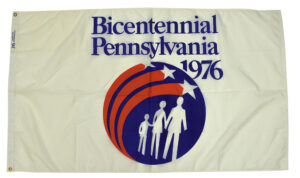
Bicentennial Flag
Authorized by the state legislature in 1968, the Pennsylvania Bicentennial Commission coordinated and promoted hundreds of Bicentennial celebrations across the commonwealth. Over the course of the year-long celebration, the commission helped organize everything from cross-country wagon trains to local parades and historical reenactments.
Photo, The State Museum of Pennsylvania
Bicentennial Quilt
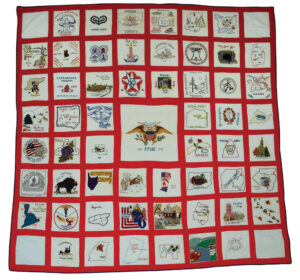
Sponsored by the Pennsylvania Federation of Women’s Clubs, this unusual quilt includes a square from each of the organization’s 56 county-based chapters at that time.
For two years leading up to the Bicentennial, federation women gathered at their local chapters to design a square for this quilt. Most but not all of Pennsylvania’s 67 counties are represented on the resulting quilt, which was presented to the membership at its annual meeting held in Lancaster in 1976.
The quilt is an example of the highly participatory nature of the Bicentennial and the role that women played in planning the celebration.
Bicentennial Conestoga Wagon
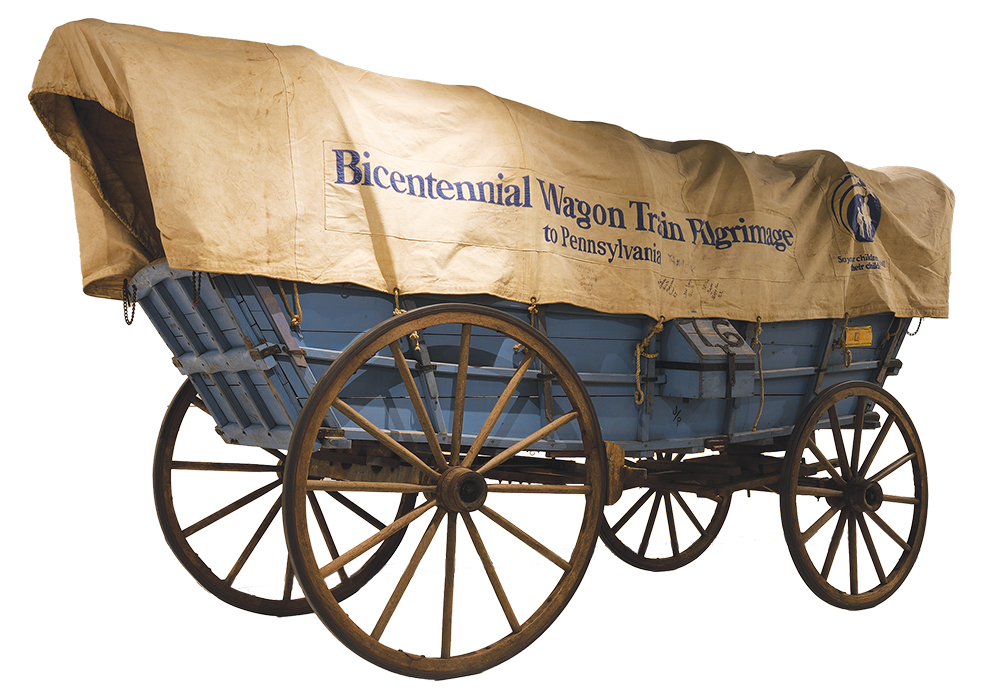
In the year leading up to America’s 200th birthday, 50 reproduction covered wagons traveled west to east across the country, reenacting the nation’s history of migration in reverse. Wagon trains started out from the West Coast with the intention of converging on the Keystone State by July 1976.
Photo, The State Museum of Pennsylvania
The Bicentennial Wagon Train Pilgrimage to Pennsylvania was the single largest celebration of the Bicentennial year. Its journey ended July 4, 1976, in Valley Forge, where a large crowd, including President Gerald Ford, gathered to greet the train and celebrate 200 years of American independence.
The horse-drawn Bicentennial Wagon Train paraded through hundreds of small towns and cities, collecting signatures on Pledges of Rededication, scrolls that proclaimed the signers’ commitment to the values laid out in the Declaration of Independence.
Curtis Miner, Ph.D., is chief of interpretation at The State Museum of Pennsylvania. He writes widely on Pennsylvania social and cultural history. He wishes to acknowledge the contributions of Lindsay Davis, Amy Hammond and Lily Kondrich to the exhibition script on which this article is based, and Kyle Weaver for his comments and suggestions.