
Rebecca Harding Davis, Literary Realist
Written by Renee Dubaich and Alli Davis in the Marking Time category and the Winter 2024 issue Topics in this article: American literary realism, authors, industrialization, iron, Lemuel C. Davis, Philadelphia, Rebecca Harding Davis, steel, Washington (Pennsylvania city)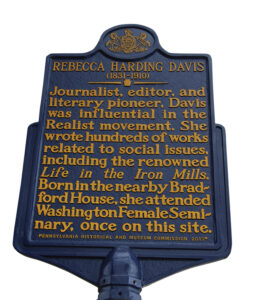 Author and journalist Rebecca Harding Davis (1831–1910) is best known for writing one of the earliest works of American literary realism, the short story “Life in the Iron-Mills.” In her career, she authored more than 500 publications, including novels, short fiction, essays and newspaper editorials. Several of these works gained a national reputation through their commentary on the working class and other social issues of the industrializing landscape of the 19th century.
Rebecca Blaine Harding was born in Washington, Pennsylvania, in 1831. When she was 6 years old her family moved to Wheeling, Virginia (now West Virginia). In 1845 she returned to Pennsylvania to attend the Washington Female Seminary, a Presbyterian school for women, one of the state’s most notable institutions of its kind. In 1848, at the age of 17, Rebecca graduated as valedictorian of her class.
After graduation, Harding returned to Wheeling and read the emerging female authors of the time, such as Harriet Beecher Stowe, Maria Cummins, and Anna and Susan Warner. She also began to write regularly. In 1854 she joined the staff of the local newspaper, the Wheeling Intelligencer.
At the time, Wheeling was developing into a productive factory city, abundant in iron and steel mills, which drew in working-class populations who were primarily immigrants. Harding witnessed firsthand the oppressive effects of the industrial revolution on these workers. On her regular walks through the city, she observed their impoverished living conditions.
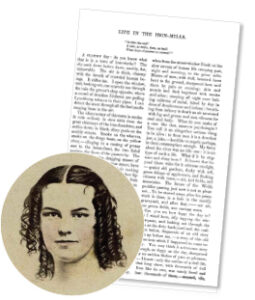
This is the only known photograph of Rebecca Harding Davis, pioneer of American literary realism. Another photo of an older woman has been mistakenly identified as Davis in some publications.
Courtesy of the Bradford House
These experiences inspired Harding to write “Life in the Iron-Mills.” She submitted the manuscript to The Atlantic Monthly, and it was published anonymously in the April 1861 issue. Described as grim, didactic and morbid by some critics, the story reflects the rising labor reform movements of the time, as workers united for better wages and working conditions. Harding sought to make her middle-class readers aware of the harmful price of their material comfort. American literary realism centered on stories of mundane, everyday experiences, primarily about the lower classes. Throughout her writing career Harding’s focus remained centered on the lives of immigrants, women and other marginalized groups.
In 1863 Harding married Lemuel Clarke Davis (1835–1904), a journalist and avid admirer of her work, with whom she had corresponded. In 1864 they settled in Philadelphia, where they had three children, two of whom became writers, Richard Harding Davis (1864–1916) and Charles Belmont Davis (1866–1926).
In Philadelphia, Rebecca Davis resumed writing, further addressing social issues of the day: racial injustice in Waiting for the Verdict (1867), gender constraints in “Earthen Pitchers” (1873) and “The Wife’s Story” (1864), and political corruption in John Andross (1874), which was set in Pennsylvania. Her last published work was a memoir, Bits of Gossip, in 1904.
Today, the Rebecca Harding Davis Society preserves her legacy and promotes the scholarship and study of her work.
The Pennsylvania Historical Marker for Rebecca Harding Davis was dedicated on April 13, 2013, and was installed on the Washington & Jefferson College campus along South Lincoln Street in Washington, at the former site of the Washington Female Seminary, which operated from 1836 until 1948. Also nearby at 175 South Main Street is Davis’ birthplace — now known as the Bradford House (bradfordhouse.org), named for its first resident David Bradford, a leader in the Whiskey Rebellion. The house museum includes an exhibit on Davis.
Renee Dubaich is the Keystone 2023 Summer Intern for the Pennsylvania Historical Marker Program.
Alli Davis is the coordinator of the Pennsylvania Historical Marker Program.