
Preserving Washington’s Headquarters
Written by Troy Grubb in the Trailheads category and the Fall 2024 issue Topics in this article: American Revolution, Battle of Brandywine, Benjamin Ring, Brandywine Battlefield Park, Chadds Ford, Christian Sanderson, G. Edwin Brumbaugh, George Washington, Pennsylvania Historical and Museum Commission, Pennsylvania Trails of History, Washington’s Headquarters (Battle of Brandywine)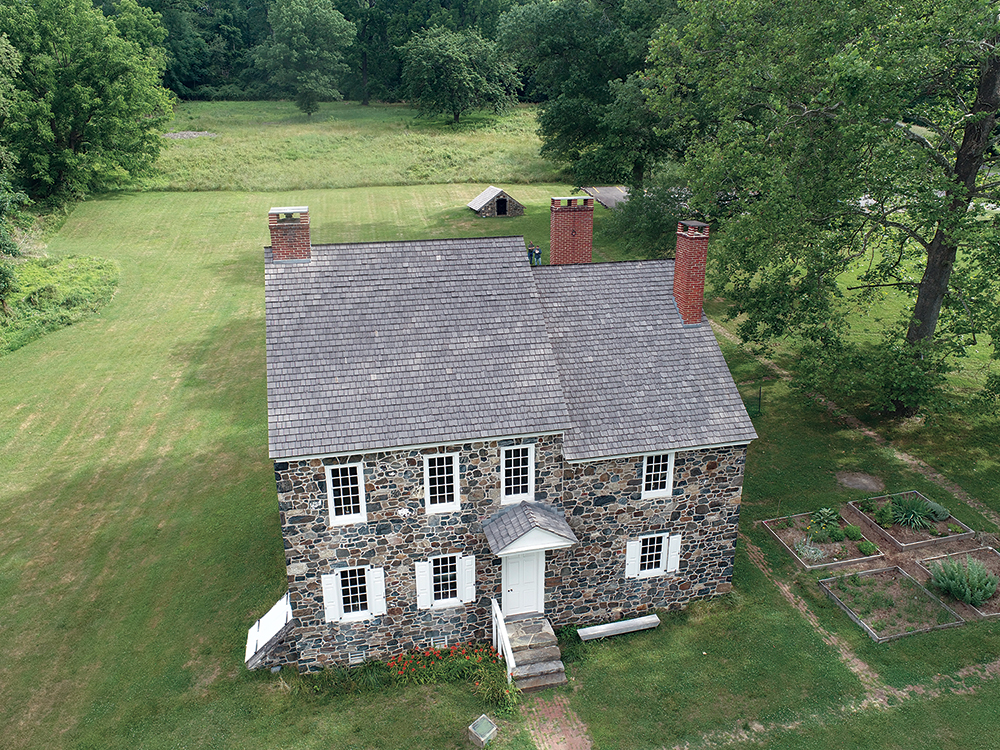
Washington’s Headquarters at Brandywine Battlefield Park, 2024.
Courtesy of Ernest Abbott
On the morning of September 9, 1777, Gen. George Washington and units of his Continental Army arrived in the village of Chads (later Chadds) Ford. Its strategic location on the Great Nottingham Road (today U.S. Route 1) and along the banks of the Brandywine Creek made it a likely place for an attack as the British army crept closer to the rebel capital of Philadelphia.
As his anxious troops took up positions along the heights of the Brandywine, Washington established his headquarters about a mile from the creek at the spacious home of fuller and sawmill operator Benjamin Ring.
Whether Ring openly welcomed Washington remains a topic of debate. Ring was a Quaker, so if he had invited the general into his home, he would have compromised his nonviolence testimony and risked expulsion from his meetinghouse. Also, he and his wife were expecting their ninth child; soldiers in the house would add unwanted stress.
Nevertheless, Washington and his staff quickly turned the Ring house into the nerve center for the collection and distribution of vital information as they awaited the British attack. On September 11, the attack came, striking the flank of Washington’s army and sending it into retreat. Washington had just finished dinner at the house around 2:00 p.m. when he received news of the British flanking move. He arrived on the scene in time to witness another crushing defeat.
Following a different outcome at the end of the Revolutionary War, reverence for Washington soared, assuring the Ring house and its residents a place in history.
After the Battle of Brandywine, Benjamin Ring, along with his neighbors, endured five days of unimaginable horror as British and Hessian soldiers plundered crops, livestock and personal possessions, leaving many residents in desperate circumstances.
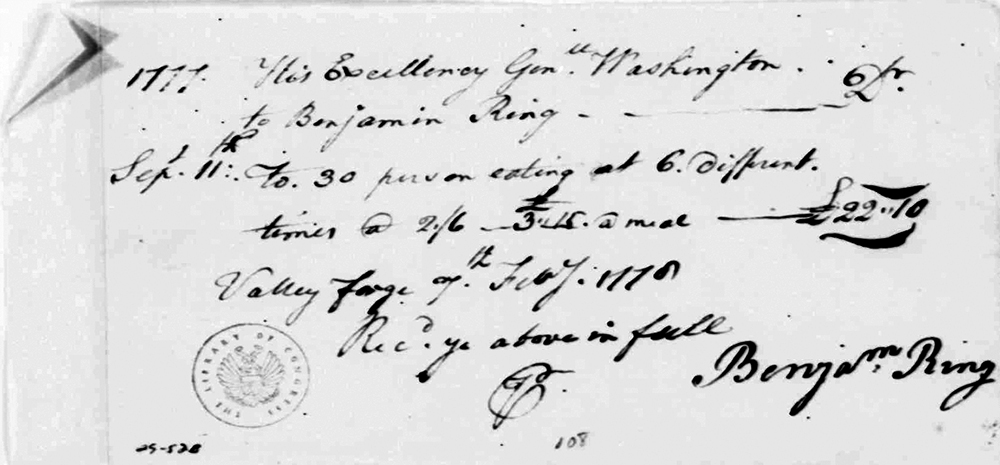
This receipt dated February 7, 1778, reveals how much Washington paid Benjamin Ring for 30 people eating at 6 different times (180 meals total), £22 10s (about $5,000 today).
George Washington Papers, Library of Congress
Ring estimated his financial losses at £739 (roughly $149,000 today). The following year, he received some assistance after Washington paid him for the 180 meals that he and his staff consumed for a total of £22 10s (about $5,000 today). More significant relief arrived in 1795 when the Quaker Committee of the Meeting for Sufferings in Philadelphia appropriated £100 (a little over $15,000 today) for his losses at the Battle of Brandywine. In his plea for assistance, Ring stated that he was “so stripped” of his personal property that “he had not even a coat left him to put on” and “his losses so affected him, that he has ever since been struggling under difficulties occasioned thereby.” Even with this aid, Ring likely never fully recovered as he died a short nine years later, and his property went to public sale.
During the Civil War, the Ring house again went to public sale and appeared in sales notices as Washington’s Headquarters. Subsequent references to the house as Washington’s Headquarters appeared in newspaper advertisements, articles and maps. This renown attracted a young teacher, Christian Sanderson, who left a lasting impact on the house when he and his mother moved into the east section in 1906.
Renewed interest in the house during the Sandersons’ years reflected their enthusiasm for history and a willingness to invite curious passersby into their home for a tour. Guests included U.S. congressmen, students, soldiers and notable local artist N.C. Wyeth. The January 15, 1921, issue of The Youth’s Comrade described the headquarters as “a veritable Mecca for famous people from all parts of the country, who come here to look, to reverence and to depart with a deeper sense of patriotism than they have ever before known.” In 1921 alone, Sanderson welcomed 9,257 visitors, who often left donations in a bean pot — a leftover relic from the British after the battle.
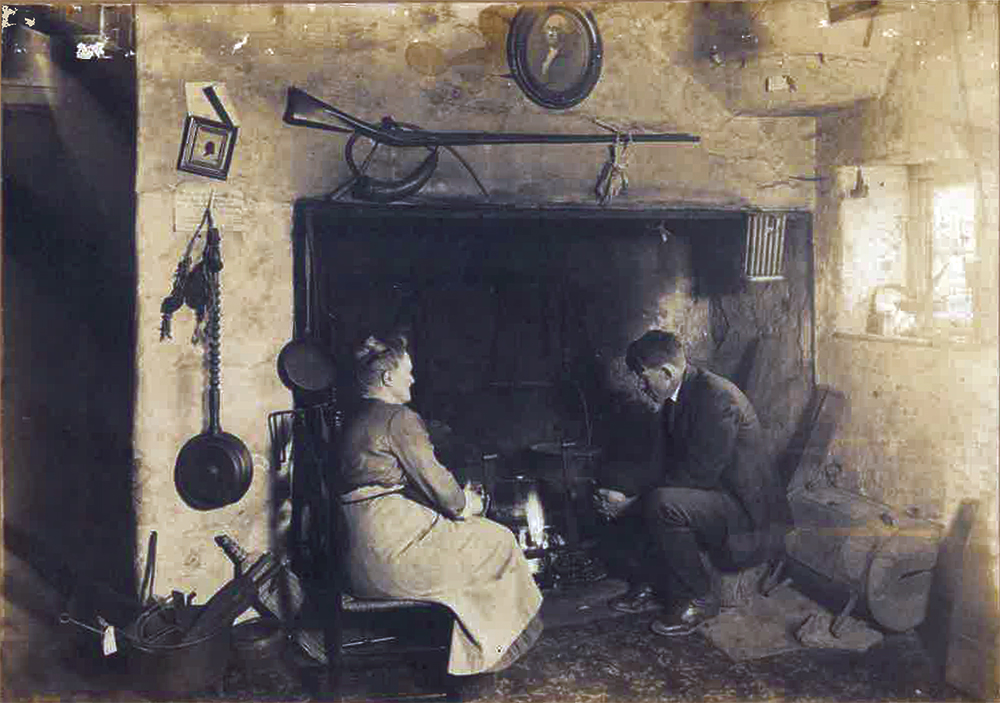
Christian Sanderson, seated with his mother, enjoyed having a fire in the Washington’s Headquarters fireplace while he graded his student’s papers. In the room are a portrait of George Washington and other Colonial Era items.
Brandywine Battlefield Park, Pennsylvania Historical & Museum Commission
The following year, the Sandersons’ landlords informed Christian and his mother that they would have to move because the owners needed the space for a family member. Before he left, Sanderson stated in the Daily Local News of January 10, 1922, that “if the public in any way appreciates the last sixteen years of being allowed to come into my private home, then the only reward I want is to see them work toward a State park. I mean by that that in allowing them to come I hope I have created a love for local history.”
This love for local history inspired the Pennsylvania American Legion to carry on the cause. At its state convention on November 11, 1923, a resolution was presented: “Inasmuch as we a nation are fast overlooking the sacrifices of our Revolutionary War forefathers; and whereas, there stands on the battlefield of the Brandywine the house which sheltered Washington during the battle; be it resolved, that the American Legion of Pennsylvania does recommend to the Congress of the United States and to the State Legislature of Pennsylvania the appropriation of funds to secure the shrine, to the end that coming generations of Americans will be instilled with the patriotism of our forefathers.”
While the patriotic sentiment did not go unnoticed, the effort to make the site a national shrine failed to gain traction.
While the house awaited recognition, it witnessed a catastrophe that nearly put the whole endeavor to rest. On September 16, 1931, Washington’s Headquarters caught fire, leaving it a burned-out shell. The cause of the fire remains a mystery, but one theory from a worker on the house’s reconstruction suggested that a tenant forgot to turn off her clothes iron and left it on the ironing board while she went to the movies in West Chester. Nonetheless, the house suffered extensive damage and remained a colonial relic for nearly two decades.
Finally, on July 5, 1947, Pennsylvania governor James H. Duff signed Senate Bill No. 517 creating the Brandywine Battlefield Park Commission, a body composed of 10 citizens of the commonwealth with the secretary of the Pennsylvania Department of Forest and Waters and the chairman of the Pennsylvania Historical & Museum Commission as ex officio members. These political appointees, who included prominent members in the historical community, a judge, and Pennsylvania Railroad president Martin W. Clement, had the responsibility of “establishing, marking, preserving, controlling, managing, and supervising” a Brandywine Battlefield Park. The proposed park would comprise no more than 50 acres on the Brandywine Battlefield with Washington’s Headquarters as the first choice. In July 1949, the commonwealth settled with the headquarters’ property owners, purchasing nearly 36 acres for $28,313.
To reconstruct Washington’s Headquarters, the commonwealth hired G. Edwin Brumbaugh, an architect known for his work restoring early southeast Pennsylvania houses and commonwealth historic sites. Construction began in early 1951 after archaeology revealed the building’s evolution, beginning with the original early 1700s house, a late 17th-century English-type, one-room, framed cabin with clapboards. Two large stone additions, a cellar and stone walls to replace the cabin walls completed the house by 1777, making it one of the finest in the area and an attractive place for Washington to establish his headquarters.
With measurements of the foundations and a few photographs, Brumbaugh attempted to replicate what he believed the house looked like during the Revolutionary War, completing his work by June 1952 at a cost of $67,000. On the 175th anniversary of the Battle of Brandywine, September 11, 1952, Brandywine Battlefield Park opened to the public with its greatest advocate, Christian Sanderson, in attendance.
Today, the Pennsylvania Historical & Museum Commission administers the park and continues the work of preserving Washington’s Headquarters and telling the story of the battle and the residents who struggled to keep the story alive.
Further Reading
The Brandywine Story, 1777–1952. [Chadds Ford]: Brandywine Battlefield Park Commission, 1952. / Harris, Michael C. Brandywine: A Military History of the Battle That Lost Philadelphia but Saved America, September 11, 1777. El Dorado Hills, CA: Savas Beatie, 2014. / McGuire, Thomas J. The Philadelphia Campaign, Volume 1: Brandywine and the Fall of Philadelphia. Mechanicsburg, PA: Stackpole Books, 2006. / Thompson, Thomas R. The Washington’s Headquarters Story. Self-published, 2002.
Troy Grubb is the site administrator of Brandywine Battlefield Park.