
Pinchot Roads: Paving the Way for Progress
Written by Tyler Stump in the Picturing PA category and the Summer 2023 issue Topics in this article: Gifford Pinchot, highways, Pennsylvania Department of Highways, photographs, Pinchot Roads, transportation, York County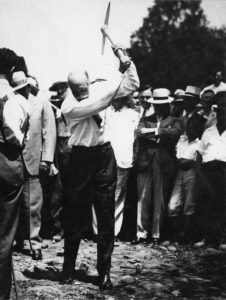
Gov. Gifford Pinchot breaks ground at the first Pinchot Road near Lewisberry, 1931.
Pennsylvania State Archives, RG-12
In the early years of travel, Pennsylvania’s roads were difficult and even dangerous to navigate. Margaret van Horn Dwight struggled to traverse the roads of Franklin County by carriage. She wrote in 1810, “I was so lame and so [tired] that for an hour I did not know but I must set down and die — I could not ride — the road was so bad, it was worse than walking.” A few weeks later she had a similar experience near Bedford and called the roads “really awful . . . I did not think a Pennsylvanian ever touch’d a road or made a bridge, for we are oblig’d to ride thro’ every stream we come to.”
A hundred years later the country roads of Pennsylvania were still a source of frequent complaint for locals and travelers alike. In 1908 New York Times reporter Walter Williams described driving in Erie County on a cold February day: “We hit Erie after six hours of nerve-wracking, bounding, swerving, digging, and pushing over the highways . . . the mad pace could be maintained for short distances only, for the road was bad and, time and time again, it became necessary to pile out and lay planks under the wheels to get the car over big holes or build bridges to cross streams.” Beyond the edges of most towns, Pennsylvania’s roads were a chaotic mess of mud and dirt dragging along the landscape.
Until the 20th century, Pennsylvania’s roads were governed by a patchwork of 650 different local laws. Road conditions and dimensions differed from township to township and were rarely, if ever, repaired. “We pass over many roads where a . . . tree has stood in the middle of the road since it was a small shoot,” a frustrated Lancaster County farmer wrote in 1889, “and where we find a stump in the same position that has been there for people to drive around for ten years.” Rain and winter conditions made roads muddy, and when they dried, ruts formed that could be a foot or more deep.
Perhaps the greatest hardship was on farmers who relied on rural roads to transport their goods to market, get to town for supplies, or send their children to school. A bad road could prevent farmers from traveling for days.
An 1891 University of Pennsylvania study estimated a horse could pull a wagon four times as easily on paved roads than a dirt road, and more than 10 times as easily if the road was muddy. That same year a frustrated Bucks County farmer declared most roads near his home were “impassable, in fact, they are damnable, and he who travels them must jump out and gravel them [to get anywhere].” Unlike larger towns and cities connected by rail and highway, these dirt roads were the only travel option for rural communities.
As each decade passed, traffic on Pennsylvania’s roads increased at a rapid rate. In 1905 there were 9,000 vehicles registered in the state. By 1930 the number escalated to more than 1.5 million cars and 200,000 trucks, each one intensifying the need for good roads connecting every corner of the commonwealth.
When Gov. Gifford Pinchot ran for a second gubernatorial term in 1930, he campaigned on a promise to “get the farmer out of the mud” by improving Pennsylvania’s rural dirt roads. By his estimate more than 100,000 farm families were “living under a ban of excommunication” because of their poor roads. “The State,” Pinchot declared, “was ignoring them.”
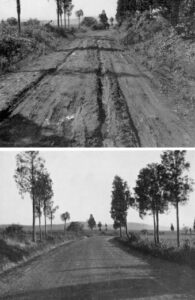
Pennsylvania Department of Highways photographs show conditions on a York County road before (1931) and after (1932) road improvements.
Pennsylvania State Archives, RG-12
After winning the 1930 campaign, Pinchot’s administration quickly went to work. The General Assembly passed legislation transferring responsibility for 20,156 miles of township roads to the Pennsylvania Department of Highways. Plans were drawn to widen roads to accommodate car traffic, lay concrete and asphalt over the dirt, and eliminate sharp curves and grades.
On a hot July day in 1931, a crowd gathered near a stretch of road in York County, between Lewisberry and Rossville, to watch the groundbreaking for the first of what the press would soon call “Pinchot Roads.” Surrounded by onlookers and state officials, Pinchot set off blasts of dynamite and shouldered a pickaxe to break heavy rocks in the dirt and prepare the road for resurfacing. A few years later, Pinchot Roads crisscrossed every county in the state.
Aside from improving travel through rural Pennsylvania, Pinchot’s rural road program also helped combat unemployment at a time when the Great Depression had put many out of work. Pinchot Roads were constructed with as little machinery as possible and relied instead on manpower to create more jobs. The Department of Highways used unemployment lists created by local relief boards to find men to work on each road-building project.
By 1933 there were 55,000 Pennsylvanians working on rural roads, and in 1936 nearly 150,000 men were employed in the project, making it one of the largest employment relief organizations in the United States. Improving Pennsylvania’s rural roads, one department report proudly stated, was helping to write “a glowing page in the reduction of human distress in this period.”
Shortly before leaving office, Pinchot urged all Pennsylvanians, not just those who lived in rural places, to go out and drive on the good country roads that now connected the state: “Try mapping out a hundred mile drive for a Sunday afternoon or holiday on these roads. You will get a closer contact with the scenic beauties of Pennsylvania, the most beautiful state anywhere — than the main highways can possibly give you. Try it!”
Materials pertaining to travel and construction on Pennsylvania roads can be found in the Pennsylvania State Archives in Record Group 12: Records of the Department of Highways Highways; Record Group 52: Records of the Department of Transportation; and Manuscript Group 11: Map Collection.
Tyler Stump is an archivist at the Pennsylvania State Archives.