
Pennsylvania’s Bicentennial Time Capsule
Written by Richard Saylor in the Our Documentary Heritage category and the Spring 2026 issue Topics in this article: Bicentennial Wagon Train Pilgrimage, Milton J. Shapp, Pennsylvania Bicentennial Time Capsule, Pennsylvania State Archives, Reynolds Metals Company, United States Bicentennial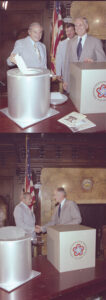
Gov. Milton Shapp adds documents to the Bicentennial time capsule.
Pennsylvania State Archives, RG-52
In 1976, Reynolds Metals Co. created 56 aluminum time capsules as a gift to the United States. These identical capsules were given to the governors of the 50 states, as well as four territories, the National Archives, and the Bicentennial Wagon Train Pilgrimage.
At that time, Reynolds was the world’s third largest aluminum and packaging company and the second largest in the United States. The company spent more than two and half years on research and development for the capsules.
The capsule for Pennsylvania and its container, now held at the Pennsylvania State Archives, are both made of aluminum, and together they weigh about 100 pounds. The front of the container features the national Bicentennial logo and printed on its top are the words, “This time capsule is presented to The Honorable Milton J. Shapp Governor of The Commonwealth of Pennsylvania by Reynolds Metals Company to be opened July 4, 2075.”
The capsule was presented to Shapp on June 28, 1976. His press release from that date stated, “The Reynolds Metals Company has captured the spirit of America — the ingenuity and resourcefulness — which made this nation great. The motto of the Pennsylvania Bicentennial is ‘So Your Children Can Tell Their Children,’ and now, with the aid of the time capsule, this century will be able to show the next the unique birthday observance of Pennsylvania.”
The inner cylinder of the capsule holds approximately 2 cubic feet of materials. After the contents were selected and placed inside, Reynolds reportedly added a special chemical, hexamethylenetetramine, to control the pH balance, and then evacuated the oxygen and charged the capsule with argon gas to preserve its contents.
Thirty-two items in total are reported to be inside the time capsule, including Pennsylvania Bicentennial Commission acts, a roster of members, invitations, programs, brochures, and commemorative items such as a plate, a mug, buttons, a license plate, medals memorializing the First and Second Continental Congresses, and a paperweight made of Lucite containing a Bicentennial medal. Also inside are The Second Signing Rededication Book, autographed by President Gerald Ford, Shapp and members of the Pennsylvania General Assembly, along with the quill pen they used; a mural of the life of Benjamin Franklin, created and signed by students from the Benjamin Franklin Elementary School in Harrisburg; and a song written by Shapp for the occasion of July 4, 1976.
The time capsule made for the Bicentennial Wagon Train Pilgrimage, intended to hold the signatures of 22 million Americans that had been gathered on scrolls while the wagon train crossed America, vanished on the morning of July 4, 1976, at Valley Forge, before it was sealed. It was apparently stolen from an unattended van near the wagon train before its dedication. An identical replacement capsule could not be produced because the mold for the capsules had been broken by Reynolds. The capsule was never recovered, and its disappearance remains a mystery.
Pennsylvania’s Bicentennial Time Capsule will be on display at the Pennsylvania State Archives from early 2026 as part of its larger exhibit for the 250th anniversary of the Declaration of Independence and the 50th anniversary of the 1976 Bicentennial commemoration.
Richard C. Saylor is an archivist for the Pennsylvania State Archives and author of the award-winning book Soldiers to Governors and numerous articles on military, political and sports history.