
Little Lithuania USA
Written by Alli Davis in the Marking Time category and the Summer 2024 issue Topics in this article: anthracite, coal mining, immigration and immigrants, Lithuanians, Pennsylvania Historical Marker Program, Schuylkill County, Shenandoah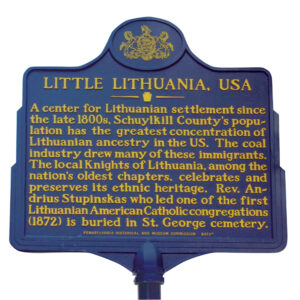 Shenandoah is a prime example of a “coal rush” boomtown where immigrants flocked in the second half of the 19th century to find jobs and a better way of life. The first wave of immgrants in this Schuylkill County borough were mostly Welsh, Irish, Scottish and German. They were soon followed by Eastern and Southern Europeans, including a large influx of Lithuanians.
The first wave of Lithuanian immigrants arrived in Shenandoah around 1869, and by the end of the century they accounted for nearly 25 percent of the population. In the 1920s Lithuanians were the largest ethnic minority there, as reflected in the town’s nickname, “Vilnius of America” (after the capital city of Lithuania). It was also known to Lithuanians as “Shenadorius.”
At the end of the 19th century, Lithuanians owned more than 200 businesses in Shenandoah. Several Lithuanian language newspapers were established there, and six mayors of Lithuanian descent were elected in the borough for 42 consecutive years.
In 1914 Lithuanians gathered in nearby Ryan Township for the Feast of the Assumption in a tradition from their home country. This celebration evolved into the current Lithuanian Days, which includes traditional food, music, dancing, crafts and a worship service. The Knights of Lithuania, formed in 1913 as a social and cultural organization of Roman Catholic men and women of Lithuanian ancestry, host the annual festival and run the Lithuanian Museum and Cultural Center in Frackville.
Why did Lithuanians leave their homeland? Several events culminated in waves of emigration, as Lithuanians faced heavy religious, cultural and political oppression under the rule of the Russian Empire, which occupied Lithuania from 1795 to 1915. Uprisings by Lithuanians and subjects of other annexed nations against Imperial Russia led to periods of forced cultural assimilation, or Russification. At times the Lithuanian language was prohibited, and the Lithuanian press ban, in effect from 1865 to 1904, restricted Lithuanian language publications in the Latin alphabet (as opposed to the Russian-favored Cyrillic). Many Lithuanians refused to partake in the compulsory military draft, first enacted in 1856; punishments for the offenders included confiscation of property, deportation or execution. In addition, ruinous taxes, crop failures and periods of famine led many Lithuanians to seek refuge outside of the Russian Empire.
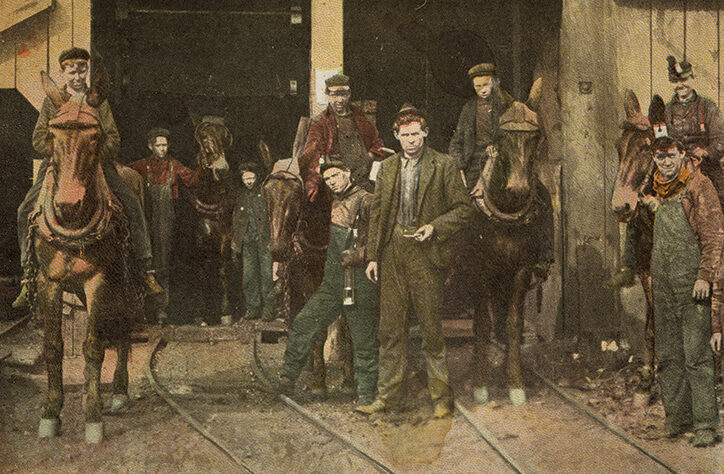
Laborers ascend from a Shenandoah mine with mules that pull cars full of anthracite to the surface, circa 1908.
Pennsylvania State Archives, MG-213
Why was Shenandoah a major destination for these refugees? The Coal Region of northeastern Pennsylvania is situated on top of the largest known anthracite coal deposit in the world. Shenandoah is located above the Western Middle basin, which holds the richest anthracite in the region’s fields. In the late 19th and early 20th centuries in Pennsylvania, many anthracite coal workers went on strike for better pay and working conditions. Employers, instead of conceding to worker demands, sought cheaper labor by sending recruiters to Eastern and Southern Europe with the promise of jobs. Many Lithuanians were drawn by the hope of a better life.
For some of the Lithuanian immigrants, the dream was not entirely fulfilled; yet, faced with discrimination and sometimes outright hostility from the earlier Western and Northern European immigrants, they formed close-knit communities, including churches, mutual aid societies and youth organizations to instill ethnic pride in their children.
Following the decline of the anthracite coal industry after World War II, the population of Shenandoah dropped precipitously; however, to this day, approximately 12 percent of the borough’s population is of Lithuanian descent. Shenandoah’s Lithuanian heritage remains visible in its clubs, churches, cemeteries, festivals, and array of delis and restaurants serving its cuisine.
The Pennsylvania Historical Marker for Little Lithuania USA was installed at 5 North Main Street in Shenandoah and dedicated on August 10, 2013.
Alli Davis is the coordinator of the Pennsylvania Historical Marker Program.