
Hawk Mountain Sanctuary
Written by Elizabeth Rairigh in the A Place in Time category and the Spring 2023 issue Topics in this article: birds, conservation, Hawk Mountain Sanctuary, Irma Penniman Broun, Kittatinny Mountain, Maurice Broun, National Register of Historic Places, Rachel Carson, Richard Hooper Pough, Rosalie Barrow Edge
A view along the Lookout Trail at Hawk Mountain Sanctuary
Photo, Pennsylvania State Historic Preservation Office
Hawk Mountain Sanctuary is a 2,600-acre forested conservation area in eastern Pennsylvania run by the Hawk Mountain Sanctuary Association for ornithological education and research. Located on the border of Berks and Schuylkill counties at the crest of the Kittatinny Ridge, the sanctuary is on one of the world’s largest migratory flyways for raptors and other bird species. The Lenape Indians who inhabited the area before the arrival of European settlers called it Keekachtatenin, or the “endless mountain,” and regarded it as sacred.

Environmentalist Rosalie Barrow Edge founded Hawk Mountain Sanctuary, the world’s first refuge for birds of prey.
Courtesy of Hawk Mountain Sanctuary
Hawk Mountain Sanctuary owes its existence to Rosalie Barrow Edge (1877–1962), an environmentalist from New York City. After seeing photographs taken in 1932 by conservationist Richard Pough (1904–2003) showing the carcasses of hawks that had been shot for sport at Hawk Mountain by hunters, she was inspired to acquire a 1,373-acre tract of land there from a local lumber company for the purpose of creating a refuge dedicated to the protection of raptors. After she secured the lease in 1934, she turned to an ornithologist named Maurice Broun (1906–79) and his wife, Irma Penniman Broun (later Kahn; 1908–97), to lay the physical, scientific and educational foundations for the groundbreaking sanctuary.
Maurice Broun was one of the leading ornithologists and conservationists of the 20th century, whose publication of bird counts at Hawk Mountain Sanctuary formed the basis for the scientific study and conservation of raptors in the United States. His counts on reduced numbers of young bald eagles migrating through the sanctuary were used by Rachel Carson in her pivotal 1962 book Silent Spring to indicate that dangerous chemicals like DDT were affecting the environment. Irma Broun was the sanctuary’s unofficial “gatekeeper” and played a central role in protecting it from sport shooters and developing its reputation as a leader in conservation education.
In 1963 the U.S. Department of the Interior and the National Park Service designated Hawk Mountain Sanctuary a National Natural Landmark. By the 1980s the sanctuary had become a leader in the conservation of migratory raptors around the world, a position it solidified and formalized in 1987 with the creation of Hawks Aloft Worldwide, a global conservation initiative to amass, analyze and distribute information on migratory raptors through the creation of an international network of independent local organizations.
The sanctuary now features five main hiking trails and several secondary trails that cover more than 8 miles and lead to 10 scenic overlooks. It also includes a visitor center, an education center, two campgrounds available to sanctuary members and educational groups, an internationally recognized research center, and staff residences.
On April 8, 2022, Hawk Mountain Sanctuary was listed in the National Register of Historic Places at the national level in the areas of conservation and women’s history. The property is significant as the first raptor sanctuary in the world and as a leader in the American conservation movement of the early 20th century, when it played an integral role in changing public attitudes toward raptors and securing their permanent legal protection. The sanctuary is also notable for inspiring, fostering and shaping the American environmental movement of the late 20th century, which reached its peak after the publication of Silent Spring in 1962.
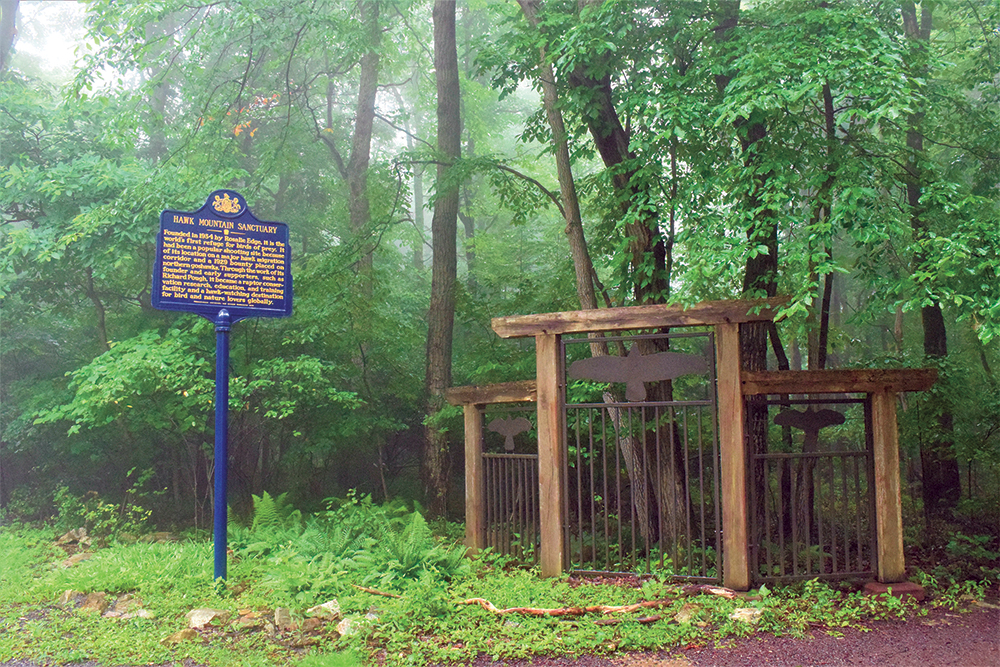
A Pennsylvania Historical Marker for Hawk Mountain Sanctuary, dedicated on September 14, 2019, stands along Hawk Mountain Road at the path to North Lookout.
Photo, Pennsylvania State Historic Preservation Office
Recent listings in the National Register of Historic Places include Cameron County Courthouse, Emporium, Cameron County; Frantz School, Kunkletown, Monroe County; Hokendauqua Thomas Iron Company Town Historic District, Whitehall, Lehigh County; New Castle Hospital, New Castle, Lawrence County; and Williamson Free School of Mechanical Trades, Middletown Township, Delaware County.
Elizabeth Rairigh is the division chief for Preservation Services and the National Register coordinator in the Pennsylvania State Historic Preservation Office.