From the Executive Director
Written by Andrea Lowery in the From the Executive Director category and the Summer 2023 issue Topics in this article: breaker boy, Ellen Webster Palmer, genealogy, Pennsylvania State Archives, photographs, Wilkes-Barre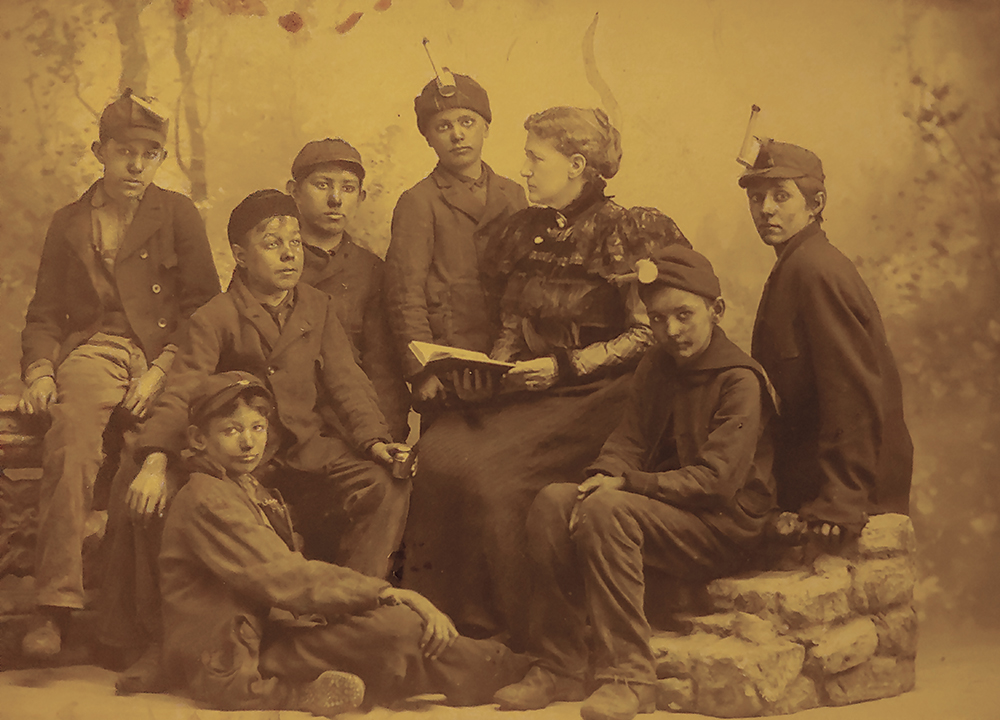
Ellen Webster Palmer (1839–1918), founder of the Boys Industrial Association, reads to a group of breaker boys.
Collection of Andrea Lowery
Everyone has family stories. I recall sitting at the dinner table as a child, listening to my parents talk about their grandparents and great-grandparents — where they had lived and the things they had done. One story I heard was about a woman, Ellen Webster Palmer, who founded the Boys Industrial Association in Wilkes-Barre to educate and entertain “breaker boys,” the child laborers at coal processing plants, helping them to prepare themselves for a better future. Little did I imagine that one day I would be working in history and find a connection to her story in my adopted home state.
Last fall I helped my parents downsize. As we were going through boxes of family photos and scrapbooks, I snapped a few shots of the pictures of my great-great-grandmother. Later, I shared those photos with one of PHMC’s commissioners, Bill Lewis, who stopped me midsentence and said, “Wait, go back to that one!” I scrolled back to a picture of a woman surrounded by a group of breaker boys. Bill then said, “That’s Ellen Webster Palmer! Why do you have a picture of her?” I told him, “Yes, that’s my dad’s great-grandmother.” Bill then recounted a story about a school outing when he was growing up in Wilkes-Barre. The students had been required to stop at a statue of Ellen Webster Palmer, “Friend of the Working Boy.”
At Bill’s prompting, I recently told her story — as much as I know of it — at the Luzerne County Historical Society. In preparing for that talk, I did some research in my free time — all of it online. Although I love doing armchair history, I must qualify this statement by acknowledging that conducting in-person research at libraries and historical societies should never be replaced solely by online research and that archives undoubtedly would have turned up additional relevant information. I was astounded, however, by how much I discovered. I found dozens of newspaper articles, old books, fire insurance maps, bird’s-eye views and photos that helped me uncover my great-great-grandmother’s story. Doing so has given me a better understanding of my family and this ancestor whose community service truly inspired me.
Genealogy is a personal gateway to history, allowing us to see how we fit into larger narratives. At PHMC, we see evidence of this in the millions of patrons from across the country who visit our State Archives virtually each year—many searching for records related to their family history. We have been investing heavily in making our collections available online and continue to expand our databases so that everyone can find a connection to Pennsylvania, no matter where they are. We also invest in our invaluable local archives across the state that preserve the history of their communities to assist them through records care grants, professional development for staff, specific archival training and, in a few instances, general operating support.
If you are interested in pursuing Pennsylvania stories that are meaningful to you, I hope you will take advantage of the historical resources offered through any of these repositories, whether in person through a site visit or virtually through the comfort of your own laptop and internet connection.
Andrea Lowery
Executive Director, PHMC