
Founding Economy
Written by Sarah Buffington in the Trailheads category and the Summer 2024 issue Topics in this article: Ambridge, Germans, Harmony Society, Heinrich Jung, manufacturing, Old Economy Village, religion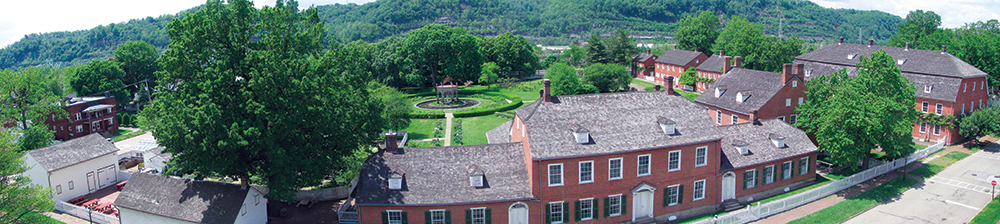
“It will be but two years since the forest was first felled upon which Economy is
built; the roots still remaining in the streets are evidences of the short time that
has elapsed. It is astonishing what united and regulated human effort has
accomplished in so short a time!”
– Bernhard, Duke of Saxe-Weimar Eisenach, 1826
Two hundred years ago, on June 6, 1824, the Harmony Society landed at French Point on the Ohio River. This land became known as Economy, Pennsylvania.
The Harmony Society was a group of German immigrants who followed charismatic preacher George Rapp (1757–1847) from the Duchy of Württemberg to America in 1804-05. Seeking religious freedom from the Lutheran church-state, about 800 people banded together to form a communal society in which all things were held in common. They believed they were God’s chosen people who would reign with Christ for a thousand years when he returned. The Harmonists became known for their agricultural-industrial enterprises, including excellent silk and woolen textiles, wine, beer and whiskey, and later for their investments in railroads, coal and oil.
The group first settled in Harmony, Pennsylvania, before moving to Indiana Territory in 1814. One decade later, they decided to move back to Pennsylvania. Among other reasons for moving, they stated that their location along the Wabash River in southwestern Indiana was not advantageous for their increased interest in manufacturing and the ability to take their goods to market. They also believed their German language was held against them there. German immigrants felt welcome in Pennsylvania where newspapers and laws were published in English and German. The area around Pittsburgh was more like home.
The Harmony Society also had biblical reasons for moving. Revelation 12:14 reads, “And to the woman were given two wings of a great eagle, that she might fly into the wilderness, into her place; where she is nourished for a time, and times, and half a time from the face of the serpent.” George Rapp believed that the Harmony Society was “the woman” (also known as the Sun Woman) in this verse. His followers’ exodus from Württemberg represented the woman flying “into the wilderness.” Rapp interpreted “a time” to be a period of 10 years. The Harmony Society lived in Harmony, Pennsylvania, from 1804 to 1814 and Harmony, Indiana, from 1814 to 1824, and they established Economy in 1824. Rapp predicted that in 1829, five years from then, or “half a time,” Christ would return.
Harmonist Heinrich Jung chronicled the voyage of the first group of 90 members who traveled to Economy to begin building their third town: “On Monday, May 24, at 4 o’clock in the afternoon, we departed from our erstwhile home on the Wabash. A touching farewell took place. Escorted by our friends with their good wishes and their blessings, we went to our boat, where we parted from them and went on board.
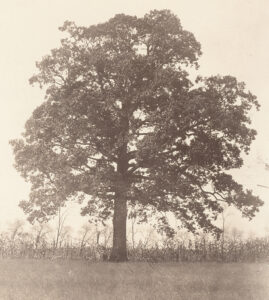
The Harmonists camped the night of June 6, 1824, underneath a giant oak tree at French Point along the Ohio River. The tree was finally cut down in 1912.
Old Economy Village, MG354, photo #366
“The distance between us rapidly increased, for at the report of a cannon, we were tossed from the shore so rapidly, that by 6 o’clock we had already navigated past Twelve Mile Island. Here were still some of our herders who waved us a last farewell, as we were rapidly removed from their sight, traveling at the rate of twelve miles an hour.”
The 14-day trip up the Ohio River was fraught with difficulties. The Falls of the Ohio below Louisville, Kentucky, were an often-impassable place with the seasonal changes in water levels. Jung wrote: “The crew had to disembark, for, since the river had fallen about six feet during the night, it was doubted by most that we would be able to ascend without unloading. After some investigation we decided to risk it, but [after two hours], we had to disembark and walk [two miles] to Louisville. The Ploughboy ploughed upward as far as the last riffle but was not able to make this. Twice they started and strained the boat to the utmost, but they were hurled back both times. We stood on the shore and watched with heavy hearts, feeling that a third effort would be fruitless. As a last resort, a rope, a several hundred fathoms in length, was conveyed to them, and a number of our strongest men exerted their utmost strength pulling thereon. This, together with the greatest strain of steam mechanism, and the strength of he great desire of those along the shore, brought them over safely to join us, in the harbor of Louisville [five hours later].”
With low river levels, the Steamboat Ploughboy became grounded several times along the route. At Wheeling, (West) Virginia, the river was only 3½ feet deep. They spent a whole day unloading cargo into two keelboats to lighten the load. Finally on June 6, they reached Economy. Jung remarked, “We now had to climb a bank about 70 feet high. Then we were shown an oak so big that, although our eyes grew larger, it appeared to pass all imagination.”
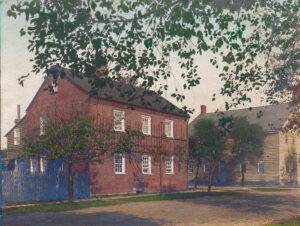
The Harmonists quickly built log houses in the back of the lots where they eventually constructed brick houses.
Old Economy Village, MG354, photo #465
The 70 men and 20 women quickly set to work building the new town. Two log houses were ready for occupancy by the beginning of July. By September, the community had enough winter quarters to house 100 people, a store, a packing house, and three barns. Although they were ready to accept more of their brethren to the new town, extreme drought for the second half of the year prohibited them from traveling. The weather also affected how much timber was available to them for building, because it had to travel downriver.
At the very end of the year, the first of eight groups was finally able to leave Harmony, Indiana. In the presence of the new residents, the last group to leave experienced a poignant farewell. Donald MacDonald recorded this in his diary: “Finally the [Steamboat] William Penn reached Harmonie on the morning of the 5th May. By two o’clock everything being on board, the remainder of the Harmonians assembled at Mr. Rapp’s house, the females sang some farewell hymns & the band played several tunes in front of the house. All the families that had come into town as Mr. Owen’s settlers had collected round. . . . Before embarking, Mr. Owen caught the opportunity to express aloud his great sense of their integrity, strict justice & kindness, and said that in all the course of his experience he had never met with so honest and affectionate a body of people. . . . The whole scene was truly interesting and appeared to make great impression upon the persons assembled. All the men & women shook hands with the company around, & then went on board. A gun was fired & the steam boat got under way. As she went down the stream both parties continued for some time waving hats & handkerchiefs, while the band played a march.”
The Harmony Society lived at Economy, now Ambridge, until 1905 when it closed with only two members remaining. Opened to the public as a historic site and museum in 1921, Old Economy Village is dedicated to the history of the Harmony Society. To mark the 200th anniversary of the Economy settlement, the site will hold a Bicentennial Weekend event on June 8–9, 2024. For more information, visit oldeconomyvillage.org.
Sarah J. Buffington is the curator at Old Economy Village.