
Forgotten Founder: Thomas Paine and American Independence
Written by William Kashatus in the Features category and the Spring 2026 issue Topics in this article: American Revolution, Benjamin Franklin, Benjamin Rush, Common Sense, Declaration of Independence, George Washington, Intolerable Acts, John Adams, Philadelphia, The American Crisis (Paine), Thomas Jefferson, Thomas Paine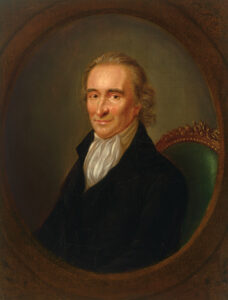
Thomas Paine articulated the argument for American independence in Common Sense, first published in January 1776, galvanizing the public to action and laying the groundwork for the Declaration of Independence. Laurent Dabos (1761–1835) painted this oil-on-canvas portrait of Paine, circa 1792.
National Portrait Gallery, Smithsonian Institution
Philadelphia was the largest, wealthiest and most cosmopolitan city in all the colonies on the eve of the American Revolution. As the major commercial hub for British North America, the city’s economy was based on trade and commerce and bolstered by shipbuilding, textiles and other industries. Philadelphia was also a hub for political activism, with town meetings and pamphlets disseminating revolutionary ideas. At the same time, the city was witnessing tremendous social, economic and political pressures.
Philadelphia’s population of 25,000 included both free and enslaved Blacks, leading residents to grapple with a glaring contradiction between freedom and slavery. Quakers established the first antislavery society in America, while the city’s large merchants prospered on a thriving slave trade. Tensions were high due to increasing British taxation and governance. After war broke out between the colonies and England in April 1775, Philadelphians feared invasion by water as well as by land. British ships blockaded Delaware Bay, while redcoat soldiers moved south from New York through New Jersey toward the city. Divided by competing allegiances to the British empire and a growing movement for independence, Philadelphia reflected the same anger and confusion that existed in all 13 colonies.
Into the morass stepped Thomas Paine (1737–1809), a 39-year-old English immigrant who had relocated to Philadelphia in November 1774 with a letter of introduction from Benjamin Franklin (1706–90), the city’s most prominent citizen who was serving as a colonial agent in London. In Philadelphia, Paine secured employment as editor of the Pennsylvania Magazine where his essays on the abolition of slavery and women’s rights captured the attention of the city’s political elites at just the time that tensions with Britain were reaching a crisis point.
Encouraged by Dr. Benjamin Rush (1746–1813), a 32-year-old physician who represented Pennsylvania in the Continental Congress, Paine wrote Common Sense, a 47-page pamphlet that promoted American independence. Written in a direct and lively style that appealed to the masses, the essay was a clarion call for unity, attacking hereditary monarchy and the corrupt British court. At a time when many still hoped for reconciliation with Britain, Paine argued the inevitability of separation and America’s providential role in providing an asylum for liberty.
Common Sense, published on January 10, 1776, sold an estimated 150,000 copies within the year, making it the most widely read pamphlet of the American Revolution. Paine’s incendiary essay not only swayed public opinion to the side of independence but also inspired Thomas Jefferson (1743–1826) in his writing of the Declaration of Independence, adopted by Congress six months later.
Despite this singular achievement, Paine became an outcast. His considerable and unique contributions to American independence, including his valuable assistance to Franklin, Rush and George Washington (1732–99), were either marginalized or forgotten. It would take nearly a century before his reputation as a founding father was celebrated by historians.
Thomas Paine was born on January 29, 1737, in the quiet pastoral town of Thetford, England, about 70 miles north of London, the son of a Quaker corset maker and an Anglican mother. His formal education ended after grammar school, and at age 13 he became an apprentice in his father’s shop. Life was difficult for Paine in England where one’s fate in life was usually determined at birth by family status. Failing at several trades including corset maker, schoolteacher and tobacconist, Paine, often on the verge of poverty, spent much of his spare time reading books on politics, history and natural science.
After the death of his first wife and an unhappy second marriage, Paine fell into a deep depression. He began drinking to excess and cared little about his appearance. At 5 feet, 8 inches, he was just average in height. Nor was he blessed with good looks. His large, pendulous nose was the most striking feature of his long careworn face. Together with his threadbare clothing and unkempt hair, Paine’s disheveled appearance discouraged the company of ladies. Relocating to the coastal town of Lewes in 1761, Paine was hired as an excise officer, collecting taxes on imports, exports and domestic industrial products. His duties also included detecting and arresting smugglers. The job was dangerous if not life threatening.
Despite their high level of responsibility, excise officers were poorly paid and frequently had to move to other parts of the country, at their own expense. In 1772 excise officers began to organize what was in effect a public employee union and petitioned Parliament for better pay and working conditions. When Paine wrote and published a pamphlet, The Case of the Officers of Excise, defending the petition, he came under the scrutiny of the Board of Excise. Two years later, in spring 1774, the Board found cause to dismiss him for being absent from his post without permission. Fortunately for Paine, the pamphlet caught the attention of Benjamin Franklin, the colonial postmaster general in England. Franklin would soon fall out of favor with the British government and defect to a growing movement for American independence.
The trouble began in the winter of 1774 when British Prime Minister Lord North passed a series of measures known collectively as the “Intolerable Acts.” The punitive measures were in response to the destruction of British East Indian Company tea in the Boston harbor the previous December by the Sons of Liberty, radicals who were angry over Parliament’s tea tax, an event later known as the “Boston Tea Party.” Not only was the Port of Boston closed but also political assemblies were shut down, due process of law was suspended, and redcoat troops were permitted to quarter in the homes of private citizens without their consent. All the measures violated the colonists’ rights under the English Constitution. Parliament hoped the punishments would, by making an example of Massachusetts, reverse the trend of colonial resistance to British authority.
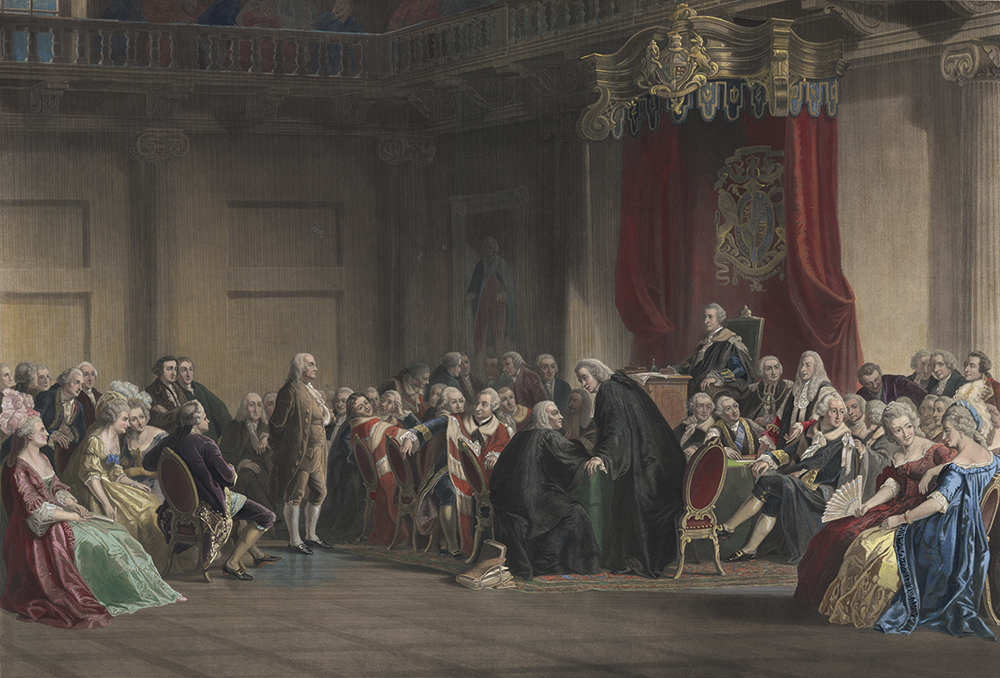
Benjamin Franklin’s castigation before the Privy Council in 1774 marked a shift in his stance on American independence.
Library of Congress Prints and Photographs Division
Franklin hoped to ease the tensions by placing the blame for the unrest on the royally appointed governor of Massachusetts. It was a shrewd plan. Franklin was an opportunist who tied his personal fortunes to the success of the Anglo-American empire. He sought professional advancement within the British government by ingratiating himself with its ministers. To that end, Franklin mediated the ongoing conflict between Parliament and the colonies, hoping to secure redress for the colonies without a resort to arms. Accordingly, he tried to convince British officials that colonial resistance in Massachusetts was due to the popular distrust of Thomas Hutchinson, the royal governor, and his lieutenant, Andrew Oliver.
Hutchinson and Oliver had exchanged letters in which they discussed ideas on how to control the unrest in Boston, including the suggestion that some of the colonists’ “English liberties” be curtailed. Somehow the letters came into Franklin’s possession, and he forwarded them to Thomas Cushing, speaker of the Massachusetts Assembly. Despite Franklin’s wish that the letters remain closely guarded, Cushing leaked them to the newspapers, inciting riots, the burning of Hutchinson and Oliver effigies on Boston Common, and protests in other colonies. As a result, the Massachusetts Assembly petitioned the British government to replace both officials.
On January 29, 1774, Franklin appeared before the King’s Privy Council supposedly to hear if the government would be approving the petition. Instead, he was excoriated by Alexander Wedderburn, solicitor general, for over an hour, not about the merits of the recall petition, but about the Hutchinson–Oliver correspondence. Wedderburn accused Franklin of sedition by leaking the letters to the newspapers in Massachusetts and causing even greater unrest in that colony. “Private correspondence has hitherto been held sacred,” declared Wedderburn. “Dr. Franklin has forfeited all the respect of societies and of men. . . . He will henceforth call it a libel to be called a man of letters,” a pun on Franklin’s position as postmaster.
Throughout the diatribe, Franklin stood still, showing no emotion, “conspicuously erect, without the smallest movement of any part of his body,” his unchanging expression tranquil and placid. When Wedderburn was ready to examine the witness, Franklin declined questioning.
Hoping to salvage whatever influence he still possessed in the British government, Franklin remained silent as the Privy Council rejected the recall petition. Even when Franklin learned two days later that he had been removed as postmaster, he continued to weigh his options. His character had been attacked and his work for conciliation ignored, but he still had not given up hope. In fact, he lobbied against the passage of the Intolerable Acts by Parliament and, on February 2, wrote to the Massachusetts Committee of Correspondence insisting that “the India Company [were] not our Adversaries” and that Massachusetts should “repair the Damage and make Compensation to the Company” for the destroyed tea.
Not until the following day, when the House of Lords hastily rejected a comprehensive plan for conciliation Franklin had drafted, did he embrace the cause of American independence. He would use Paine to further that cause.
In September 1774, Paine was introduced to Franklin by George Lewis Scott, commissioner of the Excise and Fellow of the Royal Society. Already familiar with Paine’s skills as a writer and polemicist, Franklin convinced him that in America he could make a name for himself based on his wit and hard work and gave him a letter of introduction as an “ingenious, worthy young man.” The following month, Paine emigrated to the American colonies, arriving in Philadelphia on November 30, 1774.
Paine was invigorated to be in America where so many were speaking out against a British government that he had long viewed as unjust. But he also found that a pervasive loyalty to the British Crown still existed among the colonists. Even some of the most ardent supporters of the war hoped for a reconciliation with the British Crown once disputes were settled. Shortly after he arrived in Philadelphia, Paine wrote that he “found the disposition of the people such, that they might have been led by a thread and governed by a reed. . . . Their suspicion was quick and penetrating,” he explained, “but their attachment to Britain was obstinate, and it was at that time a kind of treason to speak against it.”
Initially, Paine saw the conflict between the colonies and England as a “kind of lawsuit, in which the parties would find a way either to decide or settle it.” Nor did he entertain any thoughts of independence or of arms. “But when the country, into which I had just set my foot, was set on fire about my ears,” he added, “it was time to stir.”
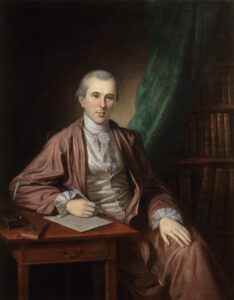
Physician and advocate for American independence Benjamin Rush encouraged Paine to write Common Sense. Charles Willson Peale (1741–1827) painted this portrait of Rush in 1783.
Winterthur Museum, Garden & Library (Gift of Mrs. Julia B. Henry)
Paine’s writings for Pennsylvania Magazine were electrifying and quickly gained a considerable readership. He dared to print essays on the rights of the laboring class, the abolition of slavery, and women’s rights. His writing style was known for its clarity, directness and persuasive power, making his works accessible to a wide audience. He employed plain language and relatable examples from everyday life, history and the Bible to effectively convey complex political ideas. This approach allowed him to connect with the common people in the coffeehouses and taverns of the city. He soon began to circulate among Philadelphia’s political elites, too.
In the autumn of 1775, Paine met Benjamin Rush, who had been heavily involved in the patriot cause, being among the first Sons of Liberty in Philadelphia. The confidante and medical advisor to Franklin, Jefferson, Washington and John Adams (1735–1826), the physician became uniquely close to the Revolution’s leading men. He had also written several articles attacking British policy in the local papers, one of which helped inspire the Boston Tea Party; however, by 1775, Rush’s actions alienated him from Philadelphia’s conservative elite and resulted in the decline of his medical practice.
Unwilling to risk his livelihood any longer, Rush encouraged Paine to write a pamphlet promoting American independence. He told the English immigrant that he “had nothing to fear from the popular odium to which such a publication might expose him.” After all, Paine “could live anywhere,” but Rush’s medical profession and connections “tied [him] to Philadelphia, where a great majority of the citizens and some of [his] friends were hostile to a separation . . . from Great Britain.”
Paine agreed and began writing the pamphlet, occasionally visiting Rush “to read to him each chapter as he composed it.” The only revision Rush made was to change the title of the work from “Plain Truth” to “Common Sense,” which was “instantly adopted by the writer.”
Franklin also encouraged Paine’s work, planning to use it to gauge public opinion in determining how genuine the sentiment for independence was. When Paine shared the manuscript with him, the elderly statesman offered his wholehearted support as well as a few suggested revisions.
The most noticeable change Franklin purportedly made was to strike out the following passage: “A greater absurdity cannot be conceived of, than three millions of people running to their sea coast every time a ship arrives from London, to know what portion of liberty they should enjoy.” The revision reflects Franklin’s cautiousness in assuming the commitment to American independence was held by all the colonists and not simply a portion of them. He would wait to see how the American people responded to the treatise before making his own unconditional loyalty to the patriot cause. Until then, Franklin kept a safe distance from Paine to avoid implicating himself in what would become a treasonable diatribe against King George III. Paine, on the other hand, had no reservations.
Using “simple facts, plain arguments and common sense,” as Paine wrote, the 47-page pamphlet went beyond the colonial resentment directed at Parliament for imposing stifling taxes by attacking King George and monarchy itself. “Monarchy,” Paine asserted, “is preposterous, heathenish in origin and an institution of the devil.” He also denounced aristocracy, which together with monarchy were “two ancient tyrannies” that “violated the laws of nature, human reason, and the universal order of things,” which began with God. Paine’s arguments against British political authority dispelled traditional theories like the divine right of kings, the legitimacy of custom, the social value of aristocrats, and the ability of monarchs to ensure peace and prosperity for their subjects.
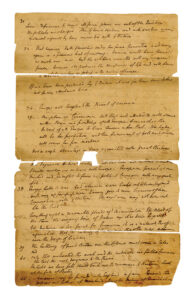
A page from Paine’s outline for Common Sense.
American Philosophical Society Library
Directing his attention to the Battles of Lexington and Concord that occurred in the spring, Paine exhorted his readers to join the patriot cause with inflammatory rhetoric: “O! ye who love mankind! The blood of the slain, the weeping voice of nature cries, ‘Tis time to part! Freedom hath been hunted round the globe. Asia and Africa have long expelled her. Europe regards her as a stranger, and England hath given her warning to depart. O! receive the fugitive and prepare in time an asylum for all mankind!”
While Paine’s savage attack on monarchy and his messianic tone helped inspire his readers to abandon the goal of reconciliation and declare independence, the work appealed to the common people because Paine made the conflict relevant by presenting a radical new vision of America. “Independence,” wrote Paine, “was not just a necessary action to right a grievous wrong,” it was more importantly an opportunity “to begin the world anew” by establishing a country where “everyone has a voice regardless of their wealth,” where anyone can vote or hold office, regardless of their economic station in life.
Published on January 10, 1776, Common Sense burst upon the scene like a “disastrous meteor,” wrote John Adams of Massachusetts, who feared that its inflammatory call for independence would undermine the deliberative work of the Continental Congress. It was a well-founded concern. The pamphlet was scurrilous, abusive and seditious. It was also exactly what most Americans needed to hear if independence was to become a reality.
Newspapers throughout the colonies printed excerpts from Paine’s incendiary pamphlet. By year’s end at least 19 different editions had been published in Pennsylvania, New York, Connecticut, Rhode Island and Massachusetts. In a country with a free population of fewer than 3 million people, an estimated 150,000 copies sold by the close of 1776. That made Common Sense the very first American best seller.
Historians credit Paine’s work with shifting the attitudes of those colonists who had been undecided on American independence by making complex political philosophy accessible to the common reader. Common Sense inspired a new kind of political discourse, demonstrating that revolutionary ideas could spread throughout society, not just from the top down, but from the bottom up. The pamphlet convinced many people that independence was the only path forward and brought excitement over the possibilities that an independent America could bring. In the process, Paine mobilized the common people to fight a war for American independence against England, the most powerful nation in the world.
There is also circumstantial evidence that Common Sense inspired Thomas Jefferson in his writing of the Declaration of Independence several months later. Jefferson received an early copy of Common Sense in February 1776 and was highly impressed by the work. His Declaration reflected many similarities.
Both writers advocated American independence from Britain based on the ideas of natural rights and self-government. Both believed that all men were basically alike because they shared a common sympathy or moral sense that made them equal. Both embraced a common faith in the innate goodness and common sense of the American people and trusted them more than government itself. The moral equality and moral authority of every person not only created an inherent need to socialize with each other but also enabled people to govern themselves. Thus, both men attacked monarchy because it promoted arbitrary authority and worse, war, which was necessary to sustain monarchical power. In fact, the only major difference between the two works was in the style of writing.
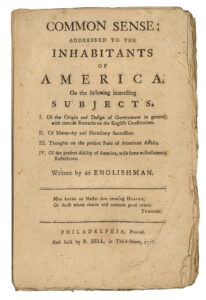
The title page of the first 1776 printing of Common Sense, published by Robert Bell in Philadelphia, attributes the work to “an Englishman.”
The New York Public Library
After reading Common Sense, Jefferson, noted that “no writer has exceeded Paine in ease and familiarity of style, in perspicuity of expression, happiness of elucidation. And in simple unassuming language.” Indeed, those qualities distinguished Common Sense as a treatise written for the common people. Paine expressed his personal beliefs in a fiery, passionate manner that appealed to ordinary people, convincing them that independence was the next logical step.
Jefferson, on the other hand, was writing for the elites and necessarily more cautious about publicizing his opinions. Thus, he adopted a more judicial, fact-based tone to list grievances and outline the philosophical basis for a new nation as a legal and moral justification for the revolution Paine had inspired.
Although there is no historical documentation that Paine played a direct role in drafting the Declaration, some scholars suspect his involvement based on an inscription of the initials “T.P.” on the back of a recently discovered copy of the original. On June 24, 1776, John Adams, one of the Committee of Five members chosen by Congress to draft the Declaration of Independence, made a hastily written manuscript copy of the original draft. He gave the draft to Roger Sherman, another member of the Committee, for review and approval before submitting a finalized draft to Congress. The “Sherman Copy” bears an inscription on the back that states: “A beginning perhaps – Original with Jefferson – Copied from Original with T.P.’s permission.” According to Harvard University’s Declaration Resources Project, the individual referenced as “T.P.” in the inscription appears to be Thomas Paine. Regardless, Paine’s contributions to the American Revolution did not end with the publication of Common Sense or his alleged involvement in the drafting of the Declaration.
Paine’s commitment to the patriot cause was so fervent that he donated whatever profits he earned from Common Sense to the Continental Army and joined its ranks as a military aide-de-camp. When Washington’s troops faltered, in December 1776, Paine wrote a series of essays, The American Crisis, that revitalized the spirit of the weary soldiers and filled their ranks with fresh volunteers. Washington was so impressed with the first essay that he had it read to his troops on Christmas Eve of 1776 in hopes of inspiring them to fight on.
The opening lines have become the most frequently quoted of all Paine’s works since they inspired the Continental Army’s victory the following day at the Battle of Trenton: “These are the times that try men’s souls. The summer soldier and the sunshine patriot will, in this crisis, shrink from the service of their country; but he that stands it now, deserves the love and thanks of man and woman. Tyranny, like Hell, is not easily conquered; yet we have this consolation with us, that the harder the conflict, the more glorious the triumph.”
The strategic victory at Trenton boosted American morale, revived the army, and launched the series of victories known as the Ten Crucial Days.
Paine later became Congress’ secretary to the Committee on Foreign Affairs, making him the only leading founder who served in both the military and the government during the American Revolution.
After the war, Paine returned to England to promote his invention of a single-arch iron bridge. But the fall of the French Bastille in 1789 fueled his desire to become involved in another revolutionary cause.
In 1791, Paine wrote The Rights of Man in response to the British Parliamentarian Edmund Burke’s condemnation of the French Revolution. Paine extolled the virtues of a republican government over the corruption of a monarchy in an essay that proved to be his greatest work. Predictably, the pamphlet was censured in England, forcing Paine to seek refuge in France where he remained for the rest of the next decade.
During the French Revolution, Paine supported the moderate wing of the revolutionaries. He was elected to National Assembly, only one of two foreigners to serve on that political body, but quickly fell out of favor when he opposed the execution of Louis XVI. On December 28, 1793, as the Reign of Terror swept across France, Paine was arrested for being a British citizen and “foreign conspirator” while the country was at war with England.
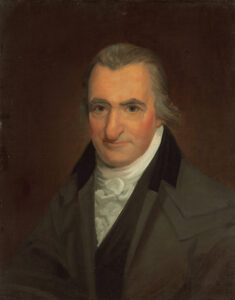
Thomas Paine spent his final years in America. This circa 1806 oil-on-canvas painting by John Wesley Jarvis (1780–1840) is the only original portrait of Paine executed in America.
National Gallery of Art (Gift of Marian B. Maurice)
Facing a certain death by guillotine, Paine appealed to his friend, George Washington, then president of the United States, to help secure his release from prison. Washington ignored his pleas, not wanting to be associated with someone whose radical political views could jeopardize U.S. relations with France and possibly lead to war with that country.
Although James Monroe, the American ambassador to France, eventually secured Paine’s release after the Reign of Terror ended in November 1794, the writer felt betrayed. He had been Washington’s most vocal supporter during the War for American Independence and even dedicated his first volume of the Rights of Man to him.
Seeking revenge, Paine, on July 30, 1796, wrote a bitter letter attacking Washington and made the correspondence open to the public. The pamphleteer not only accused the president of “ingratitude and treachery for not interceding on [his] behalf while imprisoned,” but condemned Washington as an “apostate or an imposter” for abandoning the principles of the American Revolution. Paine also called Washington a “hypocrite,” accusing him of embracing flattery and using his presidency to enrich himself and his Federalist allies. The diatribe ended his relationship with an old friend and a founder who was widely venerated for his leadership during the American Revolution and the Early Republic.
More damning was Paine’s publication, while in Europe, of The Age of Reason, an attack on organized religion, including Christianity. In the treatise Paine promotes natural religion and criticizes the efforts of Christian churches to acquire political power. He advocates reason in the place of revelation, leading him to reject the miracles of the Bible, which he considered an ordinary piece of literature rather than a divinely inspired text.
Although Paine never described himself as a Deist, one who believes in a creator god, he openly advocated Deism in his writings and called it “the only true religion.” Today The Age of Reason is regarded as a scholarly critique of the Bible, but at the time of its publication the treatise was considered deeply offensive to a strongly Protestant society.
The Age of Reason, along with Paine’s vindictive letter to Washington, made him persona non grata upon his return to America in 1802. Even the Founding Fathers purposefully distanced themselves from their fellow revolutionary. John Adams, who once begrudgingly admired Paine’s Common Sense for its advocation of American independence, now mocked him as “a mongrel between pig and puppy, begotten by a wild boar on a bitch wolf.”
Benjamin Rush was not nearly as abusive, but he also cut ties. Paine’s radical views, particularly his support for the French Revolution, clashed with Rush’s more moderate stance. In addition, the physician, a devout Christian, became increasingly critical of the pamphleteer’s nonconformist religious beliefs. “Paine’s Age of Reason,” Rush wrote, “probably perverted more persons from the Christian faith than any book that ever was written for the same purpose.” Benjamin Franklin, who passed away on April 17, 1790, did not witness the most controversial phase of Paine’s political career.
Only Jefferson continued his friendship with Paine, much to the chagrin of the Federalist Party, which despised the writer for his damning letter to Washington. As a newly elected president, Jefferson assisted Paine in returning to the United States in 1801. Upon Paine’s arrival in Baltimore in October 1802, Jefferson’s Federalist opponents criticized the president for associating with “the Infidel.” Nevertheless, Jefferson continued to correspond with Paine, whom he considered “an advocate of human liberty.”
After Paine’s death in 1809, however, Jefferson was unwilling to publicly link his name with his old friend. In 1813, for example, when the former president received a request to share his considerable correspondence with Paine for publication, he flatly refused. Not wanting the letters to be published during his lifetime, Jefferson comfortably settled into retirement, admitted that “while [Paine] lived, I thought it a duty, as well as a test of my own political principles to support him against the persecutions of an unprincipled faction.” At the age of 70, Jefferson desired “tranquility” and did not want to “risk arousing old political animosities.”
Despite his many indispensable contributions to American independence, Thomas Paine was excoriated in the newspapers as a “notorious drunkard,” “infidel,” and a “most valuable species of manure.” When the author of Common Sense died in June 1809, only six people attended his burial at New Rochelle, New York. It would take many years before he was again recognized for his vital role that inspired the formation of a new nation.
Further Reading
American Philosophical Society, ed. Philadelphia, the Revolutionary City. Philadelphia: American Philosophical Society Press, 2025. / Clark, J.C.D. Thomas Paine: Britain, America and France in the Age of Enlightenment and Revolution. New York: Oxford University Press, 2018. / Foner, Eric. Tom Paine and Revolutionary America. Updated ed. New York: Oxford University Press, 2004. / Hawke, David Freeman. Paine. New York: Harper & Row, 1974. / Keane, John. Tom Paine: A Political Life. Boston: Little, Brown, 1995. / Newman, Simon P., and Peter S. Onuf, eds. Paine and Jefferson in the Age of Revolutions. Charlottesville: University of Virginia Press, 2013. / Paine, Thomas. Collected Writings. Edited by Eric Foner. New York: Library of America, 1995. / Spero, Patrick, and Michael Zuckerman. The American Revolution Reborn. Philadelphia: University of Pennsylvania Press, 2016. / Unger, Harlow Giles. Thomas Paine and the Clarion Call for American Independence. New York: DaCapo Press, 2019. / Wood, Gordon S. The Americanization of Benjamin Franklin. New York: Penguin Press, 2004. / Wood, Gordon S. Revolutionary Characters: What Made the Founders Different. New York: Penguin Press, 2006.
William C. Kashatus, a resident of Paoli, is a regular contributor to Pennsylvania Heritage and the author of more than two dozen books on sports, biography, and Pennsylvania history. He wishes to thank Gordon S. Wood of Brown University and Michael Zuckerman of the University of Pennsylvania for their suggestions on an earlier draft of this essay.