
Edward Holland Blacksmith Shop
Written by John Wood in the Wish You Were Here category and the Spring 2025 issue Topics in this article: blacksmith, blacksmith shops, Edward Holland, Fayette County, North Union Township, postcards, real photo postcards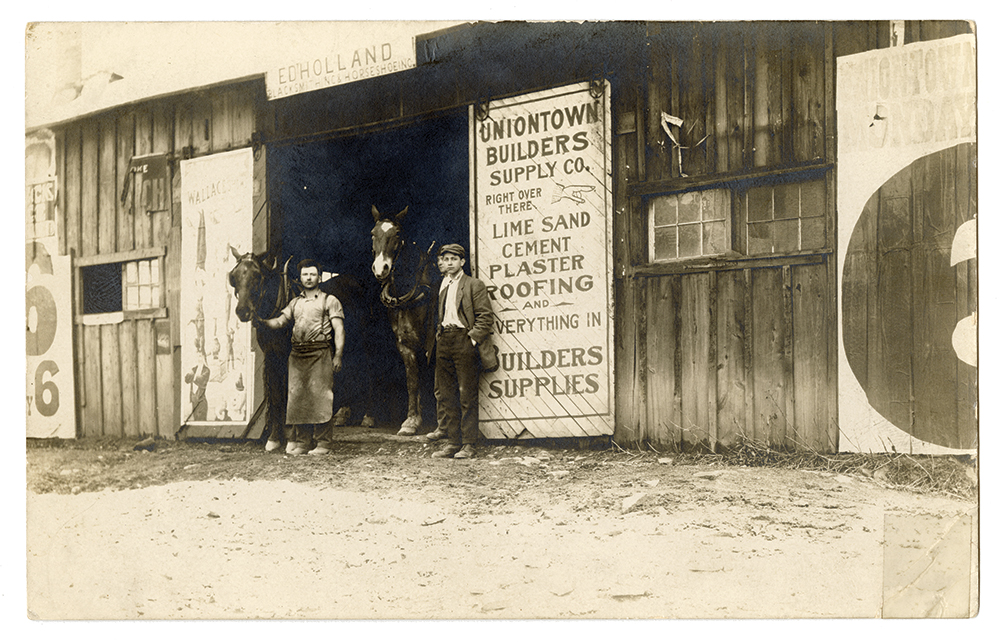
Edward Ellis Holland (1888–1964) worked as a blacksmith in North Union Township, Fayette County, for more than 40 years. In 1910, at age 21, Holland owned his own shop (shown here), located behind his residence on Coolspring Street. His services included general blacksmithing and farrier work.
By 1921, with the rising prominence of the automobile, Holland had expanded his business to include the making and repair of auto and truck springs, services that he advertised in the Uniontown Morning Herald newspaper.
Holland’s blacksmith shop was destroyed by fire on October 16, 1939. The shop was rebuilt, and Holland continued providing blacksmithing services into the 1950s.
The postcard of the Holland blacksmith shop is an excellent illustration of both a trade and building type that were once common on the American landscape. Today, blacksmith shops are a rare surviving property type.
In the mid-19th century, most rural and village blacksmiths catered to a general trade. The typical blacksmith produced and mended many of the items necessary to build and sustain a community, such as tools for all trades; architectural hardware; agricultural implements and machinery; components for wagons, carriages and boats of all types and sizes; kitchen and other household items; and horseshoes.
Until the automobile, the tractor and large-scale mass production replaced them, blacksmiths continued to be an essential part of every community until after World War I.
Given their utilitarian function, blacksmith shops were generally free-standing, square or slightly rectangular buildings, 20 by 30 feet on average, and one to one-and-a-half stories in height, with a loft or attic space for storage. They were often frame constructed and covered with rough-cut boards, finished weather boards, or board-and-batten siding. Gabled roofs predominated. To vent the forge, masonry or metal chimney stacks penetrated the roof. Multiple chimneys indicated the presence of multiple forges within.
Most shops contained several window openings with wooden sash windows. Large door openings, with multiple doors, were nearly universal and facilitated access for horses, wagons and other large equipment. As with other businesses, portions of the building’s exterior were used for advertising.
The interior of these buildings typically consisted of one large open space with exposed framing members. Floors were often either packed dirt or wood. The ambient light level inside was quite low, with light being provided by the few windows and by opening the large doors. The low light levels were an asset to the smith who would judge the temperature of the metal by its color.
Universally, all blacksmith shops contained a forge, bellows, an anvil, a workbench, a vise and racks for tools. Depending on the type of work, other specialized tools such as mandrels, tire benders, power hammers and drill presses occupied space within the shop.
Most forges were made of brick or stone, usually about 30 inches high and 24 to 40 inches square. They were sometimes covered by a brick or metal hood
connected to a chimney to vent smoke. In the base of the forge, the tuyere or fire pot consisted of a small basin connected to an air pipe from the bellows. Within the basin, a fire of charcoal, bituminous coal or coke was built. Once the fire was lit, the velocity of air pumped to the tuyere dictated the intensity of the fire.
Early bellows were of wood and leather construction with two air chambers and were operated by a chain or wooden pole at the forge. By the third quarter of the 19th century, patent cast-iron forges and fan blowers of all sizes were being produced. These blowers made the larger leather and wood bellows nearly obsolete. Cast-iron forges and fan blowers, as well as a complete array of blacksmith tools, were sold through catalogs.
Weighing as much as 300 pounds, the anvil was the blacksmith’s work surface and was often set upon a tree trunk or solid block of wood. A blacksmith had various types of hammers and numerous types of tongs that allowed him to make objects of almost any size and shape.
This image of the Holland shop is an example of a real photo postcard, consisting of a continuous-tone, black-and-white photographic image printed on postcard stock. The technique, introduced in 1903 by Kodak, was popular during the first half of the 20th century.
John P. Wood is the manager of the Historic Preservation Incentives Division in the Pennsylvania State Historic Preservation Office. He has been a blacksmith for more than 30 years.