
Editor’s Letter
Written by Kyle Weaver in the Editor’s Letter category and the Winter 2024 issue Topics in this article: Adolfas Mekas, Albert Gallatin, Double-Barrelled Detective Story, James Forten, Pennsylvania Heritage, Pennsylvania Historical and Museum Commission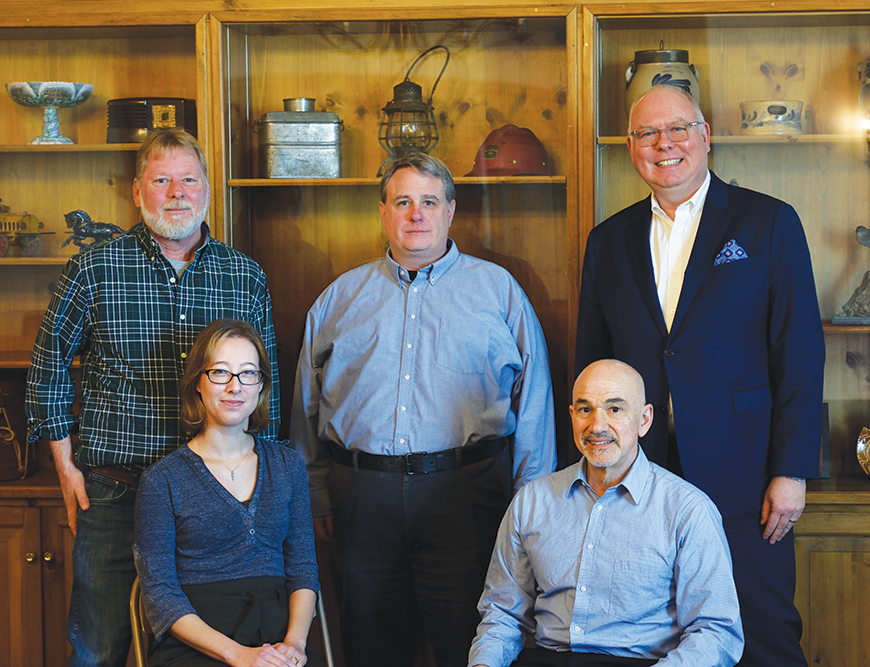
PHMC’s Division of Marketing & Media, front row, Lauren Bennett, art director; Kyle Weaver, editor; back row, Don Giles, staff photographer; Sean Adkins, digital director; and Howard Pollman, director of external affairs and division chief.
Photo, Pennsylvania Historical & Museum Commission
Fifty years ago, the Pennsylvania Historical & Museum Commission published its first issue of Pennsylvania Heritage. It’s been a long journey — 198 editions with more than 700 features and hundreds of shorter department articles collectively recounting the compelling saga of Pennsylvania. You can read about the history of our history magazine in “Pennsylvania Heritage at 50.”
On this golden anniversary, I’d like to acknowledge that Pennsylvania Heritage is produced through PHMC’s Division of Marketing & Media, which supports the agency through media relations, graphic design, photography, editing, web administration and social media. The jobs of each of the five members on the team interact, and all play a part in bringing you this magazine. The division is headed by Director of External Affairs Howard Pollman, who keeps us organized and motivated in addition to his work as PHMC’s press agent and liaison to the Pennsylvania legislature. The magazine’s creative art director, Lauren Bennett, also handles a great deal of PHMC’s graphic design needs for agency reports, brochures, guides, posters and ads. Our staff photographer Don Giles travels far and wide throughout the state to capture images of all things Pennsylvania, not only for the magazine but also for exhibitions, promotional materials and documentation. Sean Adkins is our digital director who in addition to a full slate of web administration tasks keeps PHMC and its programs, including Pennsylvania Heritage, visible on social media. I am editor of the magazine and I also work on a variety of other editorial projects for the agency.
In this edition’s features we introduce two Pennsylvanians who played significant roles in shaping the new nation in its early years. James Forten was a prosperous free Black sailmaker who operated his successful sail loft on Philadelphia’s Delaware River waterfront from 1798 until his death in 1842. He was also a leading abolitionist and advocate for Black civil rights who used much of his wealth to help support those movements. In the article “Shall Liberty Dwell?” regular contributor Todd M. Mealy tells Forten’s remarkable story, emphasizing not only his rise to affluence as an entrepreneur but also his legacy as a pioneer in the early struggle for Black freedom and equality.
The other groundbreaker, Albert Gallatin, was a Swiss emigrant who came to America in the 1780s, established a homestead in the wilderness of western Pennsylvania, and, fueled on Enlightenment ideology, entered American politics, starting first as a representative in the Pennsylvania General Assembly and then serving in succession as a U.S. representative, secretary of the treasury under presidents Jefferson and Madison, and ambassador to France and later Britain. In “Visionary of the Early Republic,” historian Brady J. Crytzer recounts Gallatin’s key role in some of the most decisive moments in American history and his substantial contributions to infrastructure development, diplomacy, and the American financial system.
The final feature in this edition, “Six-Shooters in Somerset,” chronicles the production of a Western film, based on Mark Twain’s little-known 1902 novella A Double Barrelled Detective Story, that was shot on location in a fading coal miner village in Pennsylvania’s Somerset County in the mid-20th century. Author Ryan M. Sopich has done meticulous original research to piece together an account of events, beginning in 1964 when Lithuanian emigrant and independent filmmaker Adolfas Mekas arrived in Baker-Whitely with his brother Jonas to begin preparations for shooting the film and ending with its inauspicious premiere in May 1965 at the Lyric Theatre in Johnstown. Along the way we see Baker-Whitely transformed into a movie set and meet the film’s cast and crew, including recruited local villagers and a temperamental mountain lion.
With this issue, we say farewell to Amy Killpatrick Fox, who for 29 years has fostered learning, interpretation and communications in her work as a museum educator for PHMC’s Pennsylvania Trails of History sites and museums. In that capacity, on August 1, 2009, she launched a blog called Trailheads about activities at the sites. Two years later, she began writing a separate department for this magazine, also called Trailheads, highlighting history, news and information on the Trails of History. This edition’s installment will be her last, as she is retiring from PHMC in December 2023. We congratulate Amy as she moves into this new phase in her life and thank her for the many engaging, informative essays she’s written and her significant work in sharing Pennsylvania history.
Kyle R. Weaver
Editor