
Changing Values: The Whitetail’s Challenging Existence
Written by Joe Kosack in the Features category and the Fall 2025 issue Topics in this article: hunting, Pennsylvania Game Commission, white-tailed deer, wildlife management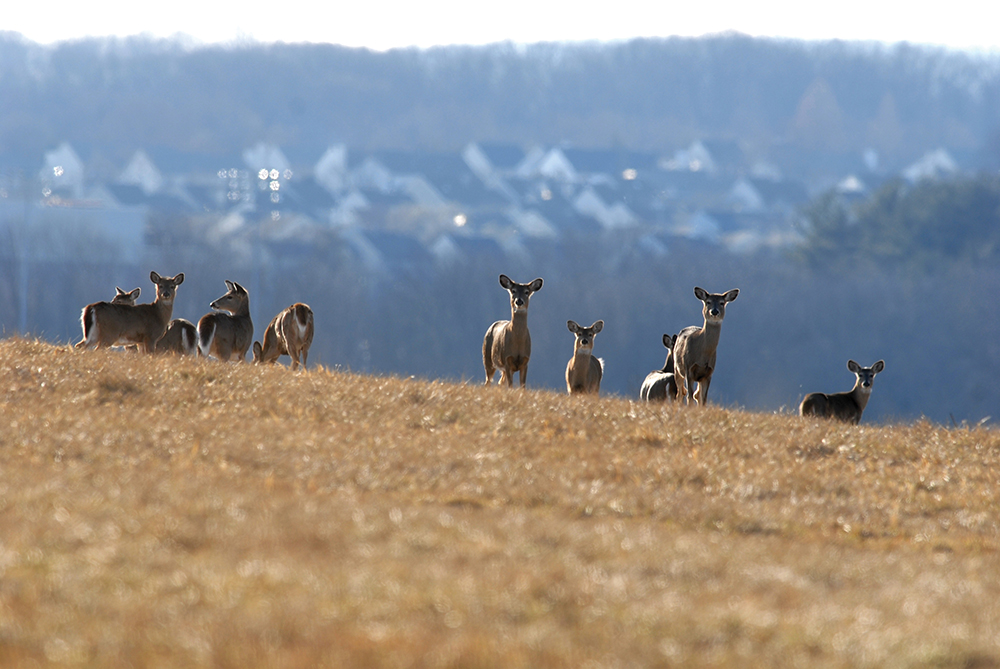
Whitetails have learned to fit into urban and suburban landscapes throughout the commonwealth. These Montgomery County deer hole up on properties where they’re not disturbed during the day and forage for soft and hard mast, ornamental shrubbery and young trees on residential properties at night.
Pennsylvania Game Commission / Photo, Joe Kosack
Deer have lost some of the cachet they once held in Pennsylvania. Their values — ranging from ecological, aesthetical and recreational to nutritional, financial and, of course, personal — have endeared many Pennsylvanians to whitetails throughout the state’s existence, but probably never more so than during European colonization and the Great Depression — when venison helped many families endure hardscrabble times — and later as Penn’s Woods’ herd mushroomed to almost unbelievable proportions during the lives of baby boomers.
Today, however, hunter ranks are declining, and deer hunting fails to draw the crowd it once did. It’s not because of a deer shortage — deer are everywhere. Rather, interest in hunting has waned for a variety of reasons: equipment costs; finding a place and time to hunt; changes in family dynamics; the arrival of chronic wasting disease, an always fatal, contagious malady afflicting deer and elk; and Pennsylvania’s status as one of the states with the highest rates of Lyme disease, contracted through blacklegged ticks, also known as “deer ticks.”
Whitetails now are cursed at by motorists because road encounters with them, both alive and dead, are so frequent. Some suburbanites refer to them as “rats with hooves” for the damages they inflict on vegetable gardens, graveside flowers and landscaping vegetation. The National Park Service uses sharpshooters to manage deer overpopulation at Gettysburg National Military Park and Valley Forge National Historical Park, where public hunting is prohibited. Many farmers and state/national forest managers rely on special deer-control programs to limit crop losses and habitat destruction.
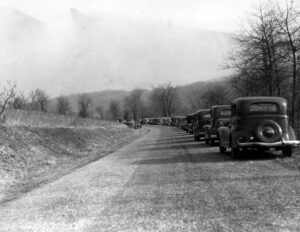
This yesteryear deer-season opening day in Penn’s Woods was photographed in the years before World War II. The newest parked cars are from the late 1930s. After December 8, 1941, scenes like this didn’t occur along state roads until after the war concluded.
Pennsylvania Game Commission
There was a time when more deer were welcomed nearly everywhere in the commonwealth; most residents saw them as magnetic megafauna. Now the whitetail’s presence has become more ambiguous because there are more Pennsylvanians, which has led to more land subdivisions, roads and other infrastructure that have fragmented forests and other natural areas. Collectively, these gains and landscape alterations have funneled and pushed the adaptable, unassuming whitetail closer to more residents than ever before, triggering complaints, concerns and challenges from entities ranging from homeowner organizations and municipal leaders to state and national government officials.
That, in and of itself, is an amazing about-face in Penn’s Woods, where deer mostly have been cherished and relied upon for centuries, particularly since the Pennsylvania Game Commission, created in 1895, began to help the then near-extirpated whitetail reclaim its former range, eventually manifesting its value and importance as a natural resource. For most of the 20th century, deer were a cash cow that primarily financed the agency’s wildlife conservation programs, as well as augmented the coffers of businesses that catered to the varied and specialized needs of hunters.
The arrival of deer season was once as important to many Pennsylvania merchants as beach season was to boardwalk entrepreneurs. It was when deer hunters took their vacations, many loading up their trucks and family cars and heading into the mountains or big woods. Before automobiles became common, they rode trains. Resourceful townsfolk and civic organizations planned special breakfasts and events, rented spare rooms and trailers, and worked long hours to accommodate an influx of hunters that enlivened sleepy northern communities such as Wellsboro, Renovo and St. Marys.
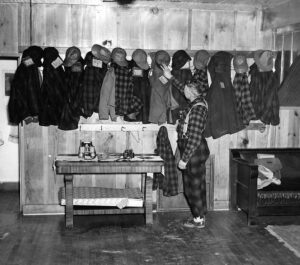
Woolrich started making its red-plaid, woolen outdoors clothing 22 years before this 1947 camp photo was taken. Known among hunters as the “Pennsylvania Tuxedo,” it was considered the warmest clothing available. It remained popular well into the 1980s.
Pennsylvania Game Commission
Selling hunting equipment and clothing, filling hunting-camp supply orders, fixing firearms issues, and providing butcher-shop services boosted the income of innumerable local merchants and odd-job specialists. This annual last-minute push to prepare for the start of deer hunting season eventually aligned with America’s more conventional after-Thanksgiving Black Friday sales, further crowding aisles in sporting goods and hardware stores, as well as grocery markets. The revenue generated, which rose over time as the deer herd grew and expanded, sustained families and businesses for generations and positioned the commonwealth to become a destination for corporate outdoors-gear retailers.
With each passing year, from the close of World War II and through the 1950s, whitetails were positively influencing the lives of more and more Pennsylvanians. By 1959 the white-tailed deer had become so popular, the General Assembly knighted it the “state animal.” Pennsylvania wasn’t alone in its assessment. Today, 11 other states also have designated whitetails their state animal or game mammal.
As the 1960s opened, Pennsylvania’s hunter ranks were growing — they’d exceed a million for the first time ever in the decade — and hunting deer had become one of America’s top outdoor pursuits. Whitetail-harvest photos appeared in most newspapers. Thanksgiving vacations were extended through Monday in many commonwealth schools to ensure students could hunt the first day of firearms deer season, changed to a Monday in 1963. And factory workers statewide sweated out seniority vacation tabulations hoping they’d get the chance to hunt an opener, typically the best hunting day of the season.

Hunting camp members pose around two bucks taken in the 1937 deer season. Hood mounting was often the only way to get carcasses home from camp; trunks were compromised—even eliminated—for more interior space.
Pennsylvania Game Commission
The attention that came with taking a whitetail buck or winning a buck pool for the largest rack taken was coveted by daydreaming schoolkids, perennially unlucky hunters, and visiting relatives looking for magic in the hills. Taking one brought congratulations, bragging rights, local celebrity status, and personal satisfaction. It fulfilled rites of passage and instilled family pride.
A primeval pursuit that still inspires myriad outdoorspeople, it’s not hard to see why deer hunting is woven into the fabric of Pennsylvania heritage. Once a part of survival in Penn’s Woods, deer hunting became a form of recreation that bonded likeminded friends and family members for centuries.
But today, deer hunting is first and foremost a wildlife management tool, an essential means to keep whitetail populations in check, limiting their damage to property, crops and habitat, as well as their capacity to impact the availability of everything from invertebrates and rare forest flowers to snowshoe hares and cerulean warblers.
Reviving the Herd
The Game Commission started to rebuild the commonwealth’s depleted deer herd by stocking whitetails in 1906 wherever woods remained; previous and ongoing deforestation had altered much of Penn’s Woods. The releases continued for the next 19 years. The agency also worked closely with the General Assembly to establish fair-chase and fairshare hunting laws. One of the most pivotal legislative moves came in 1907, when antlerless deer — females and fawns — were protected; it strengthened the herd’s annual reproductive output and gave fawns a greater chance to mature into antlered bucks or procreating does. Enforcement of these and other deer hunting laws was carried out by the agency’s appropriately named “game protectors” and their deputies.
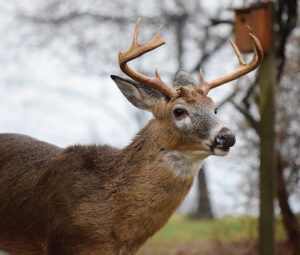
This buck was photographed in the author’s yard in the middle of the 2024 firearms deer season. He seems to have had his hideouts in order; he made it through the rest of the season.
Photo, Joe Kosack
The emerging herd benefited as more and more denuded mountainsides and stump fields sprouted with brush, providing whitetails more and better chunks of range — much of their composition in young, often impenetrable forestland. It was premium habitat for deer.
Dovetailing with these spurts of reforestation were the creation of state game refuges, state parks and state forests, many on lands still supporting mature trees or new forestland. Most provided deer with stable habitat capable of supporting herd growth.
With time, deer became more visible, satisfying an overwhelming majority of Pennsylvanians. But the state’s deer population — capable of doubling its size locally on good range every two years — soon found itself on the cusp of an unexpected problem that would impact the advocacy of its sensational rise.
Agency administrators were learning that whitetails needed to be managed more carefully — scientifically — if their goal to establish a statewide deer herd was to persevere. That meant the road forward was about to get more complicated, particularly since female deer would have to be killed in some counties to balance deer populations with their habitat. Hard feelings about killing does soon surfaced and many Pennsylvanians rallied in a misguided effort to derail what needed to be done.
In its early years, the Game Commission had done such an incredible job selling the need to protect antlerless deer that many Pennsylvanians believed deer hunting should remain that way forever. They didn’t understand, or refused to accept, that deer range has a carrying capacity, just like a farm pasture. When exceeded, whitetails cause damage to and change the composition of the natural vegetation that sustains them and other members of the ecosystems deer inhabit.
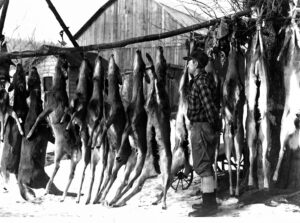
Following two years of doe-season closures, the Game Commission in 1938 closed buck season and allowed only doe harvests. This Lycoming County meatpole scene helps depict what followed—an unprecedented harvest of 171,662 deer, more whitetails taken than in the state’s five previous hunting seasons combined.
Pennsylvania Game Commission
Whitetails had begun to eat themselves out of house and home in some northern-tier forests. Winter mortality — from exposure, starvation — also started to appear. For these reasons and more, the need to harvest both antlered and antlerless deer had become a necessity. Yet, garnering support for antlerless deer harvests was a hard sell for the Game Commission. Most hunters had come to prefer taking an antlered buck. But with no other alternative, the Game Commission pushed forward with antlerless deer hunts, recognizing they were the best way to limit herd growth in woodlands where deer had overextended themselves.
After four successive abysmal attempts to balance local deer populations with antlerless deer seasons, limited by political interference, the Game Commission in 1928 decided to close deer season to antlered deer harvests statewide, which quickly became a hugely unpopular decision. The pressure became so great, John B. Truman, the agency’s third full-time executive director, resigned just before the season opened. More than 25,000 antlerless deer were killed; the largest annual deer harvest recorded since the Game Commission’s startup. Many residents, legislators and those hunters who didn’t participate in the season howled that the herd was ruined. But three years later, hunters took more than 100,000 deer. Then in 1938, buck season was closed again; during that season, more than 171,000 antlerless deer were taken.
These antlerless deer harvests helped demonstrate that killing antlerless deer would not cause monumental consequences to Pennsylvania deer hunting. And based on the sheer numbers of deer progressively taken in those three seasons, it was clear that more and more hunters were becoming comfortable with taking antlerless deer. And why not? The practice was supported by science, promoted outdoor recreation, and was a wise use of a renewable resource that provided dozens of meals to any hunter who brought home a deer. But the battle wasn’t over.
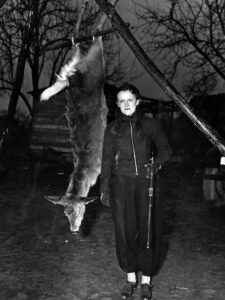
In this 1930s photo, a Pennsylvania woman stands proudly by the antlerless deer she took with a Springfield Model 1898, originally manufactured as a military firearm. Although she changed into finer clothes before the photo op, she preferred not to part with her trusty rifle.
Pennsylvania Game Commission
From 1907, when antlerless deer were first protected, through 1956, antlerless deer hunting was closed 29 times in 50 years of annual firearms deer seasons. The closures help clarify just how contentious hunting antlerless deer once was. Yet, over this same period, buck-harvest statistics, a relatively reliable barometer to gauge deer population gains and losses, continually trended upward.
These escalating buck harvests were tied to Pennsylvania’s growing hunter population, particularly after World War II, when hundreds of thousands of discharged Pennsylvania soldiers came home with their service rifles and took up hunting. Their children would become baby boomers, a generation that would buy more hunting licenses and chase more deer than any before or after it.
As decades of large deer harvests proved the commonwealth’s whitetails could withstand and flourish under the pressure of a growing army of hunters, some hardliners — hunters and nonhunters — eventually softened their stance about antlerless deer hunting. Their compassion for deer, often rooted in societal and Old World hunting mores that long had advocated benevolence toward females and youngsters, was changing to reflect recognition that all deer must be managed, not just the ones with headgear.
But plenty of hunters still oppose antlerless deer harvests. If you doubt that, consider this: As recently as 2020, at least 29 percent of hunters go afield with a goal of taking only antlered deer, according to Game Commission deer hunter survey work.
Deer Politics and the Pendulum
From 1957 forward, the Game Commission has held antlerless deer seasons annually. But when the commonwealth’s hunter population topped 1 million, the agency eventually found itself managing deer more conservatively to ensure most hunters found excitement afield, particularly through the ’70s. This approach would dovetail with the startup of a strategy called “maximum sustained yield,” which aimed to provide the greatest harvest of deer annually without reducing the size of next fall’s population. This recipe satisfied hunters and their political allies, but it deviated from the Game Commission’s responsibility to limit deer conflicts and commitment to align whitetail populations with range carrying capacities.
Many baby boom hunters look to the 1970s and early ’80s as Pennsylvania’s glory days for whitetails. The period marked the apex of hunter participation, a time when more than a million red plaid–clad hunters annually invaded Penn’s Woods on the Monday after Thanksgiving in their quest for a legal buck. It was a veritable holiday in most rural areas. Lean antlerless deer license allocations ensured everyone saw deer. So did a one-and-done bag limit. But less than 10 percent of hunters took a deer.
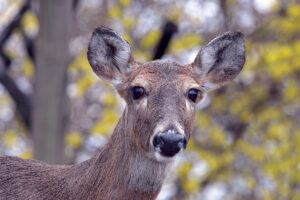
This doe stands by a blooming forsythia bush exemplifying spring’s arrival, which is when whitetails change from winter to
summer coats. But she seemed committed to hanging on to her comfortable, but out-of-season, outerwear.
Photo, Joe Kosack
Little changed in Pennsylvania deer hunting or management during these years, with the exception of county whitetail populations increasing across the state, particularly in the southern tier, even within the suburbs of Philadelphia and Pittsburgh. The whitetail’s adaptability was on full display. But so was the escalating damage they caused in farm fields and forests, as well as in a growing number of communities. These increasing problems soon precipitated changes in regional public perceptions about the value of deer.
This growing friction led to what deer biologists often refer to as “pendulum management,” which aimed to accommodate deer management stakeholders primarily by varying annual antlerless deer license allocations. It was a valid approach to manage deer more strategically by recognizing more stakeholders and using diplomacy to accommodate them. It had become clear deer no longer could be a resource managed just for hunters: They increasingly were butting into the lives of residents almost everywhere.
Allowing more Pennsylvanians the chance to influence deer management provided greater guidance in the Game Commission’s decision-making. But mounting a response to too many deer in too many places took time. It had to be done conservatively, measuring cause and effect, to ensure deer continued to meet the hopes and desires so many Pennsylvanians expected from the resource.
Antlerless deer licenses, commonly called “doe licenses” by hunters, were increased almost annually in the 1980s, but allocating more licenses eventually hit a snag, because hunters were limited to taking one deer annually. Whenever hunters took a buck, it cancelled their antlerless deer license, if they had one. That changed in 1988 when the Game Commission started to allow hunters statewide to take more than one deer with appropriate licenses. Accompanying this and subsequent bag-limit modifications were sizable increases in doe licenses. What followed, however, alarmed hunters.
A record 400,000 deer were taken in 1990. Ten years later, Pennsylvania’s annual deer harvest cleared 500,000. The numbers were hard to believe; equally amazing was the herd’s demonstrated ability to replenish itself annually. Throughout this period, deer management’s varied stakeholders asked for more deer or relief from too many deer. It made managing whitetails an emotional roller coaster ride.
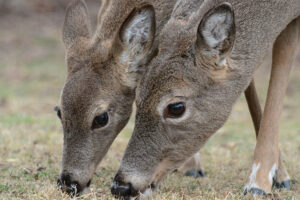
Does remain close to their youngsters into early spring. They eat, groom and roam their home range together.
Photo, Joe Kosack
Game Commission leadership began managing deer conservatively after an unbelievable 1,973,033 deer were harvested from 2000 to 2003. Not even the 2012 arrival of chronic wasting disease would compel them to alter their course. Leadership turnover and public pressure eventually would help guide the agency to adopt a more comprehensive deer management program, a product of innovative assessment tools developed by Game Commission biologists to measure deer health, habitat quality, and conflicts with humans, as well as deer population dynamics and hunter preferences and tendencies.
Since 2017 the Game Commission has tried to limit herd growth to balance local deer populations with available habitat and to limit the spread of chronic wasting disease. This is reflected in annual deer harvests. In the two most recent seasons on record, 2022 and 2023, hunters are estimated to have taken 836,600 deer in Penn’s Woods. These harvests were achieved by increasing hunter opportunities, which included the two largest annual antlerless deer license allocations in 17 years. But providing these exceptional opportunities was a response to a greater, lurking problem: attrition within Pennsylvania’s once mighty deer hunter population.
Even though antler restrictions, started in 2002 to grow larger-racked and larger-bodied bucks statewide, made deer hunting more enticing, Pennsylvania’s deer hunter ranks already were thinning. Not even an upsurge in female hunters could reverse the trend. The last time deer hunter numbers exceeded 1 million was 1992, according to Game Commission Game-Take Surveys. Now they’re around 650,000. Equally concerning is that the average age of a deer hunter is about 52.
Fifty years ago, many young men, and at least some young women, wanted to hunt. Hunter education classes were held in schools amping up interest. Everyone asked, “Did you get your deer?” Newspaper coverage gave successful hunters a chance to be local celebrities. Today is different. The rise of single-parent families has made getting into hunting difficult, let alone getting equipment and afield. The unprecedented accessibility provided by computers and smartphones, the attractiveness of video games and new scholastic sports have changed interests among teenagers. Increases in gun violence and accidents, even though unrelated to hunting, also have compelled many to stay away from this oldest of outdoor pursuits.
Such impediments to hunting were absent throughout most of the 20th century. Deer hunting was strongly supported by society, recognized as exceptional recreation and an essential conservation tool that helped put food on the table and generated economic windfalls in most communities. But today hunting just isn’t seen in the same light.
Values and Concerns
For the better part of the past 100 years, most Pennsylvanians have considered whitetails an important natural resource. But that viewpoint started to change as deer conflicts with people and the land rose. Some residents eventually would come to believe Pennsylvania might have too much of a good thing. Periods of conservative deer management and ongoing hunter attrition have helped heighten those concerns.
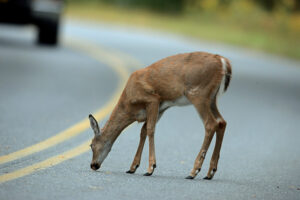
If only deer could stay off roads. But it’s impossible in Pennsylvania with 60 percent of the state in forestland and more than 120,000 miles of roads bisecting those woodlands, as well as farm country.
Pennsylvania Game Commission / Photo, Joe Kosack
The continuing decline of deer hunters presents the Game Commission with greater problems managing deer, something the agency has recognized and tried to counterbalance with increased hunting opportunities and through initiatives to improve hunter recruitment and retention. But it’s an uphill battle, given the losses to older age in hunter ranks haven’t been offset for some time. The spread of chronic wasting disease (CWD) in the commonwealth exasperates this shortcoming.
Consider the implications CWD, now found in 10 of the state’s 22 Wildlife Management Units (WMUs), presents to deer hunters. Its presence compels hunters in a Disease Management Area (DMA) to travel farther from home to hunt healthy deer. If hunters take a deer in a DMA, they must freeze the edible venison — often 20 to 40 pounds worth — and submit the deer’s head for CWD laboratory testing, which is free and takes about a week, to confirm their meat is safe for consumption. But imagine the aggravation and disappointment associated with field-dressing, dragging out, and processing a carcass, only to find out their venison is inedible. Since CWD’s 2012 arrival, more than 100,000 deer hunters have stopped hunting.
There’s heightened public concern about the trouble whitetails are getting into on roads and farms and in forests, backyards and recreational areas. In a 2012 Responsive Management survey, titled Pennsylvania Residents’ Opinions on and Attitudes Toward Deer and Deer Management, participating residents rated, on a 1 to 10 scale, that deer–vehicle collisions were their biggest concern (7.6). Each year, thousands of deer are struck or narrowly missed by motorists on Pennsylvania’s highways. Human lives are lost or ruined almost daily.
The Game Commission’s Annual Deer Population Report & 2024-25 Antlerless License Allocation Recommendations also documents growing concern about too many deer. In 2011 the report noted more than 25 percent of residents surveyed in four of the state’s 23 WMUs believed their deer population was too high. By 2023 residents in 15 WMUs felt the same way.
No county is excluded from the problems deer create. But counties with more people and buildings tend to become places where it’s tougher to keep deer populations in check. That leads to hard feelings about deer. But what’s happening isn’t the whitetail’s fault. It lives where it finds food and shelter — something it does well, often in places where people think it impossible. Sadly, that adaptability has helped tarnish the whitetail’s good standing.
In many ways, it seems whitetails were more respected in the past. It’s not that people and businesses don’t necessarily care about deer, just that whitetails are getting in the way and the problems they cause often are expensive to fix. It’s quite a fall from when deer were almost universally considered an exciting part of Penn’s Woods. Since those days, the whitetail slowly has slipped into a dichotomous relationship with Pennsylvanians. Residents seem to either love or loathe them. Few are indifferent.
However, it’s important to remember, or at least recognize, that whitetails always have strengthened most state wildlife conservation programs, because their availability compels hunters to buy licenses. Until recently, the Game Commission used hunting-license revenues to finance most of its operations. It was a cost hunters once proudly shouldered alone.
Today, however, the Game Commission has reinforced its financial stability through Marcellus Shale natural gas field leases and royalty revenues on state game lands, as well as a boon in federal Pittman–Robertson funding, generated from an excise tax on sporting arms and ammunition. So, the decline of deer hunters hasn’t hurt the agency’s solvency. But their loss eventually will limit the Game Commission’s deer management muscle.
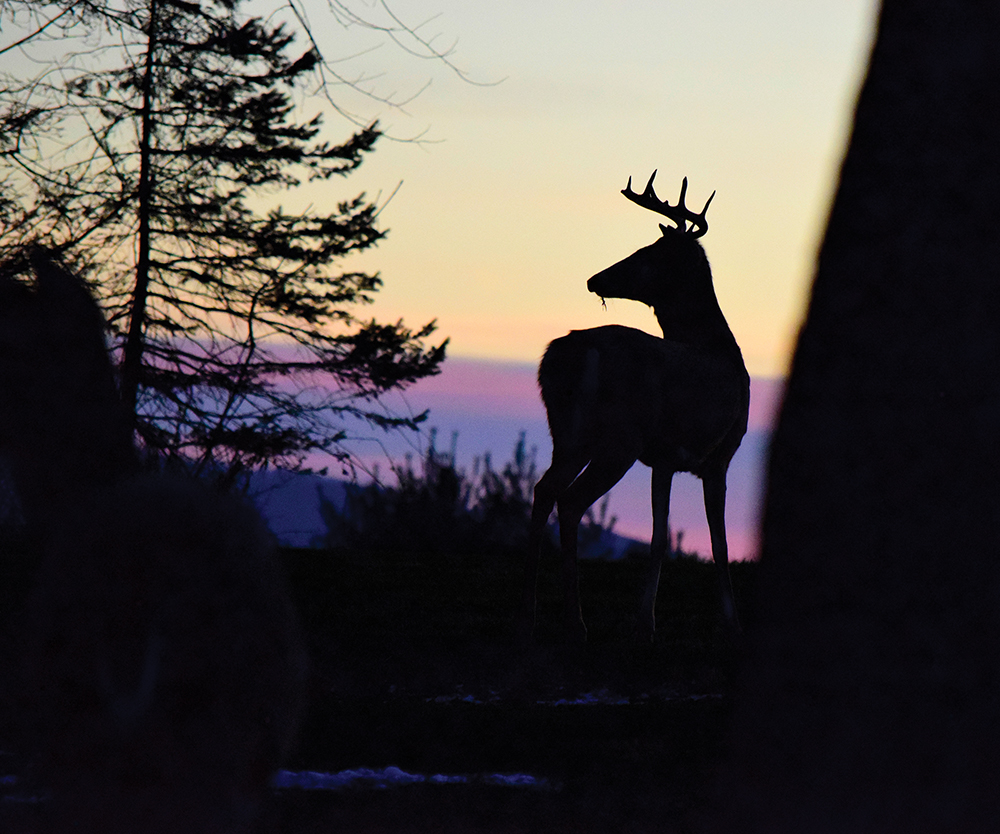
Photo, Joe Kosack
Consequently, Pennsylvania’s approach to managing deer likely will require creative alternatives if hunter ranks continue to tank. Only through exceedingly generous seasons and bag limits are hunters currently managing deer adequately. Even then, it’s clear this effort is approaching its saturation point, which begs the question: How will deer be managed and what consequences will follow if more Pennsylvanians don’t take up hunting? It’s surely something to ponder.
Human prosperity and the whitetail’s resiliency have combined to present an ecological paradox to wildlife managers, who now must wrestle with what local densities of deer will do: satisfy hunters, farmers, suburbanites, motorists and other stakeholders; achieve responsible management of the woodlands deer and other wildlife inhabit; and slow the spread on CWD, which isn’t going away. It’s never an easy decision, measuring the whitetail’s redeeming values against its conflicts. But it’s where the commonwealth finds itself.
What comes next in this evolving enigma is unclear. But rest assured, how residents feel about the state animal is apt to become more complicated and vexing than it’s ever been. That might seem unorthodox to many Pennsylvanians, given the whitetail’s enduring charm and commanding presence. But it’s clear the escalating complications deer present to society and Penn’s Woods undoubtedly will compel more and more residents to reexamine the values they draw from living with whitetails.
Joe Kosack worked for more than 30 years as a writer/editor/photographer for the Pennsylvania Game Commission. His writings and photographs have appeared in publications ranging from the Pennsylvania Travel Guide and Pennsylvania Game News to The Second Atlas of Breeding Birds in Pennsylvania and Terrestrial Vertebrates of Pennsylvania. Kosack’s latest book, Pennsylvania’s Wildlife Conservation History, was published in 2023 and is available through the Pennsylvania Game Commission. A U.S. Army veteran and volunteer hunter education instructor for 35 years, he lives in the Pine Grove area with Denise, his wife of 47 years.