
Bertha Wold’s World War I Diaries
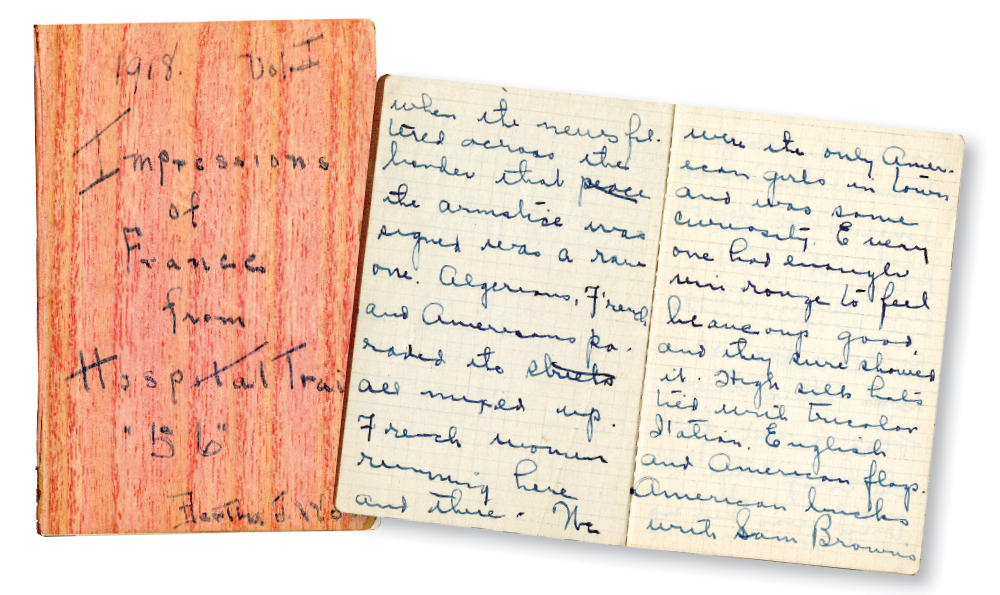
Written by Richard Saylor in the Our Documentary Heritage category and the Spring 2023 issue Topics in this article: Armistice, Austin (Pennsylvania), Bertha Johanna Wold, diaries, France, Pennsylvania State Archives, Philadelphia, Potter County, United States Army Nurse Corps, World War IThe Pennsylvania State Archives holds a large collection of diaries written by Pennsylvanians from all walks of life. Two small diaries by Army nurse Bertha Wold document her experience as she traveled by train through France at the end of the First World War to transfer wounded soldiers to base hospitals. Her entries, which begin on November 5, 1918, in Toul, provide some interesting details of the final days of the war.
 Bertha Johanna Wold, also known as “Barta,” was born in Norway in 1888 (although conflicting years appear on some official documents) and immigrated to the U.S. with her parents. Raised in the borough of Austin in Pennsylvania’s Potter County, she later attended the University of Pennsylvania School of Nursing in Philadelphia.
When the U.S. entered the war, Wold resigned from her job as the head of the health program at Drexel Institute and enlisted in the Army Nurse Corps in December 1917. She began active duty on February 18, 1918, at Ellis Island and was then sent to Base Hospital #20 in France, where she worked from May 17 to October 17. Thereafter, she was transferred to Hospital Train #56 in France where she served from October 22, 1918, to April 8, 1919.
Wold’s second dated diary entry on November 11, 1918, describes Armistice Day in the French town of Belfort: “Algerians, French, and Americans paraded the streets all mixed up. French women running here and there. We were the only American girls in town and was some curiosity. That night for the first time the town was lit up and dancing and music allowed since war began.”
On November 24, Wold wrote from Brest, France, that “Everywhere are German prisoners, loading coal.” Four days later, she and her fellow nurses travelled to Dijon, where they went sightseeing “at the palace where they have stored Mona Lisa and other Louvre treasures during the war.”
Riding a train to Paris, on December 6, Wold noted that at Dijon they passed a large train of French prisoners just returned from Germany. “They looked so happy to be back and were dressed in all kinds of clothes. They waved, smiled, and threw kisses at us, all but the English Tommies.”
On February 16, 1919, she wrote: “As we were walking down the street, we met an American funeral of two Marine officers. The coffins were covered with flowers. The band played at intervals, and about twelve officers were pall bearers. Two more of our boys laid to rest in France.”
Wold mentioned eating supper “at the Red Cross hut located in the casino” at Le Baule on February 27. She noted that she had been on 15 hospital train trips, the first occurring on October 22, 1918, and the last on February 12, 1919.
 On March 8, Wold and three other nurses went AWOL, as they wanted to spend two weeks on leave but could not get all the official approvals in time. They first left their camp at night and took an express train to Paris, where they toured the Louvre and took a streetcar to the Palace at Versailles and then visited the Notre-Dame cathedral. On a train to Reims the next day, one hour outside of Paris, they entered a “devastated area.” Wold noted: “The towns were in ruins, and trenches and barb wire. On our way we could see POW’s busy filling in the trenches.”
The next day, Wold and one of her companions visited a cathedral left in ruins by the war. “It is impossible to describe the standing walls, the mass of stone and the dead stillness of a town from which all life had fled.” They also toured nearby trenches in the following days, picking up 75mm shell casings for souvenirs.
Eventually, the women turned themselves in at Tours to Brig. Gen. Samuel Rockenbach, who sent them to the hospital in Le Baule on their own recognizance. Back at their base, they were restricted to their quarters for several weeks and had their pay docked for the time they were gone. They were let out of confinement when they left France for home on April 8, 1919. In New York City, Wold was honorably discharged on June 11, 1919.
In PHMC’s collections, in addition to Wold’s diaries at the State Archives, are her Army nurse’s coat and skirt, canteen, mess kit, and gas mask at the Pennsylvania Military Museum in Boalsburg.
Richard C. Saylor is an archivist for the Pennsylvania State Archives and author of the award-winning book Soldiers to Governors and numerous articles on military, political and sports history.