
Bath Crossroads Historic District
Written by Marissa Barrett in the A Place in Time category and the Winter 2026 issue Topics in this article: Bath (Northampton County), Federal style, Georgian style, historic preservation, Italianate style, National Register of Historic Places, Pennsylvania Dutch (Pennsylvania German), Queen Anne Revival style, Scots Irish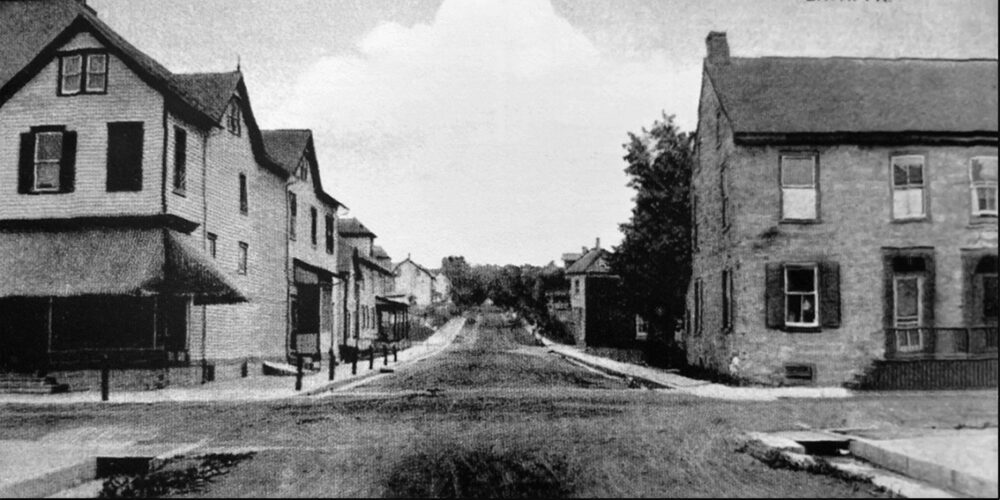
Northampton Street in Bath, circa 1900, with Joseph Steckel House to the right.
The Bath Museum
Nearly 40 years before the United States declared its independence from Great Britain, the quaint village of Bath began to emerge in Northampton County, just 8 miles north of Bethlehem. Thanks to recent local preservation efforts by the Bath Borough’s Historic Architectural Review Board, approximately 34 acres of the original crossroads village is now listed in the National Register of Historic Places.
Bath traces its roots to a Scots Irish settlement established in 1728, although many settlers relocated to western Pennsylvania after the Revolutionary War. The name, however, comes from Bath, England, the hometown of a prominent early Bath resident.
Shortly after the first settlement in the area, German immigrants flocked to the region, and the village grew steadily from the 1740s to the 1760s. By the end of the 18th century, Bath consisted of a few houses and shops, but the location, with six roads intersecting the small rural village at its core, became the catalyst for its growth and solidified its place as a regional hub in the 19th and early 20th centuries.
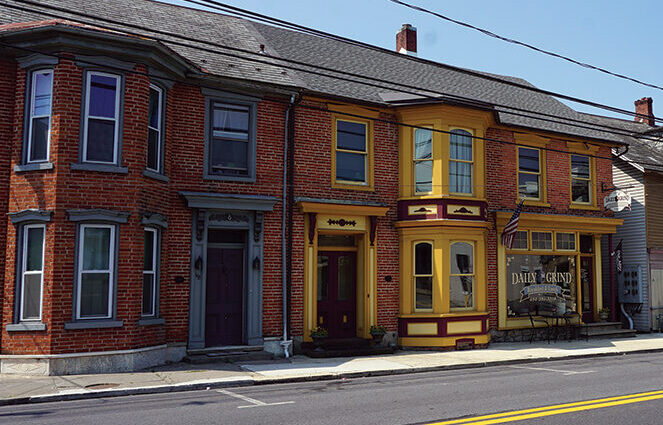
Federal and Revival styles are found along East Main Street. These circa 1850 brick residential/commercial buildings include Italianate elements with an early storefront.
Pennsylvania State Historic Preservation Office
The original village was laid out on a grid, with the earliest row homes and churches located along Main Street, which served as the primary thoroughfare. Additional commercial and residential buildings were built along Chestnut, Walnut, Race, Northampton and Green streets. Development occurred in two distinctive waves, the first being related to stagecoach routes that crossed through the village, bringing with it the establishment of hotels, two of which are still extant today, as well as a large variety of businesses. With the introduction of the railroad in 1859, Bath was transformed into a center of commerce and culture, making it a destination for balls, theatrical performances, fine dining and even sleighing parties during the winter season.
Architecturally, the Bath Crossroads Historic District features a high concentration of Georgian and Federal buildings, representing the Early American years, but it also includes Italianate, Queen Anne Revival, and regional vernacular styles from the Victorian period.
Notably, prior to the district being listed, the 1804 Daniel Steckel House, constructed from hand-cut limestone in the Federal style, was previously individually listed in the National Register. The building is quite impressive with seven working fireplaces, 9-foot-high ceilings, and intricate chipcarved columns and pediment surrounds adorning the original front door, which also happens to match the design of the roof cornice.
The district’s period of significance dates from 1799, which coincides with the construction date of the earliest extant buildings in Bath, and spans roughly 130 years to 1930, when the public transit lines ceased operation and a decline was evident.
As stated in the National Register of Historic Places nomination, “the Bath Crossroads Historic District includes the most intact and densest collection of buildings that exhibit the highest architectural merit and overall level of historic integrity.” It was listed in the register on February 12, 2024.
Recent listings in the National Register of Historic Places include Allegheny Second Ward Industrial Historic District, Clayton-Frick Art Museum Historic District, and Hanauer-Rosenberg Residence, all in Pittsburgh, Allegheny County; Charles M. Schwab House in North Braddock, Allegheny County; First Federal Savings & Loan Association of Philadelphia; Mauch Chunk Cemetery in Jim Thorpe, Carbon County; and Ridge Valley Historic District in West Rockhill Township, Bucks County.
Marissa C. Barrett is a National Register reviewer for the Pennsylvania State Historic Preservation Office.