
Back to the Cloister Fund
Written by Bradley Smith in the Trailheads category and the Winter 2026 issue Topics in this article: Bible, clocks and clockmaking, Commonwealth collections, cupboards, Elizabeth Boldhauser, Ephrata Cloister, Ephrata Cloister Associates, hymnals, J. Conrad Beissel, Jacob Gorgas, music, National Historic Landmark, Pennsylvania Trails of History, Solomon Gorgas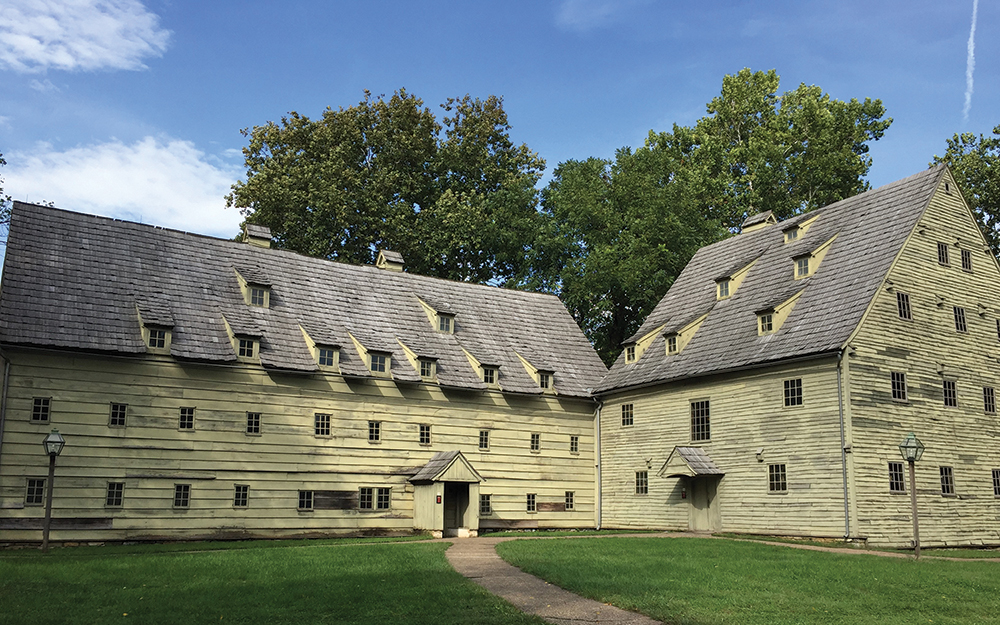
In 1925, Rev. Samuel Zerfass faced a quandary. He needed a new suit, but he lacked the funds for such a substantial purchase. Zerfass was a minister with the Society of German Seventh Day Baptists, a last vestige of the Ephrata Cloister religious community.
With a dwindling membership and an entire campus of historic structures in disrepair, financial resources were limited. Undaunted, Zerfass found a practical solution for his dilemma: He removed an 18th-century artifact from one of the Cloister’s buildings — a small corner shelf — and he sold it to a local artist and antique dealer named Hattie Brunner. With money in hand, Zerfass purchased the desired suit.
Although this story might sound apocryphal, there was already an existing precedent for Cloister representatives utilizing historic artifacts as a form of currency, and perhaps more importantly, Hattie Brunner documented this transaction in a handwritten note that survives to this day.
After leaving Ephrata, one can trace the cupboard’s circuitous journey as it passed through the hands of multiple owners until 2009, when the Ephrata Cloister Associates found and purchased the relic, returning it to its original home after an absence of more than 80 years.
This purchase was facilitated by the Back to the Cloister Fund.
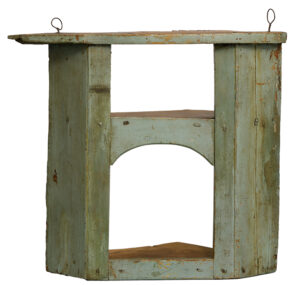
The Ephrata Cloister Associates purchased this hanging wall cupboard in 2009, almost 90 years after it had been sold by the community’s minister to purchase a suit.
Ephrata Cloister, Pennsylvania Historical & Museum Commission
The Historical Context
Ephrata Cloister was a semi-monastic community founded by German Pietists in 1732. Reaching its apex around 1745, the Cloister was home to 80 celibate members who lived communally and were renowned for their printing operations, musical compositions and devotional arts. These individuals, known as the Brothers and Sisters, worshiped with 150 “Householder” members who abstained from the stricter aspects of Cloister life but remained an important adjunct to the celibate community. Today, the Cloister is a National Historic Landmark, administered by the Pennsylvania Historical & Museum Commission, with the support of a nonprofit partner organization, the Ephrata Cloister Associates.
When the commission purchased Ephrata Cloister in 1941, it acquired land, historic structures and nearly 1,000 artifacts created or used by the community’s original inhabitants. This is remarkable by any standard, but commission representatives always knew that an equal quantity of Cloister artifacts had been disappearing since the 18th century.
Several stories of artifact losses are far more disconcerting than the story of Zerfass’ suit. For example, a woman named Sophie Spangler once operated an antique shop on the grounds of Ephrata Cloister. The Ephrata Review newspaper discussed her business in an 1888 article, noting “Miss Sophie S. Spangler, a resident of the Ephrata Cloister, [is] the possessor of a large collection of relics which are of interest to descendants of deceased members of the society” and she had “already sold a large number of relics to fanciers of these articles.” According to her obituary, Spangler was still selling artifacts at the time of her passing, 22 years later. Newspaper accounts also indicate that artifact theft was once a significant problem at Ephrata Cloister. A 1929 article appearing in the Lebanon Daily News noted that “antiques [were] disappearing . . . with startling regularity over a period of several years.” Concerned about the frequency of these thefts, the Pennsylvania State Police began posting troopers to guard the site’s treasures.
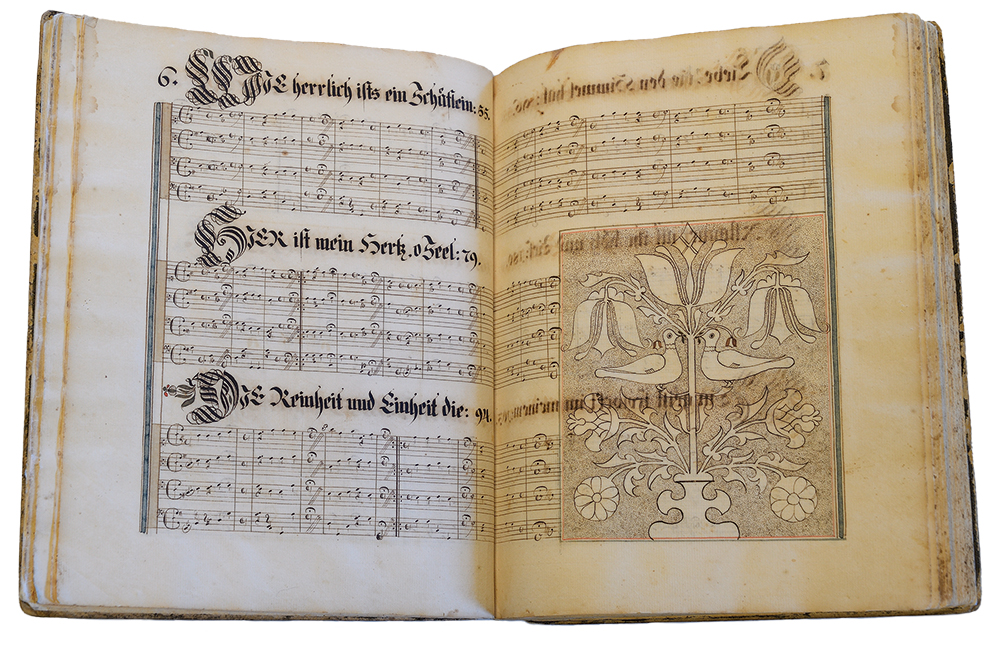
This magnificent manuscript contains the musical notation for hymns written at the Ephrata Cloister. It once belonged to Solomon Gorgas, an Ephrata clockmaker.
Ephrata Cloister (EC85.3.1), PHMC
Considering these stories, it should come as no surprise that Cloister artifacts are now found in libraries, museums and private collections worldwide. They also appear at public auctions with surprising regularity, often selling at high cost and with minimal advanced notice. It was for this reason that the Ephrata Cloister Associates adopted a resolution in April 1980 to create a dedicated Back to the Cloister Fund to “acquire, when available, things which had their origin at the Cloister such as hymnbooks, furniture, or documents.” As the exclusive property of the Ephrata Cloister Associates, the fund would be administered by the officers of the Associates, and they and the site curator would “determine the authenticity of any article acquired.”
Shortly thereafter, the Associates utilized the fund for the first time to purchase a printed hymnal of Ephrata Cloister compositions titled Paradisical Wunder Spiel (Wonder Music of Paradise) that once belonged to the community’s founder, Conrad Beissel.
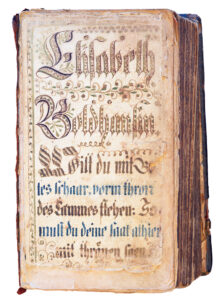
This book is made up of several German-language volumes bound together and decorated with a fraktur-style bookplate, added between 1748 and 1757, identifying the owner as Elizabeth Boldhauser.
Ephrata Cloister (EC2019.1), PHMC
Back to the Cloister Recoveries
One could argue that music was the single most important component of devotional life at Ephrata Cloister, and in the 18th century, community members — men and women alike — composed more than 1,000 original hymns. They could easily share their lyrics via hymnals printed on Ephrata’s printing press, but they lacked the ability to practically print the musical notation that was vital to their complex vocal arrangements.
To resolve this issue, Cloister artists developed handwritten tune books to accompany each printed hymnal. Artists further enhanced these tune books by embellishing them with illustrations featuring flowers, turtledoves and other recurring motifs held sacred by the community. This was a laborious task and prompted a visitor to note in 1753 that some Sisters were “constantly engaged in copying musical notebooks.”
Because they are works of original music and unique art, surviving tune books hold tremendous intrinsic value. Fortunately, the Back to the Cloister fund has facilitated the return of several tune books. One extraordinary example is marked “Solomon Gorgas, his book, 1783.” Gorgas was a Cloister Householder and clockmaker; the Associates purchased his tune book from an area historical society who deemed it superfluous to their collecting mission.
When it comes to beautiful decoration, one must acknowledge the Bible of an Ephrata Cloister householder, Elizabeth Boldhauser. Members of the Cloister cherished their German-language Bibles, and yet few Cloister-owned Bibles survive. The Boldhauser Bible was printed in Germany in 1747, but it was subsequently bound with four additional religious texts into a single, massive tome, 1,464 pages in length. A Cloister artist added a magnificent fraktur bookplate that reads “Elizabeth Boldhauser: If you want to stand with God’s flock before the throne of the Lamb, then you must sow your seeds with tears.” The decoration dates between 1748, the printing year for the supplemental texts, and 1757, when Elizabeth married and changed her last name.
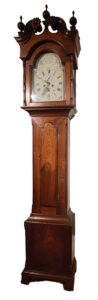
This attractive tall case clock was made by Ephrata clockmaker Jacob Gorgas and his son, Solomon. Both were married “Householder” members of Ephrata Cloister. Acquired through the Back to the Cloister Fund in 2024, the clock is now on display in the Ephrata Cloister Visitor Center.
Ephrata Cloister (EC2024.3), PHMC
Given the rarity of Cloister Bibles and the beauty of the fraktur bookplate, the Ephrata Cloister Associates utilized the Back to the Cloister Fund to purchase this treasure from the 2019 estate sale of Clark Hess, a well-known Lancaster County historian, author and private collector. According to his notes, Hess acquired it in 2008 — from a seller on eBay.
One of the largest artifacts acquired through the Back to the Cloister Fund is a beautiful tall case clock marked “Jacob Gorgas, near Ephrata.” Despite the markings, design elements indicate it is the collaborative work of Householder Jacob Gorgas and his son, Solomon (the same Solomon whose tune book is mentioned above). Several details, such as the colorful decoration painted on the clock’s face, suggest it was constructed around 1795. The Ephrata Cloister Associates acquired the Gorgas Clock at an estate sale in June 2024, and it is now on display in the Ephrata Cloister Visitor Center.
***
Because the Back to the Cloister fund is used exclusively for acquiring Ephrata Cloister artifacts, it is always available as needed. Over the years the Associates have replenished the fund through myriad fundraising initiatives, including the beloved Apple Dumpling Days held every October at Ephrata Cloister.
Since its creation 45 years ago, the fund has facilitated the acquisition of several dozen artifacts. The Back to the Cloister Fund remains vital to the site’s ongoing efforts to find, acquire and return relics to their original home in Ephrata, where they can be best appreciated by the public.
Bradley Smith is the curator at Ephrata Cloister.