America’s First Zoo in Philadelphia
Written by Pamela Reilly in the Wish You Were Here category and the Spring 2023 issue Topics in this article: Frank Furness, Paul Philippe Cret, Philadelphia Zoo, postcards, William Camac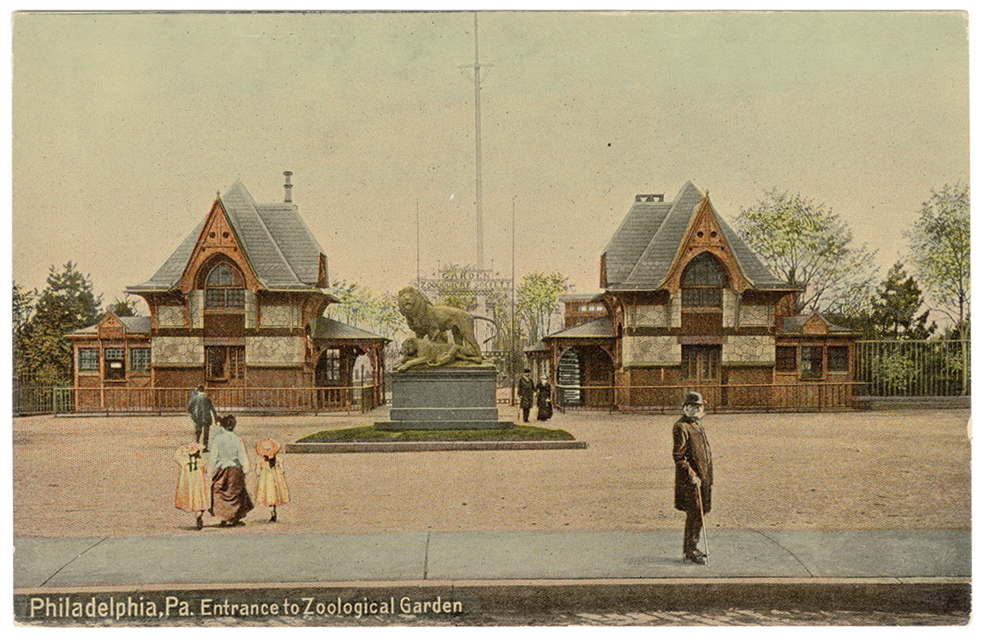
Chartered in 1859, the Philadelphia Zoological Garden was the first formally planned zoo in the United States. The Pennsylvania legislature and William Camac (1829–1900), a prominent Philadelphia doctor and civic leader, secured 32 acres of land in Fairmount Park along the western bank of the Schuylkill River with the intention of creating a world-class zoological park. The Civil War and its aftermath delayed the construction of the zoo, but when it opened on July 1, 1874, it was greeted with much fanfare and thousands of visitors. Admission cost 25 cents for adults and 10 cents for children, and it remained the same for more than 50 years.
Initially the zoo accepted donated animals, like the two bears sent by Utah religious leader and politician Brigham Young, but it also hired naturalist Frank J. Thompson to catch and transport wild animals and serve as the first superintendent. Upon opening, the zoo offered a monkey house, deer park, bear pit, buffalo range, beaver pond and prairie dog village. A few months later, steamships delivered giraffes, hyenas, leopards, lions, a yak and an elephant. The zoo was served by its own railroad station (now demolished) and a dock on the Schuylkill River.
Philadelphia had long been a leader in scientific and intellectual pursuits. The city was already home to the nation’s first scientific society, the American Philosophical Society (1743); first medical school, the College of Philadelphia (1765); and first botanical garden, Bartram’s Garden (1728). The Academy of the Natural Sciences opened in 1812 and the Franklin Institute for the Promotion of the Mechanic Arts was founded in 1824.
The Philadelphia Zoo continued the city’s commitment to science. Not surprisingly, it aspired to provide more than public entertainment by serving as a center for scientific study. In 1901 the Penrose Research Laboratory was established study animal health, nutrition and husbandry, the first of its kind in a zoo setting. The zoo was also the first to develop specialized food for zoo animals, with researcher Dr. Ellen Corson-White creating a nutritious Zoo Cake in 1935 that greatly reduced mortality rates. In 1928 the first successful orangutan and chimpanzee births in the U.S. occurred at the zoo. It also created the first dedicated children’s zoo in the country in 1938.
In the almost 150 years since it opened, the Philadelphia Zoo has continued to be an innovator in animal care and conservation efforts. It is currently home to more than 1,700 rare and endangered animals and has installed an ingenious system of visible elevated trails called Zoo360 that permits big cats, primates and monkeys the opportunity to explore and travel beyond traditional animal enclosures.
Although the Philadelphia Zoo has evolved to meet modern needs, several remarkable historic buildings remain. An architectural gem that predates the development of the zoo, the Solitude, a neoclassical stone country villa built in 1784 for former colonial governor John Penn, once served as the zoo’s executive offices and remains a part of the historic landscape. The grounds were designed as a picturesque Victorian garden landscape with buildings created by the leading architects of the day. The overall design was developed by Herman J. Schwarzmann (1846–91), a young German immigrant who was also chief architect for the Centennial Exposition of 1876. Once selected by the Fairmount Park Commission, Schwarzmann toured European zoos to gather ideas before hiring architects to design the needed buildings. The zoo’s distinctive entrance featuring two Gothic Revival–style gatehouses joined by a wrought iron archway was designed by renowned Philadelphia architect Frank Furness (1839–1912) for the exposition, and it replaced a single wood gatehouse that had been created for the zoo’s opening. In 1877 Furness’ partner, George Hewitt (1841–1916), designed the Antelope House (now incorporated into the Treehouse, designed by Venturi, Rauch and Scott Brown in 1985 as part of the Children’s Zoo). In 1941 French American architect and University of Pennsylvania professor of design Paul Philippe Cret (1876–1945) designed the Pachyderm House, which was recently converted for use as a family education center.
The Philadelphia Zoo also contains a dozen iconic sculptures by various artists. The Dying Lioness by Wilhelm Wolff (1816–87) was selected by Schwarzmann for installation at the zoo entrance in 1877 after display at the Centennial Exposition. Lioness Carrying to Her Young a Wild Boar by French sculptor Auguste Nicolas Cain (1821–94) was moved to the zoo in the early 20th century from its original location on River Drive.
The Philadelphia Zoo is part of the Fairmount Park Historic District, which is listed in the National Register of Historic Places and has two Pennsylvania Historical Markers commemorating “America’s First Zoo” and “The Solitude.”
Pamela W. Reilly is a historic preservation specialist in the Pennsylvania State Historic Preservation Office.