
Understanding Pennsylvania’s Gradual Abolition Act of 1780
Written by Todd Mealy in the Features category and the Summer 2026 issue Topics in this article: abolitionism, Act for the Gradual Abolition of Slavery (1780), African Americans, Edward Hand, Frank (Rock Ford), George Bryan, Germantown Quaker Petition Against Slavery (1688), Quakers, Rock Ford Plantation, slavery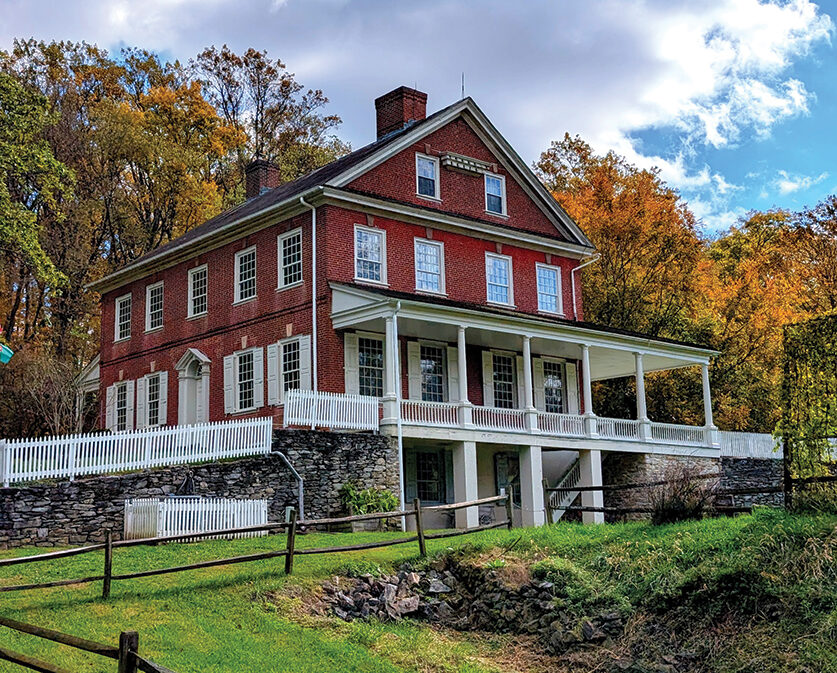
Rock Ford was the home of Revolutionary War general Edward Hand. In 1802 one of his enslaved farm workers, Frank, escaped from the estate, never to return. Frank was to remain in bondage for life according to the stipulations of the Gradual Abolition Act of 1780, so he fled from Rock Ford, emancipating himself.
Rock Ford Foundation
In March 1802, an enslaved man named Frank slipped away from his enslaver in Lancaster County. Prior to his escape, Frank had served as both a chauffeur and a laborer, moving between roads and fields that he would now use as a route to freedom. He fled on a Sunday night wearing a beaver hat and a pair of light-colored pants. Most importantly, he carried a freedom certificate that once belonged to a deceased free Black man named Prince Wheel. Frank intended to pass under that name.
Frank was about 30 years old, born either in 1771 or 1772, and described as “stout made but not corpulent,” according to the runaway advertisement placed by his enslaver, Edward Hand (1744–1802), a prominent Lancaster physician, Revolutionary War officer, and former adjutant general of the Continental Army. The notice ran for nearly six months in the Lancaster Intelligencer, offering $30 for Frank’s capture and return. Then, abruptly, the pursuit ended when Hand died on September 2, 1802. To this day, Frank’s fate remains unknown.
Frank’s self-emancipation came at a particular moment of danger. By the spring of 1802, Hand was in debt, and his estate faced formal settlement. That made Frank a liquid asset in the sale. The fact that Hand’s runaway notice warned that Frank might be sold “south” suggests a circumstance in which creditors were pressing and cash was needed quickly. Whether or not a sale had been already arranged is unknown. What mattered was the risk.
Frank fled 22 years after Pennsylvania passed the nation’s first abolition law. The problem was that the law did not apply to him. And for enslaved people excluded from its protection, an enslaver’s debt could be as binding as an abolition law was freeing. It is possible that Frank was aware of Hand’s debt and chose not to wait to learn how it would be resolved.
The Pennsylvania Gradual Abolition Act of 1780, formally titled An Act for the Gradual Abolition of Slavery, is often remembered as a moral breakthrough; however, in practice, it was more complicated. Although the act curtailed lifetime chattel slavery for some, it preserved it for others, replacing permanent, inherited bondage with a layered legal system of unfreedom that left thousands of Black Pennsylvanians, Frank among them, trapped in slavery.
To understand what gradual abolition actually meant on the ground, we must see how Frank remained enslaved for life under Pennsylvania law, not because he fled too late but because he had been born too early.
***
African slavery arrived in the Delaware Valley in 1639, 140 years before Pennsylvania enacted the nation’s groundbreaking gradual abolition law and nearly a century and a half before it became a state. By 1681, when Pennsylvania was founded as an English colony, enslaved Africans were living and working in Philadelphia and Chester counties. William Penn himself acknowledged their presence in official colonial records. Philadelphia merchants were instrumental in bringing slavery into the colony, having worked to import African labor from the West Indies, trading grain, lumber and flour for human cargo.
By the eve of the American Revolution, no more than 2 percent of an aggregate population of roughly 300,000 in Pennsylvania held Africans in bondage. Yet chattel slavery remained sufficiently entrenched to shape household economies and labor systems from Philadelphia’s shipyards to the farms and ironworks of the interior.
In reality, Philadelphia stood at the center of the colony’s slave system. According to historians, the city alone held roughly 540 enslaved people who worked as domestic servants, dock workers and skilled tradespeople, including blacksmiths, coopers, sailors and distillers. In wealthier households, owning two or three enslaved people was common; in rare cases, elite Philadelphians held dozens.
The city’s enslaved African population was visible and, as national discourse moved toward Enlightenment principles, more mobile. According to historian Edmund Raymond Turner, slaveholders increasingly complained about enslaved people gathering at night, engaging in disorderly conduct, and “gadding” around town “without written permission from a master.”
Beyond Philadelphia, slavery took on a different but no less significant form. In Lancaster County, where Edward Hand enslaved three people in his city home and Frank at his rural Rock Ford plantation, enslaved people worked on farms, in households, and at iron furnaces. These were sites where slavery was especially valued for its permanence and perceived necessity. Chester and York counties similarly held enslaved populations. Tax documents, inventory lists and runaway advertisements suggest that the average enslaver owned one or two people rather than large gangs.
Slavery in Pennsylvania was thus dispersed rather than concentrated. At minimum, the state’s slavery system could be described as personal rather than plantation based.
***
Pennsylvania’s early antislavery reputation owes much to the Society of Friends. But that reputation can be misleading. From the late 1600s to the early 1700s, Quakers were among the colony’s most significant enslavers, particularly in and around Philadelphia. Moral unease existed early, but it did not immediately translate into abolition.
What some Quakers opposed first was not slavery itself but the slave trade — and, more pointedly, the hypocrisy of fellow Friends who profited from it. In 1688 a small group of German-speaking Quakers in Germantown, many of whom had settled outside Philadelphia in part to distance themselves from slaveholding Friends, issued what is widely regarded as the first formal antislavery protest in British North America. The Germantown Quaker Petition Against Slavery was less an appeal to distant empires than a rebuke directed inward, aimed at Quakers in Philadelphia who trafficked in human beings.
Addressed to the “Monthly Meeting held at Richard Worrell’s,” the petition depicted the transatlantic slave trade as a direct violation of Christian ethics and the Golden Rule. “Is there any that would be done or handled at this manner?” the authors asked, “to be sold or made a slave for all the time of his life?” The question was deliberately universal. “Now, tho they are black,” the petition continued, “we cannot conceive there is more liberty to have them slaves, as it is to have other white ones.”
The petition draws parallels between Quaker slave traders and the very forms of captivity Europeans feared most. Many, they noted, trembled at the thought of being seized by “Turks” and sold into slavery abroad — yet Quaker enslavers did precisely that to Africans, who were “brought hither against their will and consent, and that many of them are stolen.” That Quakers would engage in such piracy, the petition insisted, made the offense worse, not better.
Most poignantly, the petition linked slavery to family destruction. Enslavers, it charged, committed “adultery” by separating wives from husbands, giving them to others, and selling children away from their parents. Such practices, the authors warned, could not be reconciled within Quaker practice.
Despite its moral warning, the petition was neither acted upon nor enforced. Its argument deferred to a later generation.
***
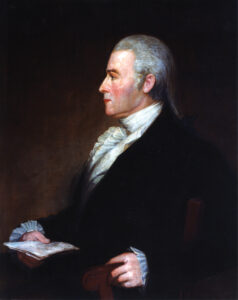
Irish-born Philadelphia politician George Bryan introduced the legislation that would eventually morph into the Gradual Abolition Act of 1780.
Courtesy of the Pennsylvania Capitol Preservation Committee
It was the American Revolution that intensified the call for legislation designed to restrict the slave trade and slavery itself. Pennsylvania’s Constitution of 1776 was among the most radical political documents produced in the Revolutionary Era. It declared that “all men are born equally free and independent” and grounded legitimate government in popular sovereignty rather than inherited authority.
Although it exceeded the democratic reach of most other state constitutions ratified that year, Pennsylvania’s document remained silent on abolishing slavery.
In fact, it can be argued that the 1776 constitution protected slavery. The same declaration that exalted freedom also affirmed the right to “acquiring, possessing and protecting property.” In a society where enslaved people were legally defined as property, the constitution left slavery intact.
This was the world into which Frank was born. He was chattel, excluded from the promise of constitutional liberty and vulnerable to sale decades after the Revolution began.
In September 1778 — roughly one year after Frank’s birth — a single line buried among war news in The Pennsylvania Evening Post announced something extraordinary. “A member,” the paper reported, “presented to the house a bill for the gradual abolition of slavery, which being read the first time, was ordered to lie on the table for consideration and a second reading.”
That member was likely George Bryan (1731–91), an Irish-born assemblyman from Philadelphia and one of the most radical lawmakers of the revolutionary generation. In 1778 Bryan served as acting president of Pennsylvania’s Supreme Executive Council — the state’s collective executive body under the Constitution of 1776, which deliberately replaced a single governor with 12 counselors and a president they selected annually to prevent the concentration of power.
On November 3, The Pennsylvania Evening Post reported Bryan had formed a three-man committee charged “to bring in a bill for the gradual abolition of slavery.” Its members included Bryan, Joseph McClean and Thomas Fitzsimons (1741–1811). Although it remains unclear whether McClean was a slaveholder, Fitzsimons would later list two enslaved people on his 1790 census return. The committee, then, represented a coalition with overlapping moral concerns but differing material interests, making compromise inevitable. The bill that eventually emerged reflected intense negotiations.
The first compromise might be described as legislative gradualism. Rather than abolishing slavery outright and immediately, the committee agreed on a phased approach that postponed emancipation across time. Gradualism eased enslavers’ economic anxieties while postponing the social consequences of integrating formerly enslaved Africans into civic life. The men agreed that emancipation would arrive at one’s 28th birthday.
The second compromise was a form of reproductive deferment. By tying emancipation to a distant birthday and making one’s freedom dependent on the status of the mother, the law ensured that enslaved women remained bound through most of their childbearing years. Therefore, children born to them would supply decades of coerced labor before freedom arrived.
When the bill reached its third General Assembly reading on November 18, 1779, eight members voted against putting it up for engrossment. Surprisingly, the dissenters came not from defenders of slavery, but from radical reformers in the Bryan faction of the Assembly who argued the bill did too little. Two opponents objected that binding children until age 28 postponed freedom “unreasonably long.” Their arguments split between immediate emancipation and reducing the age of freedom to 18 or 21.
Their protest revealed that the legislative debate was greater than proslavery versus antislavery factions. It was a struggle over how quickly liberty should arrive, and for whom.
The record fails to give us an exact tally; however, based on quorum estimates reported in The Pennsylvania Packet, or the General Advertiser, between 30 and 52 legislators likely supported moving the bill forward. It provided a commanding majority because wartime conditions usually placed active attendance at fewer than 60 members. Pennsylvania had crossed a threshold, and the final vote was set for February.
***
For the first time in any American legislature, slavery was discussed as a statutory problem, subject to repeal by law. Aware of the firestorm that awaited them if an engrossment vote were taken up without public comment, legislators sent the issue to the public arena.
On December 23, 1779, The Pennsylvania Packet, or the General Advertiser printed the draft of the bill in full on its front page. It was a transparent step designed to invite Pennsylvanians far beyond the Assembly chamber to voice their concerns. Two days later, on Christmas morning, the paper published a long, unsigned letter to the editor from an anonymous clergyman writing under the initials “C.D.” Addressed to fellow ministers in the countryside of York, Lancaster, Cumberland and Berks counties, where slavery remained economically entangled with agriculture and household labor, C.D. brushed aside standard proslavery claims that abolition would bring economic ruin.
Property, he argued, could not be claimed in human beings without violating the “natural, inherent and unalienable rights” on which Pennsylvania’s Constitution rested, turning republican government into a contradiction in practice. A government that claimed its authority from the consent of the governed could not, in the same breath, deny personhood to any group of people living in the commonwealth. When the law turned human beings into property, he wrote, representation lost its moral high ground, making citizenship a privilege to some rather than a right owed to all. (This was a debate about republican legitimacy, not yet apportionment; the federal Constitution, with its Three-fifths Compromise, still lay years in the future.)
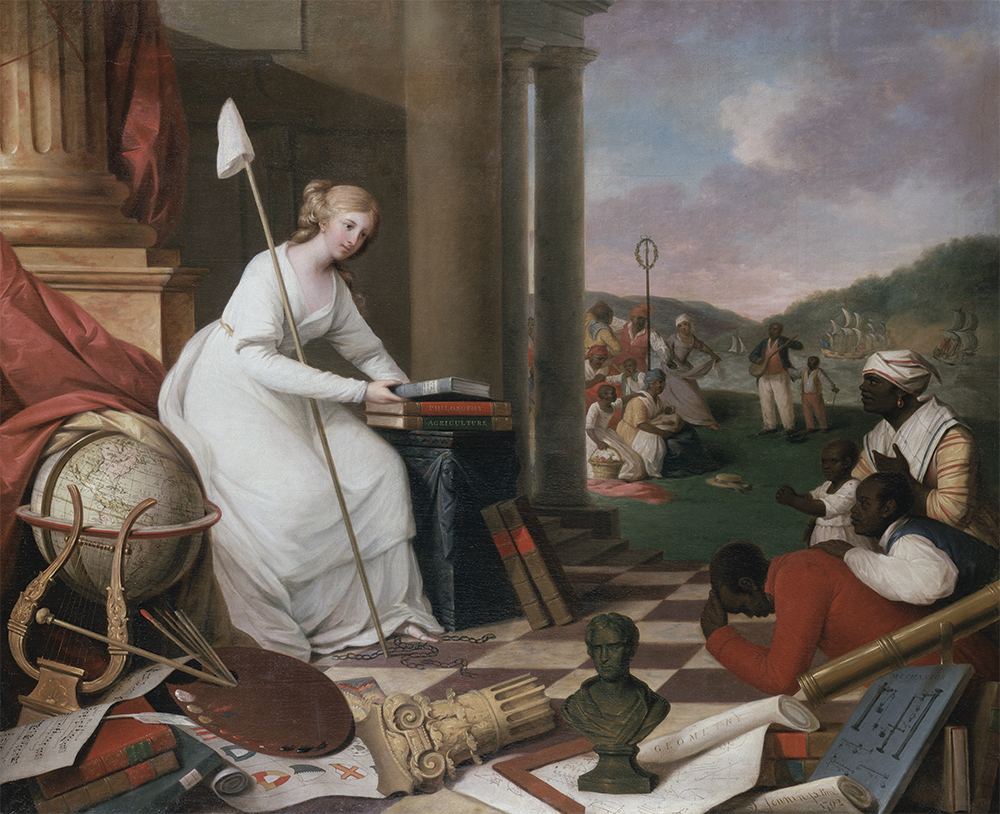
In 1792 native Philadelphia artist Samuel Jennings (active 1789–1834) created what is known as the first antislavery painting by an American, Liberty Displaying the Arts and Sciences, or The Genius of America Encouraging the Emancipation of the Blacks. The allegorical scene was commissioned by the Library Company of Philadelphia and features a personification of Liberty presenting symbols of knowledge and learning to formerly enslaved Black people.
Library Company of Philadelphia (Gift of the artist, 1792)
C.D. also took aim at biblical defenses of slavery, especially claims that enslaved Africans required Christian “saving.” Mosaic law, he explained, had permitted slavery due to greed — “the hardness of men’s hearts,” he wrote. If the Gospel could be invoked to justify chattel slavery, C.D. warned, it forfeited its moral authority altogether. To postpone abolition under Christian pretenses was not prudence, but hypocrisy. “If Christianity can allow of this,” he argued, “what shall we say is done evil?”
On January 27, another anonymous writer warned that the law’s success would depend not on its principles, but on its enforcement. “By the operation of this Act,” the writer observed, “a number of persons will in the course of time become free subjects, and have to provide for themselves.” The danger, he argued, was not freedom itself, but freedom without preparation for full participation in economic and civic life. If enslavers yielded “severe service” (slavery) while neglecting to educate the enslaved with reading, trades and moral instruction, those set free would become free without the skills of citizenship — and then bear the blame for consequences they did not create.
***
After the airing of public views, the final vote on the bill fell on Tuesday, February 15, 1780.
Although an exact tally is unknown, the abolition bill “passed by a great majority of voices,” according to the February 17, 1780, edition of The Pennsylvania Packet, or the General Advertiser. The law, hailed its supporters, was a great “effort in behalf of liberty.”
On March 1, 1780, An Act for the Gradual Abolition of Slavery became law. On enforcement day, the press called it an “act of humanity, wisdom and justice.” But what, in practice, did this landmark law actually do?
First, the act ended chattel slavery for children born to enslaved women in Pennsylvania after March 1, 1780. Slavery, thereafter, would no longer reproduce itself indefinitely through birth. In that sense, the law placed slavery on a distant path toward extinction.
Second, the act replaced lifetime slavery with a new form of statutory indentured servitude. Children born to enslaved women after March 1, 1780, were declared neither slaves nor free persons. Instead, they were bound as servants to their mother’s owner, or that owner’s assigns, until the age of 28. During that period, they were subject to the same disciplinary authority as short-term indentured servants, including what the law called “like correction and punishment.” Their freedom was guaranteed only by survival, time and legal compliance by those who controlled them.
Because legal status followed the mother, a child born to an enslaved woman was also born unfree, bound to service until age 28 regardless of their mother’s eventual emancipation. As a result, families could remain legally unfree for decades after 1780, with each generation’s term of bondage resetting at birth and extending coerced labor well into the 19th century.
This is exactly what concerned the Bryan faction. The law preserved a market in African labor long after the law’s passage. For example, advertisements for the sale of statutory servants would appear in Pennsylvania newspapers into the 1800s. In May 1815, more than three decades after the act’s passage, the Adams Centinel advertised “Four Young Servants for Sale,” noting that “copies of their registry, required by the 4th section of the law of 178[0],” would be made available to prospective buyers. The private sale of statutory servants underscores how easily gradual abolition preserved commercial exchange in African labor.
Third, the act preserved pre-existing bondage. No one enslaved at the time of the law’s passage would ever be freed by it. Men and women born before the effective date remained enslaved for life, provided their owners complied with the statute’s requirements. The law drew a firm line at birthdate, and for those on the wrong side of it — even those born on February 29, 1780 — legislative freedom remained out of reach.
Fourth, the act required enslavers to register every enslaved person by name, age, sex and residence with county clerks by November 1, 1780. Failure to register carried a stark consequence: Any enslaved person not properly entered on the rolls would automatically gain freedom. If kept in bondage thereafter, a person could claim unlawful detention or kidnapping.
This new registration requirement raises a larger question: Was gradual abolition a utopian moral gesture, or a reform grounded in the political economy of slavery itself? By placing the burden of compliance on enslavers — and attaching freedom as the penalty for failure — the act quietly transformed slavery from a customary condition into a bureaucratic one, vulnerable to error. For reformers like George Bryan, the registration compromise did not abolish slavery. It was, however, a win for the radicals, as it certainly offered a way out of bondage for chattel slaves like Frank.
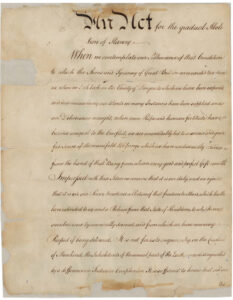
The first page of An Act for the Gradual Abolition of Slavery.
Pennsylvania State Archives, RG-26
Registration deadlines and clerks’ records now determined who remained enslaved and who did not. And it was this precise legal requirement that drew the earliest and loudest opposition to the law.
Almost immediately, enslavers petitioned the Assembly, claiming ignorance of the law, missed deadlines, and hardship in the countryside where its requirements, they insisted, had never reached them. For instance, in February 1781, according to The Pennsylvania Evening Post, a petition signed by several eastern Pennsylvania farmers had been submitted to the General Assembly, claiming that, “being ignorant of the particular directions of the law for the gradual abolition of slavery, they had omitted to register their Negroes.” While not disputing the act’s authority, the petitioners claimed ignorance of its procedural requirements and therefore sought leniency after missing the deadline. The Assembly ordered the petition “to lie on the table for consideration.”
Public reaction demonstrated little sympathy. In April, a blistering response appeared in the Pennsylvania Journal, or Weekly Advertiser, signed simply “FREEMAN.” The author scoffed at the slaveholders’ request for an extension, calling it a proposal to “resume the punishment of perpetual slavery.” To retroactively strip away freedom from those whom the law had already declared free, he proclaimed, would reduce republican law to a cruel trick. “Like a rogue’s device,” he wrote, “to give a pocket under one hand, and snatch it back with the other.” Freedom, once granted by statute, could not be reclaimed by a petition.
The Freeman’s Journal printed a second public condemnation that June. This one cautioned that any attempt to reopen the registration deadline threatened the rule of law itself. “Can the legislature make a freeman today,” he asked pointedly, “and tomorrow reduce him to slavery again?” To do so would violate not only natural rights but the very principle for which the American Revolution was fought. Once freedom had been vested by law, it could not be withdrawn “without injustice.” Free Black Pennsylvanians, he insisted, were citizens in the eyes of the state constitution. Even as Pennsylvanians debated freedom in constitutional terms, the Revolutionary War itself had produced a situation the law as written could not resolve.
***
From the war’s outset, enslavers from Maryland and Virginia displaced by the fighting had been relocating to Pennsylvania as wartime refugees. The Gradual Abolition Act of 1780 had not anticipated this movement, nor did it say anything about non-Pennsylvania residents who had previously entered the state holding enslaved people. As the flow of refugees increased, lawmakers who had championed gradual abolition confronted a problem of how to reconcile antislavery reform with wartime asylum.
In October 1781, the Assembly responded with a supplementary statute titled An Act to Give Relief to Certain Persons Taking Refuge in This State, with Respect to Their Slaves. Its preamble framed the issue sympathetically. “Many virtuous citizens of America,” driven north by the enemy, had sought safety in Pennsylvania. The question was whether those refugees could retain enslaved people they brought with them.
This 1781 wartime relief statute carved out a temporary exception to chattel slavery in the commonwealth. Refugee slaveholders were permitted to “retain, possess, and hold” enslaved people while residing in Pennsylvania. The act carried three provisions. First, they were required to register those individuals within six months of arrival or of the law’s passage. Second, they could not sell or lease their enslaved people to Pennsylvanians. And third, they were forbidden from retaining slaves in the state more than six months after the conclusion of the war. This statute closed with an explicit safeguard: “Nothing herein contained shall be deemed . . . to enslave any person . . . emancipated or freed” per the 1780 Gradual Abolition Act.
Even after the refugee exemption was carved into law, the pressure on the Assembly did not subside. Enslaver petitions continued to flood the legislature through the fall and winter of 1781. Some enslavers pleaded personal hardship. James White, for example, announced himself as a discharged Continental soldier and prisoner of war. He argued in front of the Assembly that his “captivity with the enemy” had prevented compliance and asked that the people he enslaved not be allowed to “avail themselves” of freedom guaranteed by the 1780 act. Others continued to invoke ignorance of the law or absence from the state as grounds for a registration extension.
Often overlooked in the legislative record is the history of Black Pennsylvanians petitioning in their own names, urging legislators that they “may not be deprived of their liberty by any future act of the house.” And when lawmakers finally voted on the proposal to soften the registration requirements, the measure failed on a tie vote, with 30 in favor and 30 against.
In 1782 the matter of enslavers asking for registration extensions reached the courts. Increasingly, the claim was tested through writs of habeas corpus when enslavers failed to comply with registration. One case in February involved a young man named Alexis, brought into Pennsylvania after the 1781 wartime relief statute’s passage and later sold. The court held that because he was neither registered nor lawfully indentured, he was “wholly without the provisions of the law” and therefore free.
Just two years after the Gradual Abolition Act became law, competing appeals had transformed both the Assembly and the courts into contested legal arenas where enslavers and freepersons pressed opposing claims. In the Assembly, it exposed one truth: Despite relentless petitions and political pressure, legislators kept narrowly refusing to give in to the proslavery contingent.
In the courts, habeas corpus became a formidable legal instrument for abolitionists. It helped turn missed paperwork, delayed registration or unlawful residence into grounds for liberation.
***
In 1785 The Pennsylvania Gazette reported that the number of slaveholders who had effectively forfeited their human property for failure to comply with the registration deadline was in the hundreds. What startled readers was not the registration rule itself, but the degree of ignorance feigned by enslavers. “Notwithstanding the interest all Slave-holders had in complying with this law,” the writer observed, “yet we find many hundreds of them lost their slaves from their ignorance of it.”
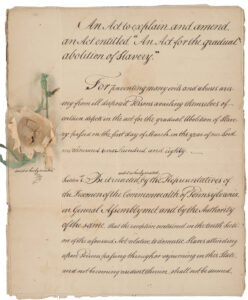
The first page of An Act to Explain and Amend an Act Entitled, An Act for the Gradual Abolition of Slavery, commonly known as the Explanatory Act of 1788.
Pennsylvania State Archives, RG-26
Even more damning was the geography. Some of these slaveholders lived “within twelve miles of the city of Philadelphia,” the Pennsylvania Gazette reported. These were not isolated frontier farmers or recent arrivals on the margins of the state. They lived near the seat of government, close to courts, printers and lawmakers. The paper seemed to confirm enslavers’ longstanding argument: “the newspapers at that time circulated only in the city.”
Nevertheless, protests against the 1780 act remained relentless throughout the decade. By that time, the law’s most vocal opponents may have been non-slaveholding white Pennsylvanians stuck paying public costs of emancipation. For example, in March 1788, residents of Bucks County petitioned the Assembly to revise Section 4 of the 1780 act, objecting to the provision that required they bear financial responsibility to “support and maintain negro children born” under the law’s gradual framework. The petitioners argued that these freepersons were not enslaved in the traditional sense and that, as statutory indentured servants, they should have acquired sufficient trade skills to sustain themselves upon entering freedom. Specifically, they objected to the fact that tax revenue from city and township residents paid for the upkeep of 28-year-old people made free by the law.
Section 4 had been designed to prevent precisely the outcome petitioners now sought — abandonment. It made local governments financially responsible for a former enslaved person’s freedom. What the Bucks County petition made plain was that gradual abolition had shifted costs away from individual slaveholders to a portion of the public that had never enslaved anyone. The idea of subsidizing an institution they neither participated in nor supported is irrational, they maintained. Their request to lawmakers: Have the perpetrators of slavery pay the cost to its victims.
The Assembly neglected to respond to the Bucks County petition by reopening debate on Section 4. Instead, it responded by clarifying and reinforcing the statute itself. That month, lawmakers passed An Act to Explain and Amend an Act Entitled, An Act for the Gradual Abolition of Slavery, commonly known as the Explanatory Act of 1788. In addition to clarifying details about the 1780 act, this new law restricted the “sale, transfer, and removal out of this state” of both chattel slaves and statutory servants. Its purpose was to prevent enslavers from cashing out on people whose freedom was near by selling servants into regions where lifetime chattel slavery still prevailed.
The Explanatory Act kept Section 4 of the 1780 law intact. Local governments remained responsible for supporting free Black Pennsylvanians once statutory servitude ended. To the Bucks County petitioners’ dismay, emancipation would impose public costs.
Historians estimate that roughly 6,855 enslaved people lived in Pennsylvania at the time of the Gradual Abolition Act’s passage. Within a decade, that number had been cut nearly in half. At the end of the 18th century, slavery lingered across the commonwealth while being “all but dead in Philadelphia.” For lawmakers like George Bryan, gradual abolition appeared to work. When he died, that achievement defined his public memory. His headstone praised him as “equally an opponent of domestic slavery” and credited him as the man from whose pen “the Act of Abolition, which laid the foundation of their liberation, issued.”
***
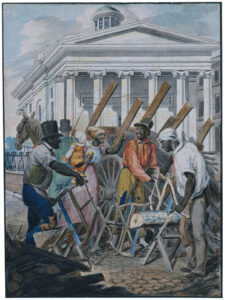
By the time this watercolor was created around 1812, Philadelphia had the largest free Black population of any city in the United States, approximately 9,000. The painting, Black Sawyers Working in Front of the Bank of Pennsylvania, Philadelphia, is attributed to John Lewis Krimmel (1786–1821), who painted scenes of everyday life around the city.
Metropolitan Museum of Art
Understanding implications of the Gradual Abolition Act brings us back to the story of Frank.
Frank’s flight from bondage in March 1802 exposes what the law actually did and did not accomplish. According to Edward Hand’s runaway advertisement, Frank was about 30 years old, placing his birth around 1771 or 1772. He had been born too early to benefit from the law’s core promise of freedom upon one’s 28th birthday. Freedom was never reserved for him.
The law required enslavers to register the people they claimed to own. Hand properly registered Frank, so the official paperwork affirmed Hand’s control over Frank. In the eyes of the commonwealth, Frank remained chattel, meaning he was saleable property. Hand’s advertisement made that danger clear. If captured, Frank might be sold south to satisfy Hand’s debts, despite Pennsylvania’s 1788 restriction. It can be surmised that Frank ran because the 1780 act left him exposed.
Because the Gradual Abolition Act also required enslavers to register slaves with the county clerk, statutory servants eventually received formal certificates of freedom. These papers identified them as legally free and protected, at least in theory, from re-enslavement. When he fled, Frank possessed a freedom certificate that had once belonged to Prince Wheel, a deceased free Black man.
Ironically, where in one instance the Gradual Abolition Act trapped Frank into eternal bondage, in another sense, it effectively presented him with the means to escape. Frank fled enslavement because abolition in the commonwealth was as flawed as it was conditional. It created a world in which freedom depended on timing and paperwork.
Pennsylvania crossed a legal threshold in 1780. Self-emancipation offered a physical one, available at any moment. For Frank in 1802, only one of those crossings offered a chance at freedom.
Further Reading
Brunhouse, Robert L. The Counter-Revolution in Pennsylvania, 1776–1790. Harrisburg: Pennsylvania Historical & Museum Commission, 1942. / Nash, Gary B. Forging Freedom: The Formation of Philadelphia’s Black Community, 1720–1840. Cambridge, MA: Harvard University Press, 1988. / Nash, Gary B., and Jean R. Soderlund. Freedom by Degrees: Emancipation in Pennsylvania and Its Aftermath. New York: Oxford University Press, 1991.
Todd M. Mealy, Ph.D., is an award-winning historian, educator and curriculum designer with 25-plus years of experience teaching in public schools and higher education. He serves as curriculum director for the Witness Stones Project and has supervised student research and community-wide commemoration projects on enslaved individuals in Lancaster. His previous articles for Pennsylvania Heritage include “Shall Liberty Dwell: James Forten and the Struggle for Black Rights in Early Pennsylvania” (Winter 2024) and “Breaking the Color Line: The Trial That Led to the End of Legal Segregation in Pennsylvania’s Schools” (Summer 2016).