
First Troop Philadelphia City Cavalry: America’s Oldest Active Service Unit
Written by Alli Davis in the Marking Time category and the Summer 2026 issue Topics in this article: American Revolution, Battle of Brandywine, Battle of Germantown, Carpenters' Hall, Continental Army, First Troop Philadelphia City Cavalry, Pennsylvania Historical Marker Program, Philadelphia Committee of Safety, Washington's Crossing of the Delaware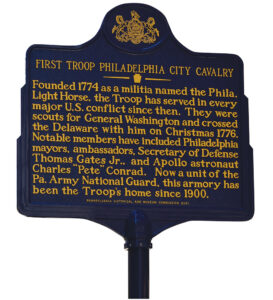 On November 17, 1774, three members of Philadelphia’s Committee of Safety met with 28 citizens at Carpenters’ Hall to discuss forming a volunteer troop amid rising tensions with Great Britain. From that meeting emerged the Philadelphia Light Horse, later known as the First Troop Philadelphia City Cavalry (FTPCC), or simply the “First Troop.” Its founders pledged to equip and support themselves and offered their services to the Continental Congress. When Congress formally established the Continental Army on June 14, 1775, the First Troop was already prepared for action. Over time, the unit came to be recognized as one of the oldest military organizations in continuous active service in the United States.
The First Troop’s founders were prominent merchants, shipowners, importers and traders. Many belonged to elite civic and social organizations, including the Gloucester Fox Hunting Club, the Schuylkill Fishing Company, the Schuylkill Company of Fort St. Davids, the St. Andrew’s Society of Philadelphia, the Friendly Sons of St. Patrick and the Sons of St. George. These men combined their skills to form a highly capable elite unit. Strong horsemanship, intimate knowledge of local terrain and waterways, and considerable social influence defined the First Troop from the outset.
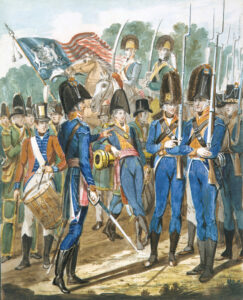
Members of the City Troop and Other Philadelphia Soldiery, circa 1813, by John Lewis Krimmel (1786–1821).
Metropolitan Museum of Art
Armed with sabers, horse pistols and carbines, the troopers trained for both mounted and dismounted combat. They drilled extensively with fencing and riding instructors and even retained a trumpeter to relay battlefield signals.
During the American Revolution, the First Troop performed vital reconnaissance, security and courier duties for the Continental Army. They escorted George Washington from Philadelphia to New York in 1775 and crossed the Delaware River on Christmas night in 1776. The First Troop fought at Trenton and Princeton, saw action at Brandywine and Germantown, and served throughout the harsh winter at Valley Forge. By March 1776, they had expanded their membership to 40 troopers.
Distinguished members have included William Ward Burrows, the first commandant of the U.S. Marine Corps, and Charles “Pete” Conrad, commander of Apollo XII and the third person to walk on the moon.
Today, membership in the First Troop is limited to soldiers serving in A Troop, 1st Squadron, 104th Cavalry Regiment of the Pennsylvania Army National Guard and is attained by election. The unit serves as the U.S. Army’s official ceremonial mounted organization while maintaining an active riding program and a continuous combat-arms lineage. Since 1774, more than 2,500 members have served, with approximately 50 to 60 active troopers today.
The Pennsylvania Historical Marker for the First Troop Philadelphia City Cavalry was dedicated on June 5, 2021, at the Armory at 22 South 23rd Street in Philadelphia.
Alli Davis is the coordinator of the Pennsylvania Historical Marker Program.