
Andy Warhol’s Mother by Elaine Rusinko
Written by Deirdre Smith in the Book Review category and the Summer 2026 issue Topics in this article: Andy Warhol, Carpatho-Rusyns, Elaine Rusinko, Julia Warhola, Pittsburgh, pop art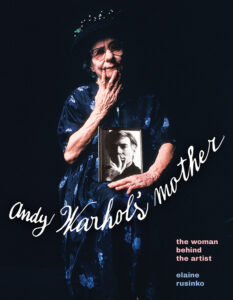 Andy Warhol’s Mother
The Woman Behind the Artist
by Elaine Rusinko
University of Pittsburgh Press, 528 pp., hardcover $40; paperback $24
Born Andrew Warhola in Pittsburgh in 1928, the man better known as Andy Warhol went on to become one of the most enduringly prominent American artists of his generation. Warhol’s legacy has been turned to repeatedly in recent biographies, docuseries and exhibitions aimed at humanizing, queering and otherwise breaking down the barriers of the artist’s inscrutable public persona and the obdurate renown of his best known works of Pop Art. Elaine Rusinko offers another path to insight: the numerous ways in which Warhol’s life and career were profoundly shaped by his mother, Julia Warhola.
Julia was a Carpatho-Rusyn woman, born in the village of Miková (present-day Slovakia) in 1891, who lived most of her life as a migrant to the United States in Pittsburgh and New York. Warhol’s Mother unfolds over eight chapters that move the reader from Julia’s marriage to Warhol’s father, Andrii, in 1909, to their years raising their children in Pittsburgh in the 1920s-1940s. At the midway point, the book takes a turn when Julia moves to New York to join Andy in 1952. The two cohabitated, and collaborated, for many years, with Julia fussing over her son and providing the lettering for many of his illustrations. A portrait of a close, if complicated, relationship emerges. While mother and son became more distant during the 1960s, Rusinko also details Julia’s acquaintance with Warhol’s romantic partners and art world associates. Rusinko credits many aspects of Warhol’s personality to Julia (and to his Carpatho-Rusyn identity): his interest in drawing, penchant for fabulation, superstitions, work ethic, stinginess, and dislike for people who think they’re better than others.
As much as Julia’s story intersects with her son’s, Rusinko’s book centers on Julia herself. Rusinko, who is a scholar of Carpatho-Rusyn literature with Carpatho-Rusyn heritage, writes on Julia less as a straightforward biography subject and more as a microhistorical intermediary to the particularities, and difficulties, of Slavic immigrant experiences in the early to mid-20th century. The book may appeal equally, and at times more so, to those interested in that subject matter as to those interested in Julia’s son.
Deirdre M. Smith
University of Pittsburgh and Carnegie Museum of Natural History