
Women Healers by Susan H. Brandt
Written by Arleen Tuchman in the Book Review category and the Summer 2023 issue Topics in this article: health, medicine, Philadelphia, Susan H. Brandt, women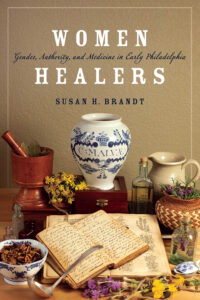 Women Healers
Gender, Authority, and Medicine in Early Philadelphia
by Susan H. Brandt
University of Pennsylvania Press, 312 pp., hardcover $39.95
In this deeply researched and well-written book, Susan H. Brandt reveals women’s central place in the intricate healing networks that flourished in the first decades of Philadelphia’s existence. Casting her net widely, she examines the ideas, practices and influence of doctresses, nurses, midwives, herbalists and apothecaries of Euro-American, African American and Native American descent. Highly sensitive to women’s absence from the archives — and to the erasure of much women’s work from elite writings — Brandt turned to an eclectic array of sources for the information they might contain about women healers. These included medical recipe books, newspapers, legal documents, published herbals, city directories, popular self-help manuals, and even magazine wrappers and gravestones. Most compelling about this erudite book is the detail with which Brandt recreates the movement of information through networks of healers — networks that both disrupted and reinforced class and racial divides.
The book consists of eight chapters, arranged chronologically, starting in the mid-18th century when, as Brandt convincingly shows, the unregulated nature of the medical marketplace created opportunities for women of all races and social classes to ply their trade and often establish successful businesses. In subsequent chapters, Brandt charts what historians of medicine already know about elite physicians’ attempts to assert their authority, but her focus is on the creative ways women responded to these efforts, adapting their skills and strategies to an emerging medical commercialism. When the Female Medical College of Pennsylvania opened its doors in Philadelphia in 1850, Brandt concludes, it was not so much the beginning of women’s entry into medicine as it was the culmination of roughly 100 years of women playing a central role in the healing of the city’s sick.
Women Healers should appeal to anyone interested in reexamining the early American history of health and healing from the perspective of those whose voices have been marginalized.
Arleen Marcia Tuchman
Vanderbilt University