
William Penn: A Radical, Conservative Quaker by J. William Frost
Written by Randall Miller in the Book Review category and the Winter 2026 issue Topics in this article: Quakers, religious freedom, William Penn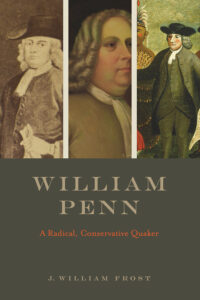 William Penn
A Radical, Conservative Quaker
by J. William Frost
Pennsylvania State University Press, 258 pp., hardcover $119.95, paperback $29.99
In this learned and revealing study of William Penn’s Quaker ideas, identity and interests, J. William Frost provides close readings and brilliant exegesis of Penn’s many and varied writings, preachments and speeches that dispel several myths and misconceptions about Penn while presenting him foremostly as a Quaker working through the meaning, means and obligations of his faith. Frost’s Penn is a complicated man — at once an aristocrat and a religious dissenter, a monarchist and a reformer, a utopian planner and a failed practitioner — who in the context of the political, social and religious tensions of his day set a course as a moralist, a rationalist, an often adroit (but sometimes misdirected) politician, a colony builder, and a persistent advocate for religious liberty as essential for realizing human happiness and harmony and creating a civil polity.
Frost’s emphasis throughout the book is on Penn’s religious faith and his place in defining and defending the Society of Friends (Quakers). In separate topical chapters, Frost examines Penn’s life; his conversion; the origins, evolution and organization of early Quakers; the struggles for religious liberty in England and Pennsylvania; Penn’s insistence on morality as fundamental to good order; and Penn’s preaching. In closing chapters, Frost assays Penn’s accomplishments and notes the failures of his “Holy Experiment” in Pennsylvania.
In the end, Frost argues that Penn’s leadership among Quakers derived from his preaching ability and its extent and the cogency and appeal of his voluminous writings on religious liberty and morality. He also reminds us that whatever Penn’s failures in managing a colony that was wracked by political ambitions, competing private interests, religious divisions, and external dangers, he bequeathed to Pennsylvania, and a larger world, a studied convincement of the utility and necessity of religious freedom and the tenacity that made it possible.
Randall M. Miller
Saint Joseph’s University