
William Bartram’s Visual Wonders by Elizabeth A. Athens
Written by Brian Black in the Book Review category and the Summer 2026 issue Topics in this article: drawings, Elizabeth A. Athens, natural history, William Bartram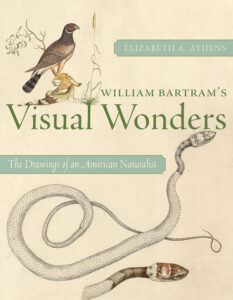 William Bartram’s Visual Wonders
The Drawings of an American Naturalist
by Elizabeth A. Athens
University of Pittsburgh Press, 264 pp., paperback $26
The Bartrams’ fascinating place in American natural history is the starting point for Athens’ sumptuous volume. Readers will gain a wide knowledge of the family of painters and how they influenced humans’ increasing understanding of the natural world in the late 1700s and early 1800s. That, however, is not the main thrust of this book. As a specialist in art history, Athens gives a remarkably in-depth analysis of the style and technique of William Bartram that will particularly interest students of visual history. Combined with glorious representations — even color plates! — of many of his works, William Bartram’s Visual Wonders provides readers with much more technical detail than they may need; however, it clearly establishes the artist’s importance in ideas of natural wonders and processes in the Early Republic era. In this fashion, Athens offers a most valuable contribution to our literature.
The fourth son of John Bartram of Philadelphia County, William has attained timeless fame as a writer of travelogues that provide an insightful, detailed record of North America at this early moment. “Writing was not, however, Bartram’s only or even preferred method of recording the world around him,” writes Athens. “Drawing was by all accounts his ‘darling delight,’ even though most of his illustrations remained unpublished.” Kept mainly in private hands and traded among other naturalists of this era, these rarely seen visuals are Athens’ primary sources. In remarkable detail, Athens traces “the roots of Bartram’s natural history to his drawing practice.” To do so, she explores minutiae of technique and practice that searches for consistency and knowledge in each of the images that she analyzes to create a most unique historical source.
Brian C. Black
Penn State Altoona