
Wampum Walloper: The Last Interview with Baseball Legend Dick Allen
Written by William Kashatus in the Features category and the Summer 2023 issue Topics in this article: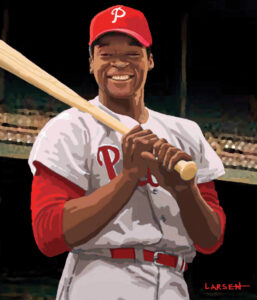
Dick Allen steps up to bat during his first stint with the Phillies in a portrait by Philadelphia illustrator Rob Larsen.
Courtesy of Rob Larsen
On July 8, 1965, the Philadelphia Phillies were playing the San Francisco Giants at Connie Mack Stadium, their ramshackle ballpark at 21st and Lehigh in North Philadelphia. With no score, the bases loaded, and no outs in the bottom of the first inning, Richie Allen, the Phillies’ young clean-up hitter, walked to the plate.
The club’s first African American star, Allen was hitting .328 and had been recently named the starting third baseman for the National League’s All-Star team. He won the coveted Rookie of the Year award the previous season when his hitting kept the Phils in the pennant race until the final day of the campaign. Despite his success, Allen was treated with hostility by the hometown fans.
Just a week earlier, Frank Thomas, a popular white veteran player, provoked a fight with the young infielder by making a racist remark. When Richie confronted him, Thomas struck him across the shoulders with his bat. Punches were thrown, and when the dust settled, the veteran was released from the team. Although Thomas went on WFIL radio to give his side of the story, Allen was ordered by manager Gene Mauch to keep quiet about the incident. Philadelphia’s sportswriters made the situation worse by making Richie the offender in a segregated city where racial tensions had exploded into a riot just a year earlier. Now, Allen, once the darling of a predominantly white fan base, was walking on eggshells.
No sooner had his name been announced than the crowd exploded in a fusillade of boos and jeers. Some screamed racial slurs at him. Others hatefully shouted the N-word at the top of their lungs. A white father seated behind the Phillies’ dugout held his little boy up in the air with one hand and pointed at the beleaguered star with the other, teaching his son to boo. Allen appeared to be unfazed by the maliciousness, but inside he could feel the anger coursing through his veins.
Working the count to two balls and one strike, Richie tore into a high-inside fastball for his 12th home run of the season. It was also his first major league grand slam, a moonshot that easily cleared the left field roof of the stadium. Suddenly, the boos turned into cheers as the 37,000 strong took to their feet to give Allen a standing ovation. It was the “ultimate mind game,” he would say after the 4-2 Phillies’ victory.
The schizophrenic treatment of Allen continued for the next four years. Although the hometown fans appreciated his offensive prowess, they never really accepted him until much later in his career, when he returned to Philadelphia. Nor did they try to understand his difficult circumstances as a Black superstar in a segregated city.
Allen was one of the finest Major League Baseball (MLB) players of all time and Philadelphia’s equivalent of Jackie Robinson. Unwittingly, he became a symbol of the growing Black consciousness of the 1960s and paid for it dearly.
Richard Anthony Allen, a native of Wampum, a small town 30 miles northwest of Pittsburgh in Pennsylvania’s Lawrence County, was born on March 8, 1942. One of nine children, Dick, as he was known by family and friends, was raised by his mother, Era, who supported the family by working as a domestic. An outstanding student-athlete at Wampum High School, Allen was a starting guard on a nationally ranked basketball team in 1958. Two years later, the team, captained by Dick, won the Division B state championship. He earned All-American honors, although he was only 5 feet, 10 inches and weighed 180 pounds.
Allen was even better at baseball. He was a power-hitting shortstop, nicknamed “Wampum Walloper.” Signed by the Philadelphia Phillies in 1960 for an estimated $70,000, Dick spent three years in the minor leagues before being promoted to the majors for good in 1963. A year later, he was voted the National League Rookie of the Year. Over the next seven years, he batted over .300 three times and averaged almost 30 homers and more than 90 runs batted in (RBI) a season. But fans never forgave him for allegedly instigating the release of Frank Thomas.
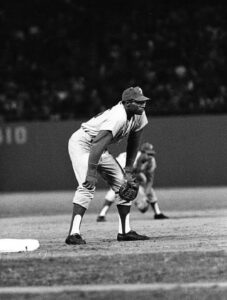
Allen began his major league career as third baseman for the Phillies and would continue in that position for the next four years.
Courtesy of Richard Allen Jr.
They booed Allen every night, often using the N-word, and threw pennies, bolts or beer bottles at him. Off the field, they sent him hate mail and dumped garbage on his front lawn. Philadelphia’s sportswriters excoriated him as a rebel who manipulated race and expected special privileges. In fact, Allen was a victim of racism, not a manipulator of it.
Indeed, Allen’s candid opinions on race and the discriminatory practices of MLB challenged the game’s white establishment and reflected the emerging independence of MLB players as well as growing Black consciousness. Like Jackie Robinson, who broke the game’s color barrier, Allen forced Philadelphia’s baseball fans to come to terms with the racism that existed in the city during the 1960s.
At the same time, Allen’s tape-measure home runs earned him the admiration of younger fans, teammates and opponents of all races. A private but congenial person, Allen was considered a “great teammate” by those who played with him and a “good friend” to clubhouse attendants and members of the grounds crew.
Traded to Los Angeles at the end of the 1969 season, Allen spent just one year with the Dodgers before he was traded to the St. Louis Cardinals, where he spent the 1971 season. Not until he arrived in Chicago in 1972, however, did he feel accepted by the fans. Allen led a talented but young White Sox team into contention, winning an American League (AL) MVP award, two home run titles, and an RBI title in his three years with the ChiSox. He also single-handedly reversed the financial fortunes of a troubled franchise, enabling them to baseball’s highest tribute — induction into the National Baseball Hall of Fame.
Dick Allen’s career achievements warrant induction because they place him in the same rarified company as some of baseball’s greatest stars, including Joe DiMaggio, Willie Mays and Hank Aaron. Among his most outstanding career statistics and honors are the 1964 Rookie of the Year Award, the 1972 AL Most Valuable Player Award, two AL home run titles, 7 All-Star Game appearances, and an AL RBI title. His career totals include a .292 batting average, 351 home runs, and 1,119 RBIs.
Baseball’s new analytics show that Allen was among the very best players of all time. His 156 career on-base plus slugging percentage adjusted to the dimensions of the various ballparks in which he played (OPS+) ranks him 19th in the history of the game. His 165 OPS+ ranks him first of all players between 1964 and 1974, and his 68.3 offensive wins above replacement (WAR) ranks him first of all position players in the same decade.
Allen’s Hall of Fame candidacy was initially considered by the Baseball Writers’ Association of America in 1983. Although 75 percent of the votes are required, he never received more than 18.9 percent of the writers’ votes in each of the 15 years he was on the ballot between 1983 and 1997.
Dick’s hopes to be enshrined in the Hall of Fame were revived in 2014, when he was considered by a special Golden Era Committee of 16 Hall of Fame players, executives and media members that was to vote every three years. His name appeared on the committee’s poll of 10 candidates who played between 1947 and 1972. To be elected, a candidate had to secure 12 of the 16 votes cast by the committee. No one was elected that year. Both Allen and Tony Oliva received 11 votes, one shy of election.
Three years later, in 2017, when the Golden Era Committee was scheduled to vote again, the Hall’s Board of Directors restructured the committee into two voting groups: Modern Baseball (1970–87), which voted in December 2017, and Golden Days (1950–69), which was not to vote until 2020. Although Allen’s career spanned both eras — and his statistical achievements and honors were evenly divided between the two — his candidacy was pushed back to 2020 because his “best years came with the Phillies in the 1960s,” according to an email to the committee promoting Allen’s candidacy from Jeff Idelson, then the Hall’s president.
In 2020, when the Golden Days Committee was scheduled to meet, Allen was forced to wait yet another year because of the coronavirus pandemic. Sadly, Dick passed away on December 7, 2020, the day after the results would have been announced. Allen was considered posthumously in December 2021, but again missed election by a single vote.
In this, his last interview conducted in the spring of 2020, Dick Allen offers a look back at his storied career, his legacy, and his prospects for being inducted into the National Baseball Hall of Fame.
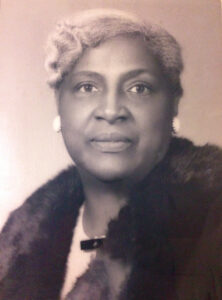
Era Allen, Dick’s mother, pictured here around 1960, was a positive force in his upbringing. He considered her to be the most influential person in his life.
Courtesy of Richard Allen Jr.
Who was the most influential person in your life?
My mother, Era. She was the person that held our family together. That was no easy task because she had to raise nine children. Mom was also a religious person who treated everyone like she would want to be treated. We were one of just a dozen Black families in town. Most everybody was white. But that didn’t matter. My mother made sure that I never knew racism growing up. I ate and slept at white peoples’ homes, and they ate and slept in ours. My mother didn’t tolerate any nonsense either. If you got into trouble, you got a good whalin’. You know people always asked me, “Who’s the best hitter you ever saw?” And I always tell ’em, “My mother! Babe Ruth had nothin’ on her!”
You were a multisport athlete at Wampum High School, earning All-American honors in basketball. In fact, you led the school to two state championship titles in 1958 and 1960. Some say that you were a better basketball player than baseball player and that you could have played in the National Basketball Association. Why didn’t you try to become a pro basketball player?
Let’s take a step back. My older brother, Hank, was the captain and leading scorer on the 1958 team. I was just part of the supporting cast. I might have been the captain and scoring leader of the 1960 team, but that team had a lot of good players who went on to play at the college level, including my younger brother Ronnie, Jim Santelli, Gene Wilson, and Bill Hennon, the coach’s son.
As for why I didn’t try to go into professional basketball, I was only 5, 10 coming out of high school. That’s not real tall. The only big school that was interested in giving me a basketball scholarship was Tennessee State — all the rest were small colleges. Besides, there was more money in pro baseball.
Phillies’ scout John Ogden signed you out of high school to your first professional baseball contract for an estimated $70,000,the highest bonus paid to an African American player up to that time. But didn’t he have to convince your mother first, because she wanted you to get a college education?
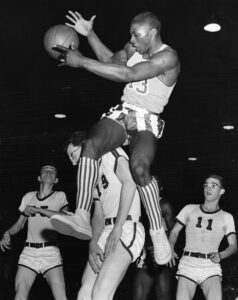
At Wampum High, Allen excelled in basketball, leading his team to the Division B state championship and earning All-American honors.
Courtesy of Richard Allen Jr.
That is correct. Not many people know that John Ogden was a major league pitcher for the old St. Louis Browns. He was quite a competitor himself. But he was also quite a scout. As you said, my mother wanted me to go on to college, but she also trusted Mr. Ogden. I don’t think there was a greater scout in the game at the time. He had a tremendous eye for talent. You know, John Ogden also signed Hank Aaron, Warren Spahn and many others who made the majors, but more important, went on to become doctors, lawyers and teachers and made a great contribution to society. But the thing that appealed to me most was his honesty. Everything he promised to me or to my mother, he delivered. Nothing had to be written. His handshake was as good as his word.
What did you do with the bonus money the Phillies paid you?
I bought my mother a brand new house here in Wampum. What else would I do with it? Your mother is the most important person in your life.
You spent your first two years of pro ball in Class D at Elmira, New York, and Class C in Twin Falls, Idaho. But in 1962 you skipped Class B and were promoted to Class A in Williamsport, Pennsylvania, in the Eastern League. Although they converted you from shortstop to center field, you hit .329 with 20 home runs and 109 RBIs. Why do you think you were so successful at Williamsport?
Well, first, I was back home in Pennsylvania, and I’m a country boy at heart. Second, I met two people who would become very important in my life—my first wife, Barbara, who made things easier for me off the field, and Pete Cera, the clubhouse manager, who became one of my best friends. Now that doesn’t take anything away from the team we had in Williamsport that year.
We had great hitters like Bobby Sanders, who led the league in runs scored, and Pat Corrales, an All-Star catcher. The pitching was even better. Ray Culp was our ace and we had [future Hall of Famer] Ferguson Jenkins in the bullpen. We made the Eastern League playoffs that season but lost in the final round to Elmira.
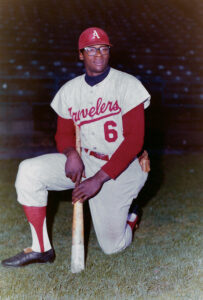
Allen played for four teams in the minor leagues, the last being the Arkansas Travelers, before his Major League Baseball debut in September 1963.
Courtesy of Richard Allen Jr.
In 1963 the Phillies promoted you to their Triple-A affiliate at Little Rock, Arkansas. There had never been an African American player there. You would be the first Black player to integrate baseball in that city. Did the Phillies prepare you for that challenge?
No, and I wish they had. It was the first season for the Phillies as the parent club — and no Blacks. I didn’t know anything about the racial tensions in Arkansas. I wish the Phillies had prepared me like the Dodgers had done with Jackie Robinson [before he broke baseball’s color barrier]. Maybe if they called me in and said something like, “Dick, we’re thinking of breaking the color line in Little Rock. It’s going to be very difficult, but we’re with you.” At least I would have been prepared. I’m not saying I would’ve liked it. But I would’ve known what to expect.
Because of the Jim Crow laws, you were not able to live in the same hotel as your teammates or eat in the same restaurants. You were also forced to endure death threats and the epithets of racist fans. Why did you stay with the team?
Where else was I going to go? I couldn’t go home. If I was looking for sympathy from my mother, I wasn’t going to get it. When I called her and told her I was thinking of leaving she said, “You listen to me, boy! God gave you a gift and a place to show it. If you don’t do that, you’re not only being disobedient to me, but you are also being disobedient to God.”
Even if I went home there was nothing there for me. I’d have to get a job like everyone else at [the] Medusa [Cement company] or Kohlman [Bottling Company] and I sure didn’t want to do that kind of work.
I couldn’t go to the Phillies, either. They thought I needed another year in the minors. If I asked for my release, where would I go? There was no free agency. The reserve clause made me their property.
Still, you did more than survive at Little Rock. That season, you hit .289 with 33 homers and 97 RBIs and were voted the team MVP by the fans. That performance earned you a September call-up to the Phillies and, eventually, a spot on the roster for the 1964 season. Considering that, what did you learn from your experience at Little Rock?
I learned two things. First, that there are one set of rules for white players and another set of rules for Black players; and second, if I ever faced discrimination again, I couldn’t count on the Phillies to support me. I’d have to handle the situation myself.
You won the Rookie of the Year award with the Phillies in 1964 when you hit .318 with 29 home runs and 91 RBIs. The Phils were also in a pennant race that year. They were in first place in the National League with 12 games left to play. Unfortunately, the team lost 10 games in a row and finished second to the St. Louis Cardinals for the pennant. What happened?
You have to tip your cap to the Cardinals. In early September they were 15 games out of first, but they never quit. They were young but they were also extremely talented with players like [Curt] Flood, [Lou] Brock, [Ken] Boyer, [Tim] McCarver and [Bill] White. [Bob] Gibson was their [pitching] ace and he was nasty. He’d throw at his mother if he had to win a game. That bunch would win the World Series that year and go back again in 1967 and ’68.
The Phillies were a young, inexperienced team, too. But there were two important differences between us and the Cardinals. First, the Cardinals got hot in the last two weeks of the season. They couldn’t lose, and we couldn’t win to save our lives. After losing seven straight [games] at home, we went to St. Louis and were swept by the Cardinals, who took over first place.
The other difference was in the managers. Johnny Keane was the Cards’ manager, and he didn’t panic. He kept his team loose. But Gene Mauch, who was our manager, wanted to win so badly that he panicked. Instead of giving [Jim] Bunning and [Chris] Short, our two best pitchers, their usual three days between starts, there were times he’d pitch them on less than two days’ rest because he wanted to clinch the pennant. He exhausted those two pitchers.
When we started to lose, Mauch became a wild man. He would close the clubhouse door and start dressing us down, throwing things around. All we really needed was for him to pat us on the fanny and say, “Thanks fellas, good effort, we’ll get ’em tomorrow.” Instead we got ranting and raving, and all that did was make us feel more tired than we already were.
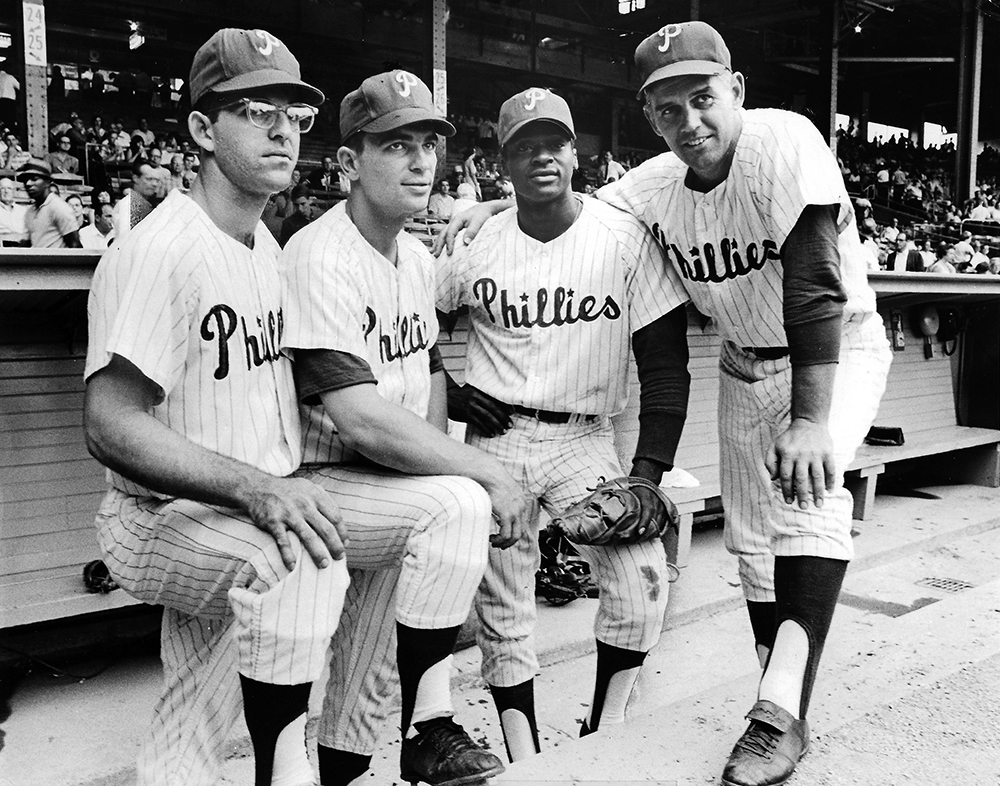
Allen in 1964 with Phillies teammates Cookie Rojas and Johnny Callison, to Allen’s left, and manager Gene Mauch, right.
Courtesy of Richard Allen Jr.
In 1965 Frank Thomas, one of your white teammates, got into a fight with you. The fight resulted in his release by the Phillies. Do you think the incident was the primary reason you were treated so poorly by the fans in the 1960s?
Look, everyone on the team knew that Frank Thomas liked to intimidate young players. But he was also brought to Philadelphia from the [New York] Mets to help us win the pennant. There was a lot of joking around between the players. But sometimes Frank crossed the line. When he started calling me “Richie X” after Malcolm X, I didn’t appreciate it. I wanted him to know that. The press made a much bigger thing out of it than it was. I didn’t want Frank to be released. But Mauch threatened to fine me if I talked to the press about it. I wasn’t given a chance to tell my side of the story.
As for Philles fans, my relationship with them changed over the years. Remember, I played in Philly at two different times. Back in the 1960s, I think I was considered a threat to the fans because I said what I thought. I wore an Afro. When they booed me, I wrote “BOO” in the dirt around first base where I played. I guess I acted like a jerk at times. But when I returned to Philadelphia in 1975, the race thing wasn’t an issue. The fans treated me well, and I loved them. In fact, I can’t remember being booed during those two years.
The Phillies traded you in 1969 to the St. Louis Cardinals for center fielder Curt Flood among other players. Flood did not want to play in Philadelphia and refused to report to the Phillies. Instead, he challenged Major League Baseball’s reserve clause that bound a player to the team that originally signed him unless he was traded or released. Flood took his case to the Supreme Court where he lost. But he opened the door for other players to become free agents, enabling them to go to another team if they were dissatisfied. Did you have any idea of the historic significance of the trade when it happened?
I had no idea what would come about. I wanted to leave Philadelphia, and Curt wanted to stay in St. Louis. That’s called “freedom”—the freedom to control your own future.
Flood had a right to challenge the reserve clause because it took that freedom away from the players. It also gave the Players’ Association the motivation they needed to pursue free agency, which they did successfully. That was a good thing for the players because it gave us the freedom to control our futures.
My hat’s off to Curt Flood because he walked away from the $90,000 the Phillies were going to pay him. It takes a real man to do that on principle.
After the Phillies traded you in 1969, you spent the 1970 season with the St. Louis Cardinals, who traded you to the Los Angeles Dodgers, where you spent the 1971 season. Then, in 1972, you were traded again, this time to the American League, here you played for the Chicago White Sox. That’s four different teams in four years. Why were you traded so often?
So many negative things were written about me as baseball’s “bad boy” during those years that I got a [bad] reputation. Once you get a rep in baseball, it’s hard to break. Truth is that I hated to play politics and I said what was on my mind. Back then you couldn’t do that in baseball.
The other thing was that the teams I played on in St. Louis, Los Angeles, and even in Chicago were loaded with kids, many of them rookies. In all three cases, those teams finished in second place because they didn’t have the veterans to put them over the top [and clinch a playoff spot]. Those teams used me not only to get to the playoffs but to teach the younger players how to win. When it didn’t happen, I was traded.
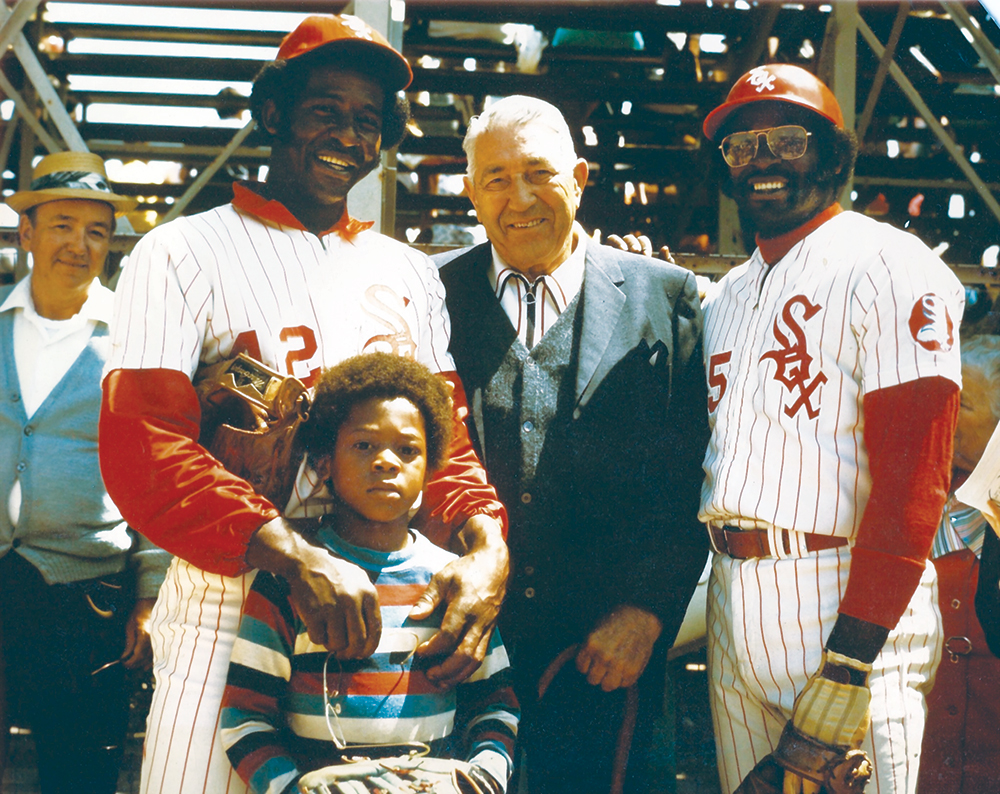
John Ogden, the Phillies scout who signed Dick Allen in 1960, stands between Hank and Dick Allen when the brothers were both playing for the Chicago White Sox, circa 1972–73.
Courtesy of Richard Allen Jr.
You seemed to resurrect your career after you were traded to the Chicago White Sox. In 1972 you won the American League’s Most Valuable Player Award for hitting .308 with 37 home runs and 113 RBIs. You were the AL home run champion in 1972 and 1974, the league’s RBI champion in 1972, and an All Star all three years you played in Chicago. Why were you able to do so well in Chicago?
You know, if I could’ve broken up that MVP trophy and given a piece to all my teammates, I would’ve done it. I loved that bunch. Besides, statistics don’t really tell the whole story. Baseball is a team sport. When we lose, we all lose. When we win, we all win. That’s why I enjoyed it. I saw the game from the inside out. I saw how all my teammates contributed when we won. For example, for me to hit a game-winning, three-run homer, two other guys had to get on base. They might’ve done that with a base hit or a walk. But if they don’t get on base, we don’t win.
The fans don’t see that. They see the game from the outside. That means they focus on the performances of individual players and are quick to give those individuals all the credit when a team does well. I can’t see that, singling out one guy. That’s not how the game works. If I wanted to blow my own horn, I would’ve played tennis or golf, sports that are for individuals.
Beside all that, I enjoyed my time in Chicago because I was with [manager] Chuck Tanner, an old friend from New Castle, [Pennsylvania]. Chuck understood me. He knew that I was tired of being moved from position to position, so he made me the regular first baseman. For the first time in three years, I wasn’t the only teacher. Chuck and I taught those kids how to play the game. Finally, the players and the fans made me feel appreciated, like I had a home in Chicago.
When you returned to Philadelphia in 1975, the Phillies had a core of talented young players like Larry Bowa, Garry Maddox, Greg Luzinski, and a future Hall of Famer, Mike Schmidt. One of the reasons the organization wanted you back was to mentor those young players, especially Schmidt, who was putting a lot of pressure on himself to please the fans. What did you do to help him?
I was 33 years old when I went back to Philadelphia. I could no longer be the power hitter I was when I was younger. I had a partial tear in my Achilles tendon, which affected my ability to hit with power. But I still had the desire to play. I also thought I could help the younger players like Schmitty and Bull [Luzinski].
Schmitty wasn’t hitting for [a high batting] average. I talked to him about swinging down on the ball instead of up like most power hitters do. He picked it up pretty quickly. The other thing was Mike’s mental approach. He analyzed everything. If he had a bad game, he’d take it home with him. The fans would get all over him. Of course, I’d been there before. The Phillies’ fans were tough on me, too. So, I’d take Mike out after a game for a couple beers and we’d talk about things, have a few laughs. I’d tell him to have fun, like he did when he was playing ball in high school. I think that helped take some of the pressure off him.
I told him that once when we were playing the Cubs at Wrigley in Chicago. He’d been pressing, and he just needed to take some of the pressure off. By golly, he went out there and hit four home runs in one game. I was proud of him. Mike was quite a ballplayer.
In 1976 the Phillies won the National League’s Eastern Division, and you finally made it to the postseason for the first time. But the Phils faced the Cincinnati Reds, winners of the NL’s West division, and lost the championship series in three straight games. What happened?
Cincinnati was called the “Big Red Machine” because of all their power hitters. Johnny Bench, Tony Perez and Joe Morgan were all [future] Hall of Famers. They also had a few other guys like Pete Rose, George Foster and Ken Griffey [Sr.] who could give you a run for your money. That gang had been together for seven years and during that time they had won four pennants and five division titles. The Reds were also the defending world champions in 1976.
All that said, the Phillies were a more complete team. We had better pitching. Two of our starting pitchers — Steve Carlton and Jim Lonborg — were former Cy Young Award winners. Defensively, we were strong up the middle with Bob Boone as our catcher, [Larry] Bowa at shortstop, [Dave] Cash at second, and Garry Maddox in center field. All those players won [the] Gold Glove. Our offense was every bit as strong as Cincinnati’s. Schmidt had won the [National League’s] home run title three years in a row. Luzinski was good for another 20 to 25 homers and had won the [National League’s] RBI title the year before. Plus, five of the eight starting players hit .280 or better.
With that kind of lineup, we matched up pretty well against the Reds heading into the playoffs. In fact, we played Cincinnati 12 times during the regular season and won eight of those games, lost only four. But we just didn’t have the playoff experience the Reds had. We were playing a lot of young guys who had never been to the postseason before. It was a best-of-five-game series, and we lost in three straight. A lot of people don’t realize how frustrating that series was for the Phillies. To this day, I still don’t think the best team won. In terms of sheer talent, we were better than the Reds that year.
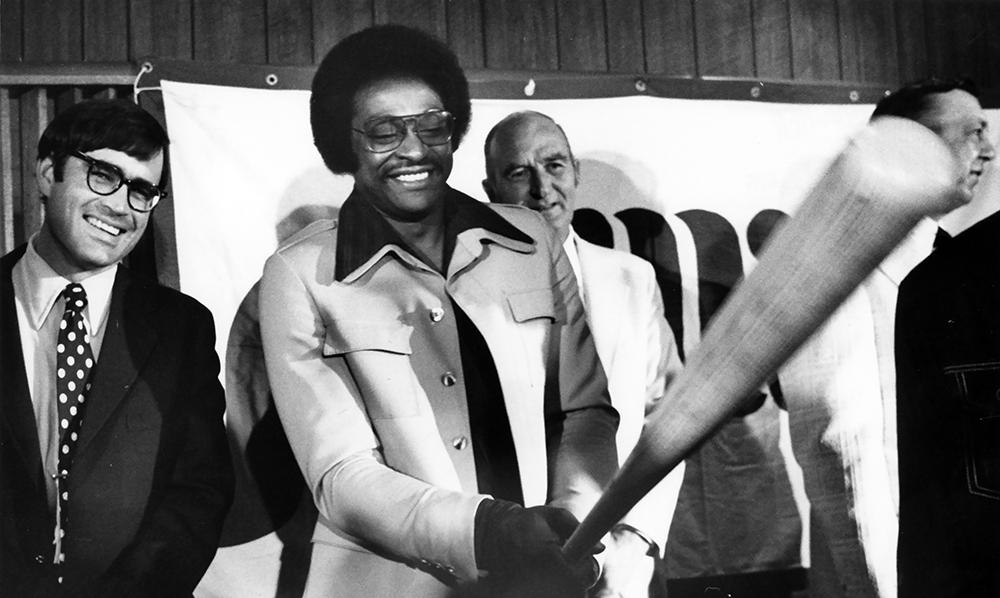
Phillies owner Ruly Carpenter, left, encouraged Allen to return to the team after Allen retired from the White Sox in 1974. This Philadelphia Evening Bulletin photograph was taken after Allen signed with the team on May 7, 1975. Longtime Phillies manager Paul Owens is behind Allen on the right.
Special Collections Research Center, Temple University Libraries, Philadelphia, PA
You’ve played several different field positions. You came up to the majors as a third baseman with the Phillies and later some outfield. But in the latter part of your career, you were a first baseman. Was there any one position you enjoyed more than the others?
No, not really. I’d play wherever they put me. But I think I would have benefitted from playing just one position. Instead, I was moved around a lot. In high school and American Legion, I was a shortstop. But when I went to the minors in 1960, I was moved to center field. Then, when I was first promoted to the majors in September 1963, Gene Mauch, the Phillies manager, came up to me and asked, “Did you ever play third base?”
“Yeah,” I said. “I played one inning at third base in high school.”
I guess that was good enough for him because he told me to grab my glove and go out there to third. For better or worse, that’s the position I played for the first three years of my major league career. It was baptism by fire. No one ever taught me how to judge the speed of a runner, or how to set my feet to make a throw. I had to learn those things on my own. But third base is where the team needed me, so that’s the position I played.
Near the end of my career, a writer for Sports Illustrated wrote that I was “all hit and no field.” That bothered me because I’ve been told by others that my career fielding percentage was .975 and if the top percentage is 1.000, I couldn’t have been that bad.
You were also known to swing a 42-ounce bat, the heaviest in the major leagues during the 1960s and 1970s. Why did you use such a heavy bat?
When I was in the minor leagues, John Ogden, the scout who signed me, sent me a box of bats. Each one of those bats was 42 ounces. They were so big and so heavy they looked like tree trunks. Most major leaguers used bats that were between 32 and 36 ounces at the time. I was using a 35-ounce bat. But Mr. Ogden felt that it was too small and too light.
Well, I began taking practice swings with those 42-ounce bats. Every afternoon I’d have the hitting coach come out and throw me batting practice for an hour and a half, and I’d swing from both sides of the plate, right-handed, then left-handed. I was still just a kid, about 19 years old. But after a while I figured out that the bat was top-heavy and that all I had to do to make solid contact was to throw the barrel of that bat out over the plate and I’d drive the ball pretty far. Plus, I had fairly large-sized hands and strong arms, and that allowed me to drive the ball even farther.
I’ve been told that I hit quite a few balls out of old Connie Mack Stadium that went 450 to 500 feet. The longest I think was 550 feet. All because of those 42-ounce bats.
Do you think you will ever be elected to the National Baseball Hall of Fame?
I have friends who’ve pleaded with me to campaign for the Hall of Fame. I’m not going to do that. I don’t believe in campaigning for myself. I got all the enjoyment from playing that God intended for me. Whatever I did on the field will stay in people’s minds and hearts for the rest of their lives.
Those folks who vote players into the Hall are nothing more than people with their own opinions and biases. Many of them have made their judgments on me without facts to back it up. I’m not going to change that. Whether I get into the Hall of Fame or not will take care of itself. I can’t concern myself with things I can’t control. I’m happy with the way my career turned out.
Further Reading
Allen, Dick, and Tim Whitaker. Crash: The Life and Times of Dick Allen. New York: Ticknor & Fields, 1989. / Bonventre, Peter. “Dick Allen: ‘Still My Own Man.’” Newsweek (August 21, 1972): 83–84. / Kashatus, William C. September Swoon: Richie Allen, the ’64 Phillies and Racial Integration. University Park, PA: Penn State Press, 2004. / —. Dick Allen: The Life and Times of a Baseball Immortal: An Illustrated History. Atglen, PA: Schiffer Books, 2017. / Leggett, William. “The Rookie from Wampum, PA.” Sports Illustrated 20, no. 16 (April 20, 1964): 28–29. / Nathanson, Mitchell. God Almighty Hisself: The Life and Legacy of Dick Allen. Philadelphia: University of Pennsylvania Press, 2016. / Westcott, Rich, and Frank Bilovsky. The Phillies Encyclopedia. 3rd ed. Philadelphia: Temple University Press, 2004. / Wolf, David. “Let’s Everybody Boo Rich Allen!” Life Magazine (August 1969): 50-53. / Wright, Craig R. “Another View of Dick Allen.” SABR Baseball Research Journal 24 (1995): 2–14.
William C. Kashatus is the author of more than two dozen books on baseball, biography and Pennsylvania history.