
Visionary Road to the Capital by David Biser
Written by Linda Ries in the Book Review category and the Summer 2024 issue Topics in this article: American Revolution, Dauphin County, David Biser, French and Indian War, Harrisburg, John Harris Jr., John Harris Sr., John Harris's Ferry, Pennsylvania State Capitol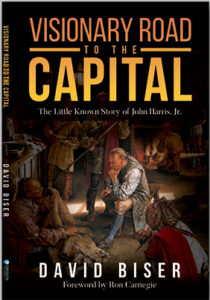 Visionary Road to the Capital
The Little Known Story of John Harris Jr.
by David Biser
Orison Publishers, 108 pages, paperback $19.95
This slender volume is a must for anyone interested in early Harrisburg and Pennsylvania’s frontier history. It is the first and only book-length biography of John Harris II (1726–91, sometimes called John Harris Jr.), the founder of Harrisburg, and has been a long time coming. Truly a “Little Known Story,” as the subtitle suggests, there is a paucity of scholarly output devoted to Harris and his father, John Harris I (1673–1748). This book is especially welcome and helps fill that gap.
Harris, who inherited his father’s lands at “Harris’ Ferry,” where Paxton Creek flows into the Susquehanna River, was a trader, frontiersman, ferry operator and agent for the Penn family, among many roles. Harris’ Ferry, or Harrisburg, as it later became known, and Harris himself, were key players for shipping goods, troops and materiel back and forth during the French and Indian War and the Revolutionary War. After the Revolution, it was Harris who put the commonwealth on the “Visionary Road” of the title by donating his own land on a rising hillock just north of his ferry as the future site for Pennsylvania’s Capitol.
For author Rev. David Biser of Harrisburg, who has been reenacting Harris around central Pennsylvania, Colonial Williamsburg and elsewhere for more than 15 years, the work is a labor of love. Using the first person, and eminently readable prose, Biser discusses his ongoing research into Harris’ life and family and draws provocative conclusions from it. The book is divided into nine short chapters that chronologically follow the city founder’s life, and it is full of facts, figures and illustrations. Especially welcome is a chapter on Harris and slavery.
We can applaud Biser for this effort, which will be used as a reference for years to come by future historians.
Linda A. Ries
Pennsylvania Historical Association