
Tun Tavern, Birthplace of the U.S. Marines
Written by Alli Davis in the Marking Time category and the Fall 2025 issue Topics in this article: breweries and brewing, Pennsylvania Historical Marker Program, Philadelphia, Society of St. George, St. Andrew’s Society, St. John’s Lodge, Tun Tavern, United States Marine Corps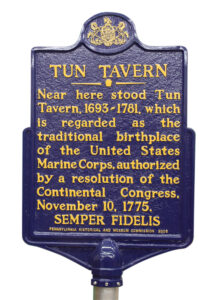 The Tun Tavern in Philadelphia is best known as the birthplace of the United States Marine Corps, but its legacy extends far beyond military history. In its prime, the tavern served as a social and political hub, hosting early meetings of several prominent organizations that still exist today. Its influence on civic and fraternal life in Colonial America is a reminder of how essential taverns once were in public life.
Built in 1686 by master brewer Joshua Carpenter at the intersection of King Street (later Water Street) and Tun Alley, the tavern likely opened in 1693 and quickly made a name for itself. Tun is an Old English word for “large cask,” especially for wine or beer. The name is fitting, as the tavern was known for serving some of the best beer in Philadelphia. In the 1730s, under proprietor Mary Campion, the tavern became noted for its good food as well. Later owners Thomas and Peg Mullan continued that legacy in the 1740s, putting on an addition to the tavern named Peggy Mullan’s Red Hot Beef Steak Club.
With its quality offerings and prime location on Carpenter’s Wharf, Tun Tavern attracted influential patrons and served as a gathering place for emerging organizations. One of the earliest was the Society of the Sons of St. George of Philadelphia (now The Society of St. George). Though the society was officially founded at Patrick Byrne’s Tavern on Front Street in 1772, there are claims that members met at Tun Tavern as early as 1720. Named for the patron saint of England, the organization modeled itself after similar groups in England and focused on supporting new English immigrants in Philadelphia.
Freemasons also held early meetings at Tun Tavern. Before the Grand Lodge of Pennsylvania was established, St. John’s Lodge No. 1 met at the tavern, with the first recorded Pennsylvania Lodge meeting taking place there in 1732. Similar to The Society of St. George, another fraternal group, the St. Andrew’s Society, was formed in 1747 to assist Scottish immigrants and likewise met at Tun Tavern.
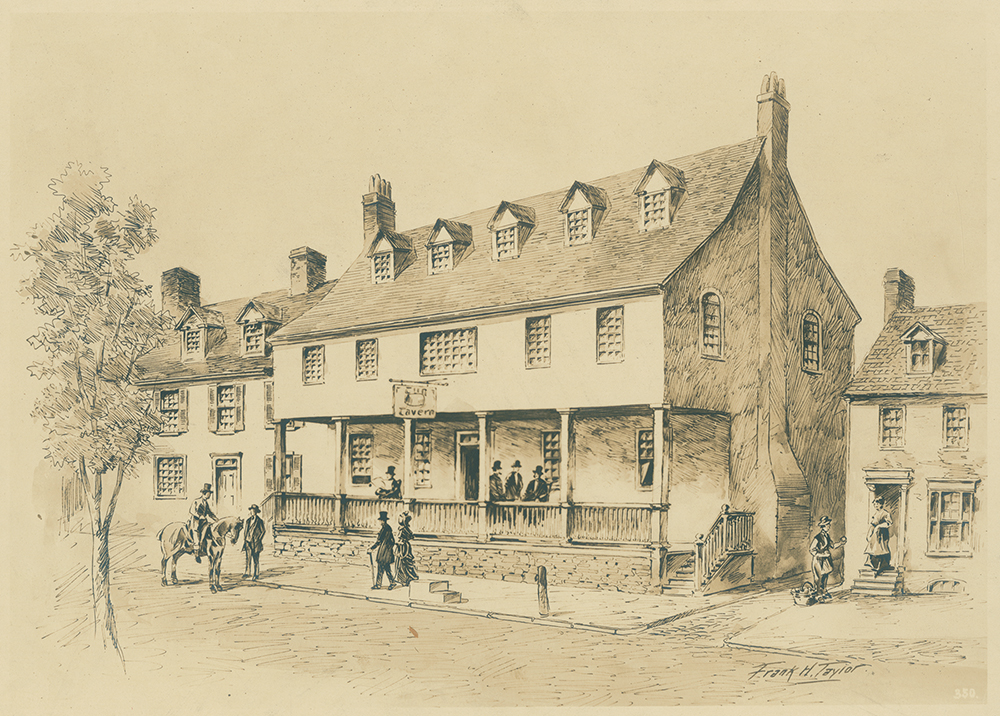
A rendition of Tun Tavern by Philadelphia artist Frank H. Taylor (1846–1927).
Library Company of Philadelphia
Most famously, the Tun Tavern is recognized as the birthplace of the United States Marine Corps. On November 10, 1775, the Second Continental Congress passed a resolution establishing the Continental Marines to serve as landing forces for the newly formed Continental Navy (whose formation committee may also have met at the Tun). The resolution stipulated “That two battalions of Marines be raised” and “that no persons be appointed to offices, or enlisted into said battalions, but such as are good seamen, or so acquainted with maritime affairs as to be able to serve by sea when required.” On November 28, Congress commissioned Capt. Samuel Nicholas as “Captain of Marines.” Robert Mullan, then managing Tun Tavern, took on the role of “chief Marine Recruiter.” Although the Continental Marines were disbanded at the end of the Revolutionary War, they were re-established on July 11, 1798. Despite the break, the Marine Corps continues to celebrate November 10, 1775, as its official birthday.
Before the end of the war, Tun Tavern fell into disrepair. In 1781 it was damaged by fire and was later razed. Today, the site of the tavern lies beneath Interstate 95, near Penn’s Landing.
The Pennsylvania Historical Marker for Tun Tavern was installed on Front Street, between Chestnut and Walnut streets, and was dedicated on November 11, 2005.
Alli Davis is the coordinator of the Pennsylvania Historical Marker Program.