
The World War One Diary & Art of Doughboy Cpl. Harold W. Pierce, edited by William J. Welch
Written by L. Isherwood in the Book Review category and the Summer 2025 issue Topics in this article: 28th Division, diaries, Harold Pierce, Meuse-Argonne Offensive, painting, United States Army, William J. Welch, World War I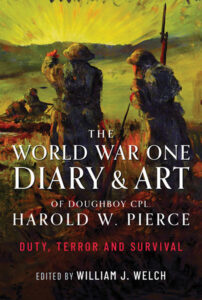 The World War One Diary & Art of Doughboy Cpl. Harold W. Pierce
Duty, Terror and Survival
edited by William J. Welch
Pen & Sword, 224 pp., hardcover $37.95
Cpl. Harold Pierce’s diary is a fascinating glimpse of army life in a combat division in the First World War. Born and raised in Pennsylvania, Pierce joined the 28th “Keystone” Division in 1917 and served through the armistice in 1918, miraculously unscathed after extensive combat. Pierce’s diary details how and why the 28th Division earned its nickname by German soldiers, “the Bloody Bucket,” for its sustained fighting at Second Marne, Fismes and Fismette, and Meuse-Argonne. In each of these battles, Pierce wrote lengthy diary entries with colorful and valuable anecdotes on his experiences. He also records in detail the more mundane aspects of army life: marching, training, and the continual search for food, wine and women (though Pierce was abstemious of the latter two) to satiate soldiers who were in the prime of life and under considerable strain and stress. Though the diary was originally serialized in The Titusville Herald in the late 1970s, this edited volume by William Welch captures the war diary in its fully realized form.
The book is a valuable contribution to the literature on American soldiers in the First World War. Rather than jotting a few reminiscences in his diary about food or the weather — as the standard Doughboy diary often did — Peirce is a vivid writer with a significant knack for detail. He is also reflective on his war experiences and is not afraid to show his emotional journey in war.
Though there is room for more commentary and annotations to help the reader, Welch’s editing places each of the chapters of Pierce’s war experiences in their proper context. He also provides many photos of the men with whom Pierce served alongside. Even better, Welch includes Pierce’s war paintings, which show his considerable talents as an artist. It is a rare enough thing to have such a vivid war diary — it is an even rarer thing to have one written by someone with as much artistic talent as Pierce.
This book is recommended for all interested in the experiences of the common soldier in the U.S. Army in World War I and, more generally, for military history readers.
I.A. Isherwood
Gettysburg College