The Skills That Built a New Nation Are Building the Next Generation: The InHarmony Initiative at Old Economy Village
Written by Heather Hicks in the Trailheads category and the Summer 2026 issue Topics in this article: Ambridge, communities, crafts, Harmonists, Old Economy Village, skilled labor, United States Semiquincentennial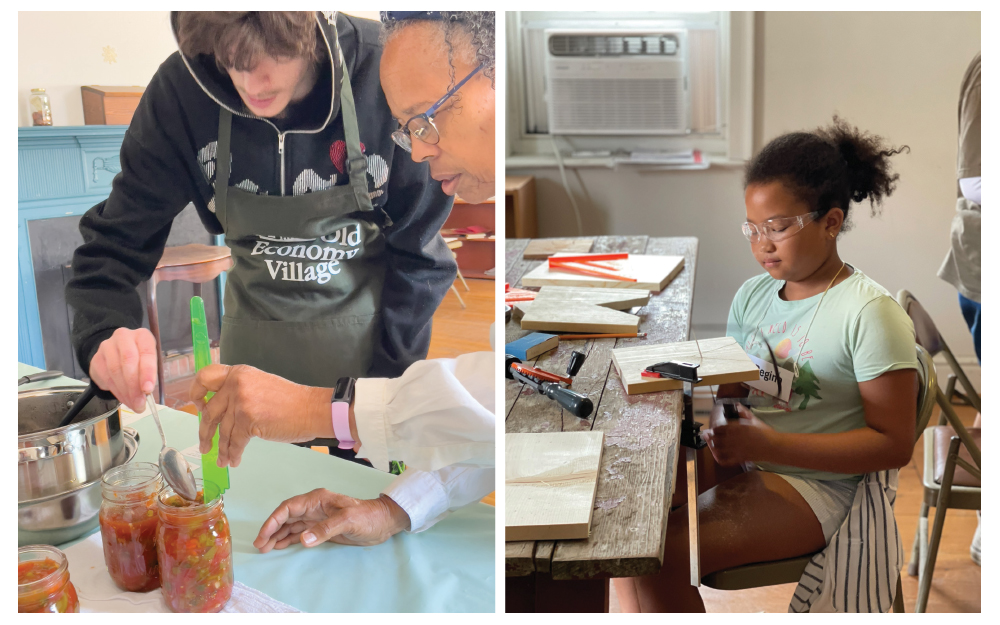
Left, A teenaged “little” from Big Brothers Big Sisters of Beaver County learns the fundamentals of food preservation by canning fresh salsa made from garden produce, discovering how self-reliance and shared knowledge once sustained entire communities. Right, At Crafting the Past summer camp, a young maker focuses on cutting with care, gaining confidence through the steady rhythm of basic hand tools and practical skill-building.
Old Economy Village, PHMC
A student runs a hand along the smooth edge of a wooden board, carefully checking for splinters before lifting it onto a workbench in the woodshop at Old Economy Village, a preserved 19th-century Harmonist settlement and National Historic Landmark in Ambridge. For many students, it is the first time they have created something tangible, something that began not on a screen but in their own hands.
Moments like this offer a window into Pennsylvania’s deeper story. At its heart, the commonwealth is shaped by makers. From blacksmiths and carpenters to printers, farmers and industrial innovators, Pennsylvania was built by people who understood that skilled labor sustains communities, drives innovation, and supports shared civic life. As the United States approaches its 250th anniversary, these foundational skills provide a powerful lens for understanding both America’s past and its future.
The InHarmony Initiative at Old Economy Village embraces this perspective by exploring how skilled labor, cooperation and shared responsibility formed early American communities and how those same principles can guide the next generation. Rooted in the legacy of the Harmonists and aligned with the goals of America 250, InHarmony positions historic trades not as relics of a pre-industrial world but as engines of innovation and industry that continue to shape civic life today.
Pennsylvania: A Commonwealth Built by Skill
From the earliest days of settlement through the American Revolution and into the rise of American industry, Pennsylvania relied on skilled labor to sustain daily life and fuel growth. Craftspeople made tools, printed ideas, built infrastructure, and maintained food systems that allowed communities, and ultimately the nation, to operate with increasing independence. In doing so, they helped shape enduring ideals of ingenuity, cooperation and shared responsibility.
Founded in 1824 by the Harmonists, Old Economy Village offers a particularly vivid example of how these principles were put into practice. The Harmonists were a German-speaking religious communal society that understood disciplined work, shared labor and collective investment as expressions of faith and as the foundation of a stable, meaningful life. Their village functioned through an integrated network of trades, including blacksmithing, woodworking, weaving, printing and agriculture, organized to meet communal needs while supporting industrial enterprises that connected the settlement to a rapidly changing nation and positioned it at the forefront of early American industrial innovation.
Within this system, work was never merely about production or profit. Purposeful labor, carried out with skill and intention, was both a spiritual discipline and a civic responsibility. Every object made, every field cultivated, and every structure raised reflected a belief that shared effort strengthened both the individual and the community.
This understanding of craftsmanship offers a broader insight into American development. Skills were passed on, adapted and refined across generations, reinforcing social bonds and mutual responsibility. Craft was not only a means of making a living; it was a way of participating in community life. Viewing work as contribution rather than consumption helps clarify how early American communities functioned and why skilled labor was so deeply entwined with civic identity.
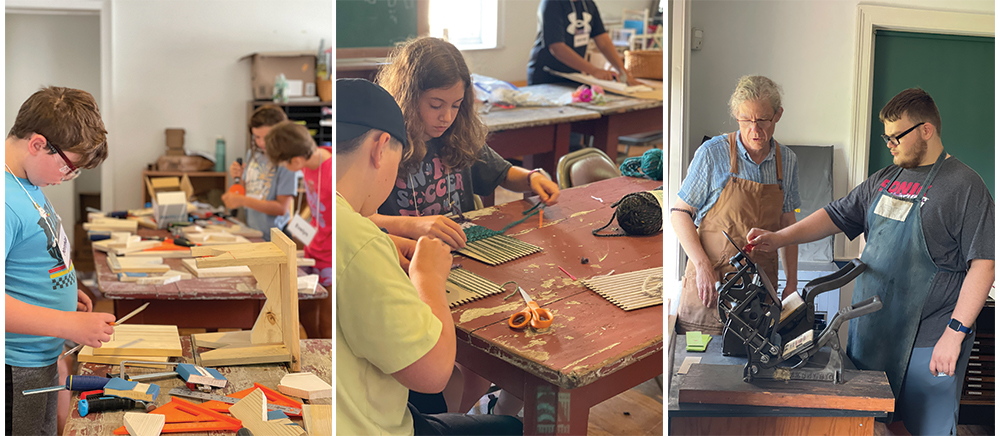
Left, In Makerspaces, students transform raw lumber into handcrafted stools, putting math, patience and teamwork into action as they bring a project to life. Center, Students weave their own water bottle carriers, learning the structure and pattern behind textile traditions while creating something both useful and uniquely their own. Right, With inked type and a careful pull of the press, a Beaver County Rehabilitation Center student experiences how craftsmanship once carried ideas across a young nation and innovation has always started with skilled hands.
Old Economy Village, PHMC
Reframing Craftsmanship for America 250
As America 250 approaches, Old Economy Village is drawing on this legacy to reframe how craftsmanship is interpreted and experienced. The InHarmony Initiative is Old Economy Village’s workforce and civic learning platform, using historic trades to connect youth and families with hands-on skill development, industry awareness and civic engagement.
Rather than operating as a single program, InHarmony brings together a set of complementary learning experiences, including Crafting the Past summer camps; a series of trade-focused America 250 Industry Days that spotlight traditional and modern trades through demonstrations, hands-on activities, and conversations with today’s skilled professionals; and opportunities for students to explore pathways connected to skilled trades. These offerings invite students, families and visitors to explore how cooperation, creativity and skilled labor have long played a central role in American life.
Within these experiences, participants work with traditional tools, materials and practices while developing skills that remain relevant today, such as problem-solving, collaboration and systems thinking. Each program is anchored by a guiding question: How does a community meet its needs responsibly? As participants build, weave or cultivate, they begin to see how individual skills connect to larger systems of production, care and shared effort. History becomes something engaged through action, rather than observed at a distance.
In this way, InHarmony reflects a central America 250 theme: Innovation grows from tradition, and the skills that built the nation continue to shape its future.
Craft as a Civic Act
One of the core ideas behind InHarmony is that craftsmanship is a civic act. In early American communities, skilled labor supported infrastructure, communication, food security and environmental stewardship. These were not individual pursuits but collective endeavors that required trust, cooperation and shared responsibility.
InHarmony invites participants to reflect on how these values persist today. Whether through making, building, growing or preserving, students and visitors are encouraged to consider how their own skills contribute to community well-being. Citizenship is framed not only as a legal or political status but also as active participation in sustaining shared systems.
This perspective resonates strongly in the context of America 250, which calls for inclusive narratives that recognize the many forms of labor, often overlooked, that built and sustained the nation. By centering craftsmanship, InHarmony highlights the contributions of artisans, farmers, printers and makers whose work formed the backbone of American life.
Activating History for the Next 250 Years
As Pennsylvania plays a leading role in commemorating America’s 250th anniversary, the InHarmony Initiative offers a model for connecting commemoration with action. It reminds us that America’s story is not written solely in founding documents or milestone anniversaries but in the hands of those who make, build, grow and care for one another.
By treating craftsmanship as civic life, Old Economy Village ensures that the values of skill, cooperation and ingenuity remain active forces in shaping the future. InHarmony does not simply preserve the past, it activates it, passing on the tools, knowledge and spirit that sustain communities across generations.
As America marks 250 years, InHarmony poses a forward-looking question: How will the values that built the nation continue to guide it? At Old Economy Village, the answer is found in the enduring power of craft, not only as a skill but also as a shared civic practice.
By celebrating craftsmanship as civic life, Old Economy Village honors its past while inviting educators, families and communities to imagine that the next 250 years might be built with one skill, one idea, one community at a time.
To explore upcoming America 250 Industry Days, youth programs, and hands-on learning opportunities through the InHarmony Initiative, visit Old Economy Village at oldeconomyvillage.org.
Heather Hicks is site administrator at Old Economy Village.