
The Nile Swim Club of Yeadon
Written by Alli Davis in the Marking Time category and the Summer 2023 issue Topics in this article: African Americans, Nile Swim Club, swimming, Yeadon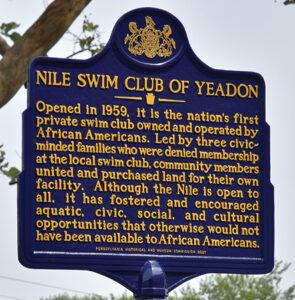 As the summer heat starts to buzz, many folks flock to their local swimming pool to cool off, relax, exercise and socialize. Many childhood memories are formed at the pool through swimming lessons, games and friendships. This opportunity, however, was not always available for African Americans. Segregated public pools of the past have had a lasting impact on the Black community. According to a recent study by the USA Swimming Foundation, 64 percent of African American children are unable to swim compared to 40 percent for white children. A study by the Centers for Disease Control and Prevention has revealed that African American children are six times more likely to drown in a pool than white children. For more than 60 years, the Nile Swim Club, the nation’s first private swimming pool owned and operated by African Americans, has overcome racial barriers to serve the Yeadon community and provide positive swimming experiences for African American families.
In the Great Migration, which began around 1910 and lasted through the 1960s, 6 million African Americans left the South for Northern cities to seek better economic opportunities and escape racial violence and oppressive Jim Crow laws that upheld segregation and discrimination. Many of the migrants, however, would experience similar treatment in the North, despite laws prohibiting it. In Pennsylvania, an equal rights bill was passed in 1935 that imposed fines or imprisonment on any “owner, lessee, proprietor, manager, superintendent, agent or employee” of “places of public accommodation, resort, or amusement” who refused service based on “race, creed, or color.” But in many instances, this law was not strictly enforced. In the 1950s swimming pools became one of the arenas where such discrimination and segregation would be contested.
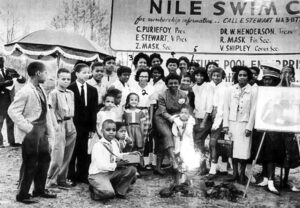
The groundbreaking ceremony for the Nile Swim Club, May 1959.
Courtesy of Nile Swim Club
The 1920s and ’30s saw a building boom of public pools in urban areas, predominantly for white American and immigrant communities, with little or no funding for Black communities. By the post–World War II period, during the massive migration of white people from urban areas to racially homogeneous suburbs, many communities opened private swim clubs to create exclusive access through membership fees and applications. Frequently, this meant Black applicants were denied membership without legitimate reasons. This is what happened in 1957 to Zoe Mask, Carson Puriefoy and Elmer Stewart when they applied for family memberships to the Yeadon Swim Club.
After Mask, Puriefoy and Stewart dropped off their applications, Puriefoy wanted to add something more to his form and went back to retrieve it. He discovered that the three applications had already been discarded without review. The families decided to direct that frustration into something constructive that would benefit the Black community in Yeadon. They would open their own private swim club, one that would not deny membership based on color, race or creed.
In 1958 the families created a nonprofit corporation, naming it the Nile Swim Club to harken back to African heritage along the Nile River. This was the first Black-owned, administered, managed and staffed swim club in the region. By early 1959 the club acquired 4.8 acres of land in what is now Yeadon Community Park, and in May they celebrated the official groundbreaking.
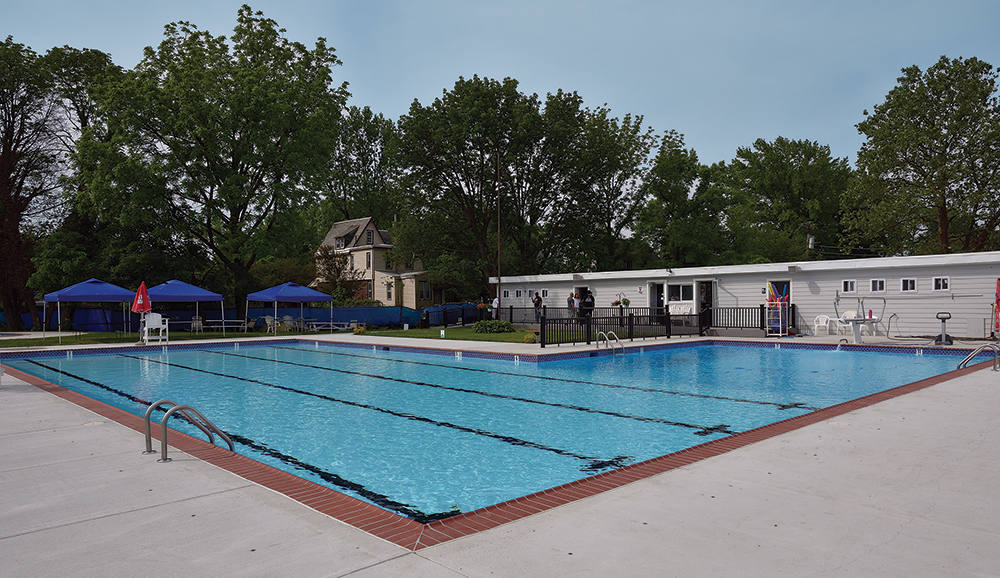
The swimming pool at Nile Swim Club, Yeadon, Pennsylvania.
Photo, Pennsylvania Historical & Museum Commission
The club built an L-shaped pool to Olympic specifications for swimming and diving and a circular wading pool for children. Today, Nile Swim Club offers swimming lessons, splash parties, basketball, tennis, aquatic fitness and other activities.
The Pennsylvania Historical Marker for the Nile Swim Club of Yeadon was dedicated on May 22, 2021. It is located at 513 South Union Avenue in Yeadon on the lawn of the club.
Alli Davis is the coordinator of the Pennsylvania Historical Marker Program.