
The Hanna’s Town Resolves
Written by Brady Crytzer in the Features category and the Spring 2025 issue Topics in this article: American Revolution, Hanna’s Town Resolves, Intolerable Acts, John Carnaghan's Battalion, John Proctor Battalion, King George III, Scots Irish, Westmoreland County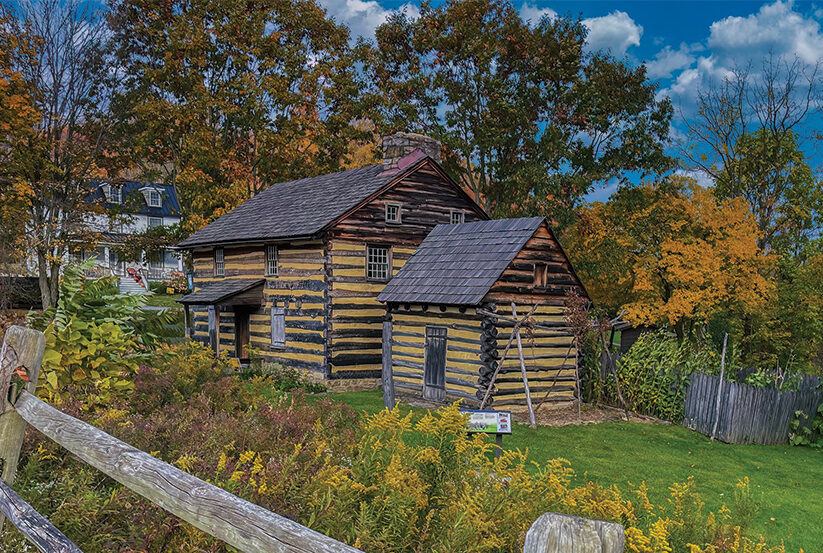
Hanna’s Tavern was reconstructed at Historic Hanna’s Town to commemorate the location where community leaders convened to adopt the Hanna’s Town Resolves on May 16, 1775.
Westmoreland Historical Society / Photo by Anna Jo Noviello
On May 16, 1775, the citizens of Pennsylvania’s Westmoreland County gathered at Hanna’s Town to draft a series of resolutions condemning the actions of Parliament and to organize themselves into an armed militia. The resulting 755-word document, known as the Hanna’s Town Resolves, challenged the scope of British authority and took the western backcountry one step closer to revolution. Signed 14 months before the Declaration of Independence, the Hanna’s Town Resolves reinforced values of freedom, self-reliance and constitutional rights.
In the wake of the shocking Battles of Lexington and Concord, fought on April 19, 1775, the people of Westmoreland County produced a highly organized and thoughtful response to the growing unrest witnessed in Massachusetts. In their minds, British authorities showed an increasing disdain for the colonists’ fundamental rights. Without swift action, it appeared that the political unrest in North
America would only escalate. In their estimation, the American colonies were in immediate danger, as Parliament had “attempted to reduce the said inhabitants to a more wretched state of slavery than ever before existed in any state or country.”
The signing of the Hanna’s Town Resolves was a watershed moment that revealed a newfound solidarity between eastern and western Americans in the face of a looming political crisis. Despite being separated by hundreds of miles, western Pennsylvanians stood beside their fallen countrymen in Massachusetts. The document declared that Parliament’s actions were unlawful, and that it was “the indispensable
duty of every American, of every man who has any public virtue or love for his country . . . to resist and oppose the execution of it; that for us we will be ready to oppose it with our lives and fortunes.”
A New Home
Founded by Scots Irish immigrant Robert Hanna in 1773, Hanna’s Town was a unique community on the western frontier. The Scots Irish experience in western Pennsylvania was one of new beginnings; these settlers were a hardy, self-reliant people with a profound devotion to their community and their faith. Disenfranchised in Europe and often marginalized along the Eastern Seaboard, these Irish Presbyterians found a home on the frontier and sought to make it a space of their own.
Like many Scots Irish communities in the west, Hanna’s Town was free from the yoke of landlordism and aristocracy. It wasa settlement where the dream of property ownership prevailed and individual rights were held sacred. Due to its proximity to the 1758 Forbes Road, Robert Hanna’s village quickly gained fame. By 1775 it was the seat of the newly formed Westmoreland County, and it hosted the first British-style court west of the Appalachian Mountains.
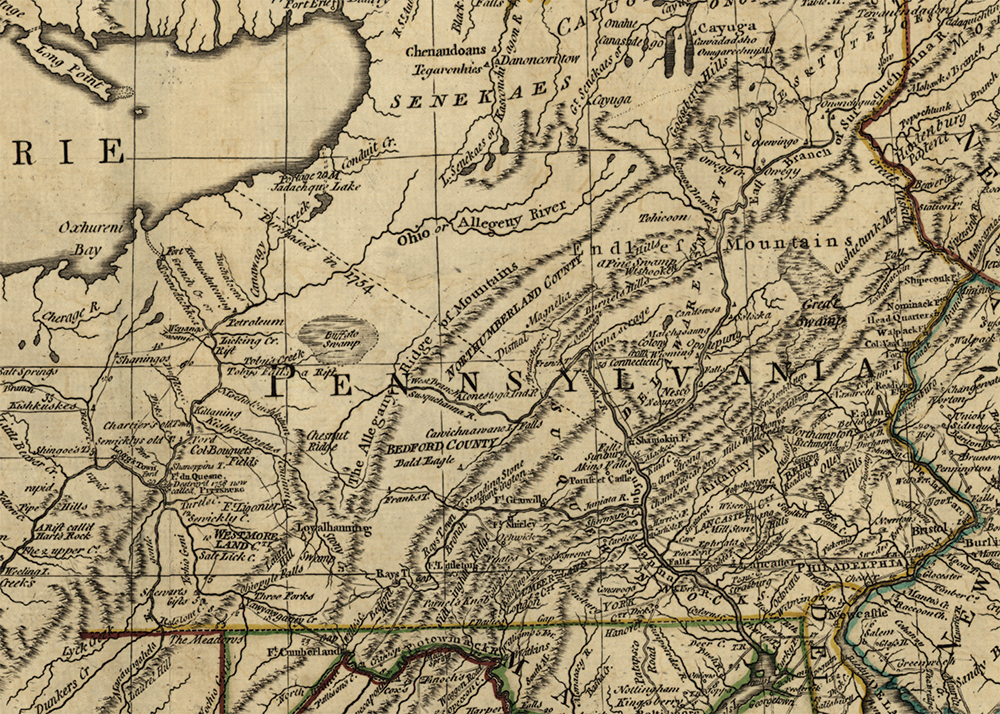
Westmoreland County appears on this detail of Pennsylvania from the larger Map of the Middle British Colonies in America, printed in London in 1776.
Library of Congress Geography and Map Division
Hanna’s Town was a Pennsylvania settlement in the truest sense. As part of William Penn’s original proprietary vision, the colony upheld religious freedoms and enabled political expression. Pittsburgh, its chief rival, sat 30 miles west. In 1775 Pittsburgh was still claimed by Virginia, and it adopted many of the Old Dominion’s cultural values. The community at the Forks of the Ohio was a regimented military city at its heart, and it possessed a blended, cosmopolitan atmosphere. Hanna’s Town on the other hand was homogenous and fiercely independent.
As part of the Scots Irish tradition, residents settled their disputes “in house” and managed their economic, religious and personal disputes in a communal fashion. Situated in the heart of the town, Robert Hanna’s Tavern became the primary meeting place for the community and was the center of public life in Westmoreland County. When news of Lexington and Concord finally reached the west, an urgent meeting was called at Hanna’s rough-hewn log cabin.
“a corrupted Parliament”
Although the impetus for the convention at Robert Hanna’s Tavern was the Battles of Lexington and Concord, the spirit of the meeting was truly defined “by several late acts” passed by Parliament. In early 1774, the British government passed a series of reforms labeled as the Coercive Acts, designed to rein in the rebellious tendencies of the colony of Massachusetts.
Among the most contentious of these actions was the closure of Boston Harbor, a draconian reconfiguration of Massachusetts’ governmental structure and a new regulation of judicial procedure. Officially called the Administration of Justice Act, the new law stipulated that British officials could be tried in other portions of the empire for criminal offenses committed in the colonies, especially if a fair trial could not be provided. American colonists viewed this as a fundamental violation of their civil rights, and George Washington famously denounced the law as “the Murder Act.”
In America, the Coercive Acts were dubbed “the Intolerable Acts,” and the residents of Westmoreland County believed that they set a dangerous precedent. In Hanna’s Town, they declared that “there is no reason to doubt that the same system of tyranny and oppression will (should it meet with success in Massachusetts Bay) be extended to every other part of America.”
As Concord proved, the westerners believed that an organized militia force was essential to protect their sacred liberties. In only the second paragraph of the Hanna’s Town Resolves, its signatories affirmed that
“we will immediately form ourselves into a military body, to consist of companies to be made up out of the several townships under the following association, which is declared to be the Association of Westmoreland County.”
From this pronouncement came two battalions, one under the command of Sheriff John Proctor and the other under John Carnaghan. Although Carnaghan’s regimental flag is lost, Proctor’s flag survives and is on display at Fort Pitt Museum. Classified as a Red Ensign and adorned with a rattlesnake, reading “DON’T TREAD ON ME,” it remains the oldest rattlesnake flag still in existence.
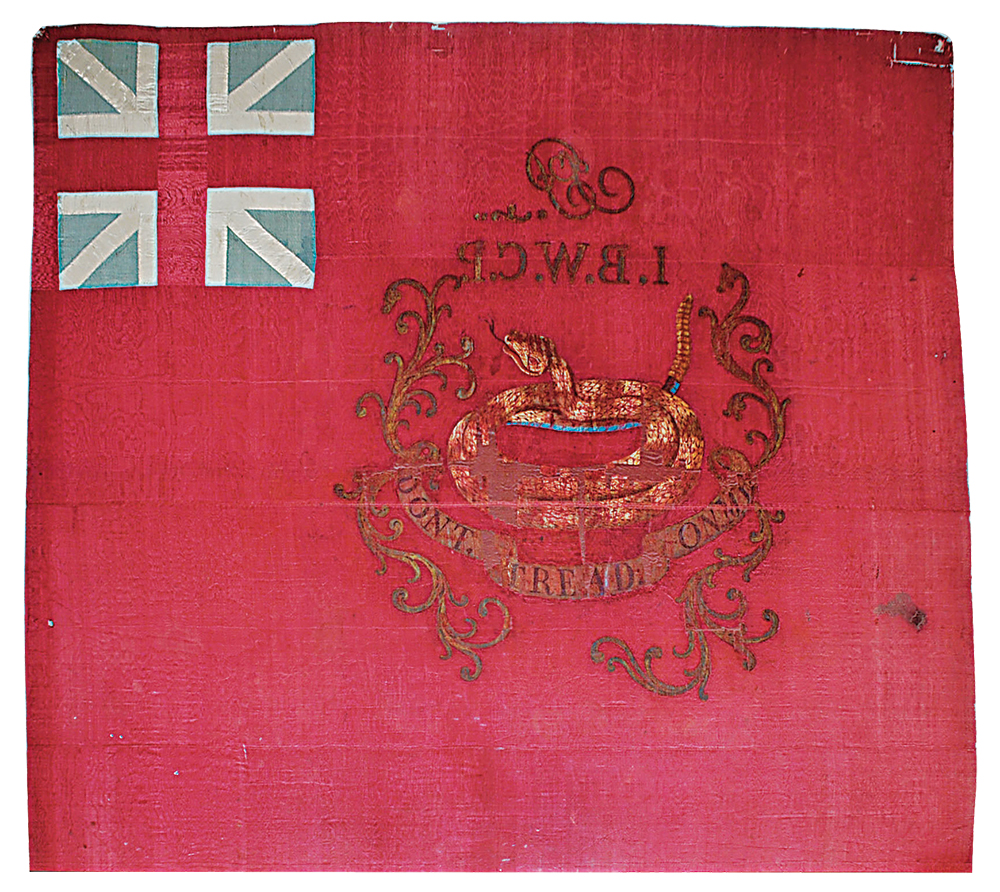
The flag of Col. John Proctor’s 1st Battalion of Westmoreland County is a Red Ensign that includes the British Union Jack in the upper left corner and a rattlesnake with the motto “DONT. TREAD. ON. ME” in the center.
Fort Pitt Museum, PHMC
In the formative years of the American Revolution, the colonies found themselves divided between their love of country and a distinctive disdain for the British Parliament. Since the end of the Seven Years’
War, colonists decried taxes and regulations imposed upon them by the overseas legislature as a violation of their rights. As Americans, they could only vote for local representation in their respective colonial government and had no means of influencing the outcome of Parliamentary elections held in Great Britain. As a result, the tumult of the Revolutionary Era could be best viewed as a resistance to Parliament’s legislative agenda, not against the empire itself.
It was argued that King George III was the only person who had incentive to nurture the entire British world, and that members of Parliament only served the narrow voting districts of their constituents at home. To bring order to the king’s domain, Patriots clamored for him to exercise his royal veto and serve as a much needed check on the actions of a legislature that overstepped its bounds. Although it seems paradoxical, the first decade of the Revolutionary Era was largely a pro-Royalist movement, and those sentiments were felt strongly in western Pennsylvania.
The Hanna’s Town Resolves blamed “a wicked Ministry and a corrupted Parliament” for the late unrest and plainly supported the Monarchy. Westmoreland County possessed an “unshaken loyalty and fidelity to His Majesty, King George the Third, whom we acknowledge to be our lawful and rightful King, and who we wish may long be the beloved sovereign of a free and happy people throughout the whole British Empire; we declare to the world, that we do not mean by this Association to deviate from that loyalty which we hold in our bounded duty to observe.”
With their loyalty to the king affirmed, the frontiersmen of western Pennsylvania offered stern warnings to the members of Parliament who remained committed to further provocation. In the first official resolution of the document, they stated that Westmoreland County planned “To arm and form ourselves into a regiment or regiments and choose officers to command us in such proportions as shall be thought necessary.”
In the second, they raised the stakes even further, promising to “make ourselves masters of the manual exercise” and to “meet at such times and places as shall be appointed either for the companies or the regiment, by the officers commanding each when chosen.”
Although these actions appeared to be rebellious in nature, such martial organizations were common practice throughout the Colonial Period. The organization and maintenance of a militia force was not only encouraged but expected. As a means of self-defense, such actions were essential components of frontier life in the British Empire. Normally utilized to combat the ubiquitous threat of Native American
raids, the existence of a militia itself was not a problem for British officials.
The third resolution, however, offered a chilling response to recent military developments in the east. “That should our country be invaded by a foreign enemy,” it read, “or should troops be sent from Great
Britain to enforce the late arbitrary acts of its Parliament, we will cheerfully submit to military discipline, and to the utmost of our power resist and oppose them, or either of them, and will coincide with any plan
that may be formed for the defense of America in general, or Pennsylvania in particular.”
Although the document was unprecedented in Colonial America’s western frontier, it was far from revolutionary. Throughout the text, Westmoreland County officials prefaced their threats with pledges of allegiance and fealty to the Crown. The resolutions offered direct warnings to Parliament regarding further provocation, but their overall message was clear. If circumstances reverted to pre-1764 conditions, the frontier would happily remain as loyal British subjects. “We do not wish or desire any innovations,” the Resolves stated, “but only that things may be restored to, and go on in the same way as before the era of the Stamp Act, when Boston grew great, and America was happy. As a proof of this disposition, we will quietly submit to the laws by which we have been accustomed to be governed before that period.”
Although the Hanna’s Town Resolves and Declaration of Independence are often compared to one another, a quick study readily separates them. Often touted as a direct challenge to imperial authority, the Hanna’s Town Resolves were noncommittal at best. When Thomas Jefferson penned his famed document in 1776, his language was intentional, announcing complete separation from the British Empire. No less passionate, the Hanna’s Town Resolves offered a critical caveat in its fifth resolution
that the Declaration did not: a path to reconciliation. It conceded that “when the British Parliament shall have repealed their late obnoxious statutes, and shall recede from their claim to tax us, and make laws
for us in every instance; or when some general plan of union and reconciliation has been formed and accepted by America, this our Association shall be dissolved.”
Whereas the Declaration of Independence announced an irrevocable split from the British Empire, the Hanna’s Town Resolves did quite the opposite. While the Declaration severed relations with Great Britain, the people of Westmoreland County actively sought a resolution to the impending crisis in North America.
“Dear and Sacred Amongst Men”
The Hanna’s Town Resolves were published in the Pennsylvania Gazette in August 1775. Although it cannot be said for certain, the burning of Hanna’s Town on July 13, 1782, likely destroyed the original document.
Despite being among the most critical moments in the history of the western frontier, the names of the document’s signatories have been lost, and only their words remain. Lack of attribution aside, the Hanna’s Town Resolves leave an undeniable legacy. The resolutions formally codified the political position of Westmoreland County in 1775, as being of neither rebellion nor separation. Instead, its signers demanded a simple recognition of their previously established rights. The formation of a militia, the act of self-defense, and the right to express their grievances were all considered to be “dear and sacred amongst men,” and the resolves signed on May 16, 1775, reinforced those values.
Brady J. Crytzer teaches history at Robert Morris University. The author of eight books, he is an editor for the Journal of the American Revolution and the winner of the 2023 Judge Robert K. Woltz History Award. His work has been featured in The Wall Street Journal, The Washington Post, USA Today, and SiriusXM. His new book, The National Road: George Washington, Albert Gallatin, Henry Clay, and America’s First Way West, will be released in 2026.