
The First Frame of Government: Penn’s Democratic Experiment
Written by Richard Saylor in the Our Documentary Heritage category and the Summer 2023 issue Topics in this article: First Frame of Government, Pennsylvania General Assembly, Pennsylvania Provincial Council, Pennsylvania State Archives, Quakers, William Penn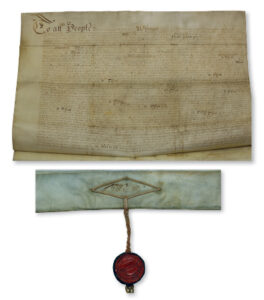 The First Frame of Government was William Penn’s charter to the colonists of Pennsylvania, issued in England on April 25, 1682, and bearing Penn’s personal seal and signature. As a Quaker, Penn intended to establish religious toleration and political freedom in the colony that had been granted to him in 1681 by England’s King Charles II. The document has been considered an original and innovative move in the development of democracy in America.
The political philosophy espoused in the preface to the First Frame of Government has often been quoted and applauded: “Any government is free to the people under it where the laws rule, and the people are a party to those laws, and more than this is tyranny, oligarchy, or confusion.”
The frame created a government for Pennsylvania that granted the people limited power through two legislative bodies, both popularly elected by the colonists. The Provincial Council, a 72-member upper house, could propose legislation but only in the presence of the governor, Penn himself. The 200-member lower house, the General Assembly, had a more limited role; they were authorized to meet for only nine days each year, debate only the legislation proposed by the upper house, and vote on the final day of the session. They were not permitted, however, to make changes to any proposed legislation. The frame also gave the governor three votes in the Council and veto power in the legislative process.
The General Assembly found the plan unworkable and rejected it in December 1682. The First Frame, though, was a bold experiment by Penn, whom Thomas Jefferson later called “the greatest lawgiver the world has produced.”
Three more frames of government were created for Pennsylvania during the Colonial Era. The second frame was written and signed by Penn and was approved by the General Assembly in April 1683. It was considered more practical than the first frame because the number of Council members was reduced to 18, three for each of the six counties of Pennsylvania, and the Assembly went from 200 to 72. Also, the governor’s voting power in Council was abolished. The Frame of 1683 served as Pennsylvania’s constitution until 1696, when a third frame was adopted.
The Frame of 1696 was written by Penn’s deputy governor, William Markham, while Penn was back in England settling a border dispute. It was passed by the Assembly in November 1696 but was never approved by Penn. This frame gave the Assembly equal power with the Council in initiating bills. It also included provisions that allowed more small farmers the right to vote, while limiting the franchise of propertyless city dwellers. When Penn arrived in Pennsylvania for the second time in 1699, he immediately repudiated Markham’s Frame.
In October 1701, before Penn left for England again to defend his proprietorship, he signed a fourth frame of government, the Charter of Privileges. In this frame, the governor was prohibited from using his public office to interfere in property matters. It also increased the power of the General Assembly, making it the only legislative body. The Charter of Privileges functioned as Pennsylvania’s constitution for the next 75 years. In 1776 the Pennsylvania Constitution superseded it as the fundamental governing document for the commonwealth.
In the 1920s the Philadelphia Public Ledger raised funds to purchase the First Frame of Government for approximately $25,000 from rare document dealer Gabriel Wells, who had previously acquired it at auction. It was then donated to the Commonwealth of Pennsylvania and has been cared for ever since by the Pennsylvania State Archives (RG-26).
Richard C. Saylor is an archivist for the Pennsylvania State Archives and author of the award-winning book Soldiers to Governors and numerous articles on military, political and sports history.