
The First Baptist Church of Germantown
Written by Elizabeth Rairigh in the A Place in Time category and the Summer 2024 issue Topics in this article: African Americans, First Baptist Church of Germantown, Great Migration (African American), Greek Revival, National Register of Historic Places, Philadelphia, Samuel Sloan, Wissahickon schist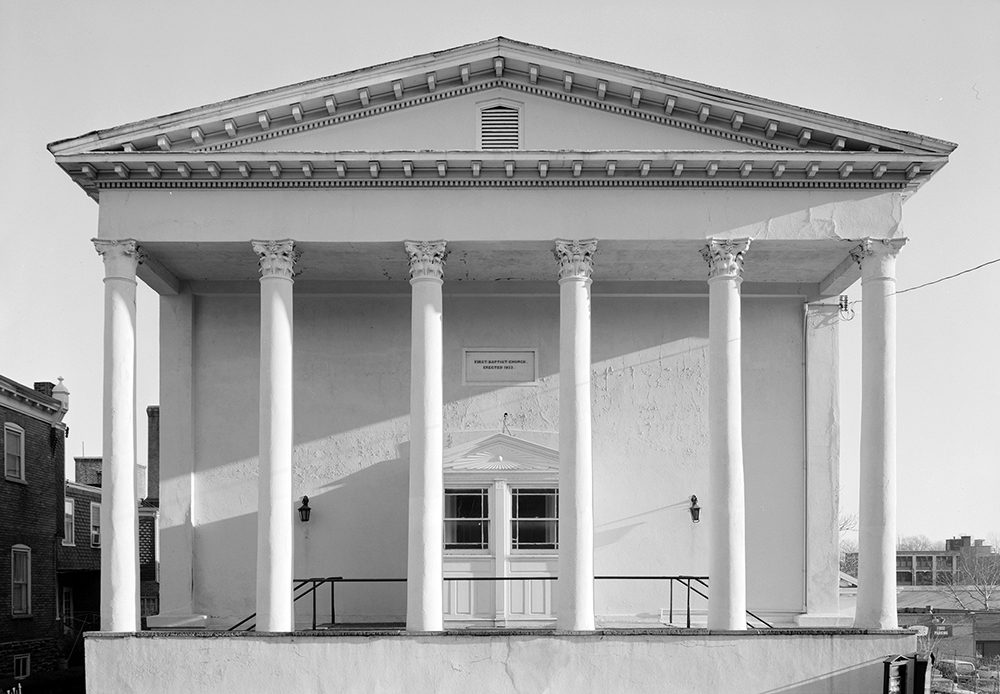
The First Baptist Church of Germantown in Philadelphia was documented and photographed by the Historic American Buildings Survey in the mid-20th century.
Library of Congress, Prints and Photographs Division
The First Baptist Church of Germantown, now operating as the Polite Temple Baptist Church, at 40 East Price Street in the Germantown neighborhood of Philadelphia, was listed in the National Register of Historic Places on August 21, 2023, for the significance of its social and ethnic history and its architecture.
The Greek Revival building was designed in 1852 by Philadelphia architect Samuel Sloan (1815–84), who was also the author of popular architecture books. His bestselling, two-volume architectural pattern book, The Model Architect (1852), features the design of the First Baptist Church in its second volume.
Sloan’s trademark use of substitute materials for cost-effective but high-style architecture is at play in this building. Styled like a Greek temple, the church is constructed of Wissahickon schist rubble, locally quarried from the Wissahickon Formation, coated in stucco and embellished with a combination of wood and terra-cotta. The exterior is fronted by a portico strengthened by six Corinthian columns with terra-cotta capitals, representing one of the oldest surviving uses of the fired earthenware for architectural ornament in the United States.
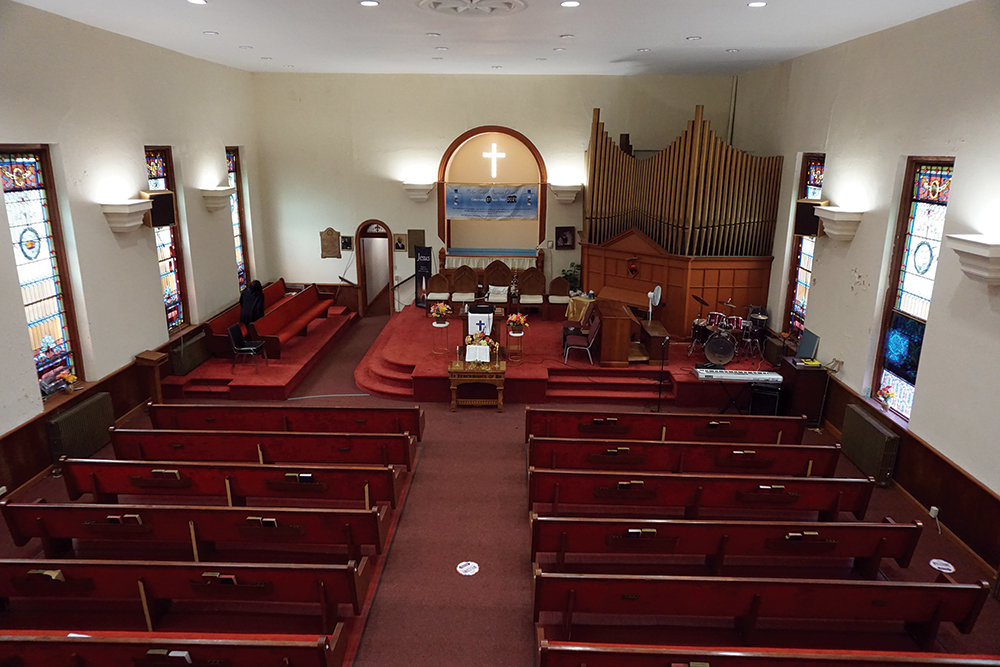
The sanctuary of the First Baptist Church is rectangular, true to the design of a Greek temple, as opposed to churches in Gothic and Romanesque styles that include a transept that shapes the sanctuary into the form of a cross.
Photo, Pennsylvania State Historic Preservation Office
The church’s history exemplifies the social and economic changes that took place in the Germantown community in the 20th century and, by extension, the transformation of the larger American society of the era. Between 1910 and 1970, during the Great Migration, more than 6 million African Americans from the rural South moved to urban areas of the North. In Germantown in the 1950s, Black southerners moving into the area, along with the exodus of the white middle class to the suburbs, resulted in a population change to 80 percent African American by 1980.
The Black Baptist congregation that purchased the church had formed in 1940 under the leadership of Rev. Collins Nichols Polite, who became the church’s namesake. As the congregation expanded, they moved through a series of larger buildings in the area to accommodate their growth as a result of the second wave of the Great Migration. In 1955 the congregation bought the First Baptist Church, renaming it Polite Temple Baptist Church, where they continue to worship today.
Recent listings in the National Register of Historic Places include Bath Crossroads Historic District, Northampton County; William and Elisabeth Edwards House, Spartansburg, Crawford County; Historic Moravian Bethlehem Historic District, Northampton County; Nineteenth Street Theater, Allentown, Lehigh County; Pringle Electrical Manufacturing Co. Building, Philadelphia; and Zembo Shrine, Harrisburg, Dauphin County.
Elizabeth Rairigh is the division chief for Preservation Services and the National Register coordinator in the Pennsylvania State Historic Preservation Office.