
The Early Days of Penn State
Written by Pamela Reilly in the Wish You Were Here category and the Fall 2023 issue Topics in this article: agriculture, Centre County, Evan Pugh, Farmers’ High School Historic District, Frederick Watts, James Irvin, Pennsylvania State Agricultural Society, Pennsylvania State University (Penn State)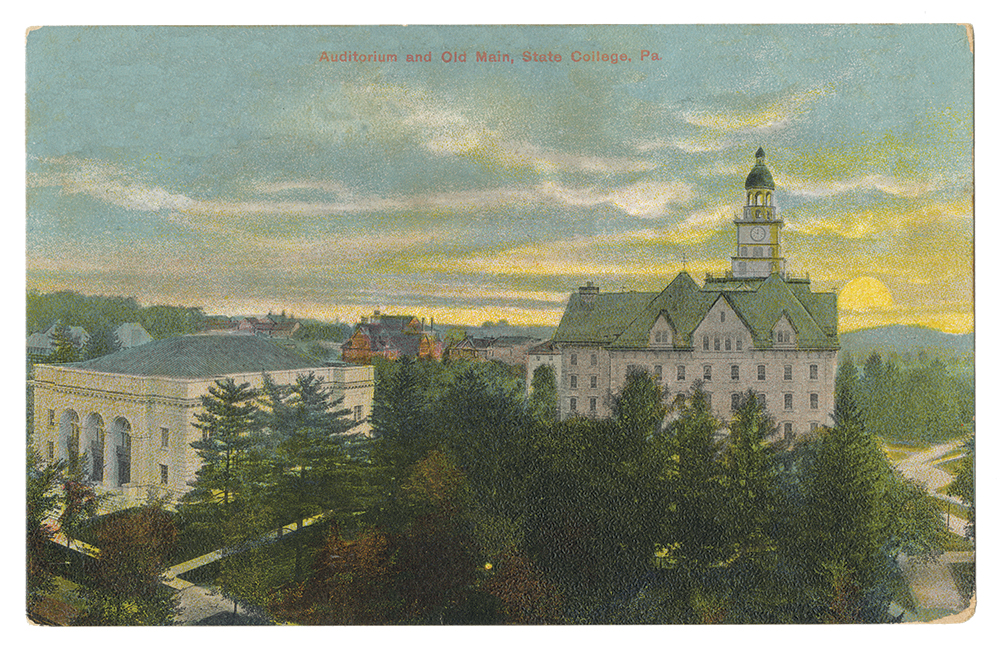
Pennsylvania State University (Penn State) was chartered by the commonwealth in 1855 to serve as the first agricultural college in America. Originally called the Farmers’ High School, it was endorsed by the State Agricultural Society, a group formed in 1851 to promote the economic, political and social interests of Pennsylvania farmers, led by Frederick Watts.
The name Farmers’ High School was chosen to counter the assumption that only classical subjects were taught in pursuit of a baccalaureate degree. The charter required 13 trustees to explore locations for the new college along with the governor, James Pollock.
Ironmaster James Irvin offered 200 acres of land near his iron furnace in Centre County and an additional 200 acres of adjoining land available for rent. After debate and consideration of other sites, the trustees agreed to accept Irvin’s offer, despite criticism of the remote location. The setting was defended as having advantageous soil, a healthful climate, and a central location in the state. The citizens of Centre and Huntingdon counties pledged to raise $10,000 in support of the college.
Classes did not commence until 1859, with the first ones held in a newly built barn designed by Watts. Construction of the first Old Main building began in 1856 with a state appropriation of $25,000. It contained offices, classrooms, a chapel, and dormitory rooms for students and instructors. The college farm and campus were laid out and planted by Centre County horticulturalist William G. Waring, who served as the superintendent of buildings and grounds.
Evan Pugh, a native of Chester County and expert in the science of agriculture, was hired as the first college president and developed a four-year curriculum. The first class of 11 students graduated in 1861, each earing a Bachelor of Scientific Agriculture degree, the first of its kind in the United States. In 1862 the name of the school was changed to the Agricultural College of Pennsylvania.
Despite the ongoing Civil War, the college grew under Pugh’s leadership with enrollment reaching 146 in 1864, making it the largest agricultural institution in the nation. Pugh, Watts and the college trustees successfully lobbied for the passage of the Morrill Land-Grant College Act, signed into law by President Abraham Lincoln in 1862, establishing an endowment for at least one college in each state that taught both agriculture and mechanical arts/engineering. With such secure funding, the future of the college seemed assured in 1863, when it was designated as the state’s sole land-grant institution. Shortly thereafter, the name was changed to Pennsylvania State College (retained until 1953, when it became Pennsylvania State University), reflecting its wider role in education. In 1871 it was among the first land-grant colleges to admit women to degree programs.
In 1887, under the guidance of college president George Atherton, a new wave of building construction and curriculum expansion occurred and continued throughout the early 20th century. Classroom buildings, Greek fraternity houses, the University Club, and the Nittany Lion Inn were added, and a campus plan was developed to landscape the grounds and guide future growth.
The postcard, top, shows the Auditorium, built in 1903 to serve as a chapel with funds donated by Bethlehem Steel tycoon Charles Schwab, and the original 1856 Old Main building, which was replaced with the current Old Main, below, in 1929, when the earlier structure was deemed derelict and in need of expensive repairs.
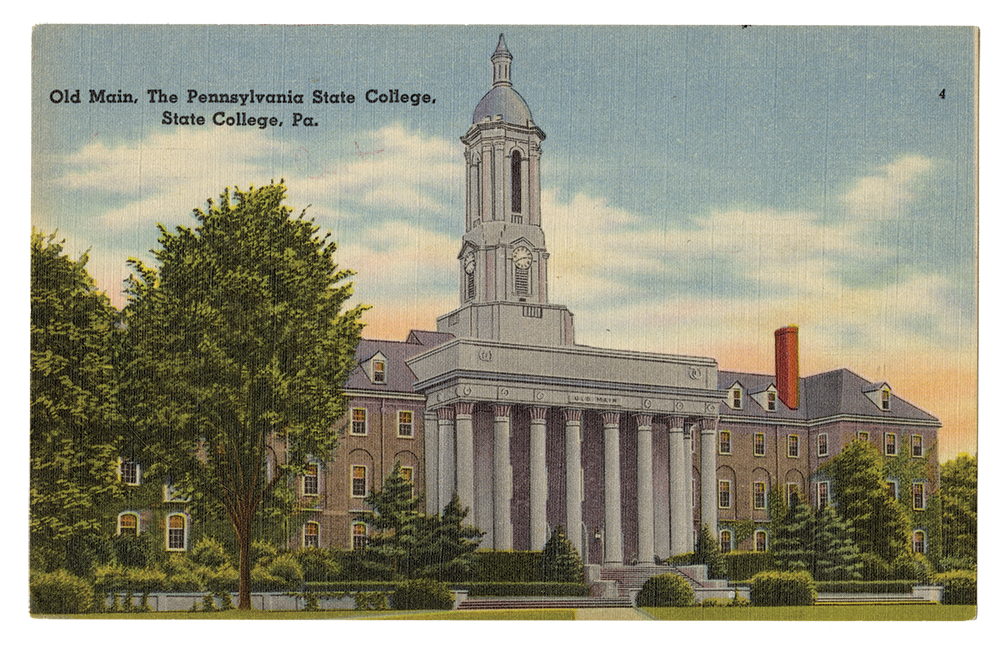
The 1929 Old Main is an iconic Classical Revival–style limestone building with eight massive stone pillars facing the landscaped lawn. It was designed by Charles Klauder (1872–1938), a prominent Philadelphia architect whose career included many university commissions. The tower clock, a gift from the Class of 1904, was retained from the original Old Main and was reinstalled, preserving the beloved campus landmark. The Farmers’ High School Historic District was listed in the National Register of Historic Places in 1981 for its significance in education, architecture and agriculture. A Pennsylvania Historical Marker, dedicated in 1947, commemorates the history of the university.
Pamela W. Reilly is a historic preservation specialist in the Pennsylvania State Historic Preservation Office.
Sidebar: State Archives’ Postcard Collection Now Online
On May 9, 2023, the Pennsylvania State Archives completed a large-scale, in-house digitization project to provide online access to its collection of 23,260 postcards (MG-213) from the 1880s to the 1970s. Printed in color or black and white, the often-rectangular postcard images depict buildings and streetscapes, businesses and industries, parks and scenic views from all 67 counties in Pennsylvania, encapsulating the history of the commonwealth.
Archivists and support staff have been digitizing the remarkable collection of postcards since 2017. Robust metadata was captured and entered to provide optimal search and description. Information such as unique identifying titles, indexed subject terms, postcard size, and other technical details assist patrons looking for granular information. The entire postcard collection can be viewed at phmc.info/PostCards.
Suzanne Stasiulatis and Megan Rentschler
Pennsylvania State Archives