
The Bicentennial Raft
Written by Richard Saylor in the Our Documentary Heritage category and the Summer 2026 issue Topics in this article: American Revolution, Bicentennial Raft, Clinton County, Lock Haven, logging, Pennsylvania State Archives, Renovo, Susquehanna River, United States Bicentennial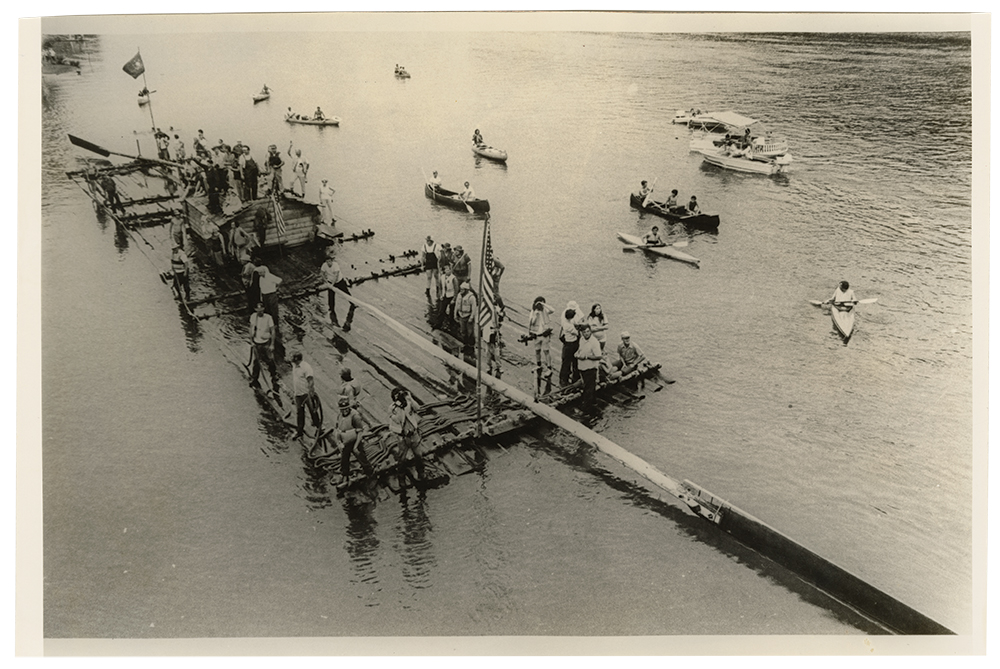
In concurrence with the national Bicentennial events of 1976, Pennsylvania counties and local municipalities also staged celebrations for the nation’s birth. Smaller events such as parades, picnics and performances were frequently held throughout the state during the year. One unusual event held in the north-central part of the commonwealth was the Bicentennial Raft project.
After the Revolutionary War, logging became one of the first large industries in Pennsylvania. The Bicentennial Raft paid tribute to the commonwealth’s history of transporting timber by raft to established markets further south on the Susquehanna River. Before the luxury of a robust railroad or automotive highway system, Pennsylvania’s enormous wilderness forests were cut and taken to markets in the southern part of the state using the world’s oldest means of transportation, the river system. The era of floating rafts down the West Branch of the Susquehanna ran from 1837 to 1917, with the peak occurring between 1850 to 1890. It is estimated that close to 3,000 rafts were floated to market each year during this period. Most of the logs in the rafts were white pine with some oak included.
In the spring of 1975, Ron Cole of Lock Haven first approached James Maguire of McElhattan with the idea of building and floating a full-scale log raft down the West Branch of the Susquehanna during the Bicentennial year. They presented their plan to the Clinton County Bicentennial Commission, which happily accepted the rafting project as a Clinton County Bicentennial Event. Maguire, owner of an automated sawmill called Wood Chips Inc., paid for the entire project and donated the use of his company’s logging equipment.
The log raft was constructed at Miller’s Landing in Clearfield County, 3 miles upstream from Karthaus on the West Branch. Initial construction of materials for the raft began in January 1976 and the process ran until March 6. It was assembled over the weekend of March 20–21. The raft was made of 45 white pine and hemlock timbers that were squared using chainsaws. When assembled, the raft was 27 feet wide by 116 feet long, weighing 80 tons. It was held together with wooden bows, pins and lash poles.
A 5.5-foot flood stage was needed to launch the raft and begin its trip down river. For the next three months, the average river stage was only 2.4 feet. When the raft was finally launched on June 22 at 1:24 p.m. it moved low in the river with only a few inches of timber above the river’s surface. It was navigated with a front and rear oar by an all-volunteer crew.
The raft made three stops on its trip. The first one was at Keating after floating 25.5 miles on June 22, another at Renovo on June 23 after another 13 miles, and the final one at Lock Haven on June 24 after 24.5 miles. It took three days and a total of 63 miles to complete the journey. The trip was successful with the raft and its 22 crew members arriving safely in Lock Haven at about 4:45 p.m. The raft remained in Lock Haven as part of the city’s Bicentennial celebration.
Thousands of people observed the raft trip in person while others watched film footage taken by Penn State University’s WPSX-TV (now WPSU). The raft was finally taken apart by James Maguire’s lumber company in October 1976. Most of its timbers were cut at his sawmill in Lizardville for various lumber products.
Materials on the Bicentennial Raft are located at the Pennsylvania State Archives in Record Groups 6.52 and 6.55.
Richard C. Saylor is an archivist for the Pennsylvania State Archives and author of the award-winning book Soldiers to Governors and numerous articles on military, political and sports history.