
The Battle of Lancaster Station: How a Civic Squabble Turned into a David and Goliath Standoff
Written by Dan Cupper in the Features category and the Summer 2023 issue Topics in this article: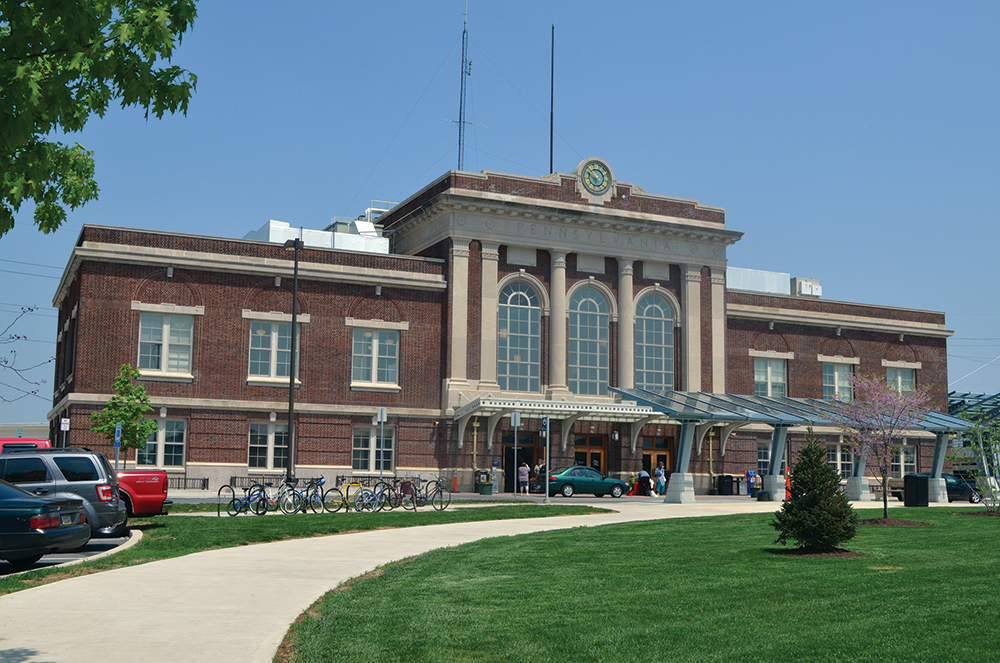
A $17 million facelift gave the 1929 Lancaster station and its entrance driveway a fresh look in 2013.
Photo, Dan Cupper
For 30 years, from the 1890s to the 1920s, the citizens of Lancaster, Pennsylvania, fought bitterly over the need for a new train station and where to locate it.
The New York–Chicago main line of the Pennsylvania Railroad (PRR) ran in a more or less direct line from Philadelphia to Harrisburg — except for a looping 2½-mile-long diversion through downtown Lancaster that the townspeople had demanded in the 1830s when the state built its Philadelphia & Columbia Railroad (P&C), an ancestor of PRR. Over time, Lancaster citizens became obsessed with what to do about that loop and its increasingly outmoded depot.
The P&C, too, had wanted a straightline route that avoided going through city streets with all the congestion and delays that meant, but it bowed to public pressure — and to cold, hard cash.
Nineteenth-century American history is filled with stories of outposts that grew into thriving cities because a railroad laid its tracks there, linking it to the outside world via passenger trains for business and personal travel, freight trains for industrial development, and mail trains for that all-important means of communication, the postal system. Bypassed villages stagnated, or they died.
Amid the great railroad-building fever of that day, bankers, industrialists and civic leaders often tried to induce major trunk-line railroads to literally put them on their maps. They raised money, they subscribed to buy stock, and they donated land for right of way and stations. Towns that failed to attract the big railroads usually didn’t give up, chartering their own shortline railroads with local money to build connections to the nearest main line. If they couldn’t have a main line, at least they could enjoy some of the spillover benefits of linking to it.
Raising Money
Lancaster citizens raised $60,000 to induce the state to divert the P&C’s straight-line route southward into the city, fearing that they’d be left behind commercially, industrially and socially. And so, from the partial opening of the P&C through Lancaster in April 1834, trains ran through downtown streets.
Six months later, the P&C held a formal celebration signaling the completion of the railroad. “A run of one hour brought the trains [from Columbia] to Lancaster at 9 o’clock,” wrote William Bender Wilson in his 1899 History of the Pennsylvania Railroad Company. “They were received by a large and enthusiastic concourse of people, who had assembled in North Queen, Chestnut, Market, and Prince streets, from town and country. . . . As the trains passed triumphantly over the line, they were greeted with one continuous ovation from the people, who left their work afield in shop, house and barn to witness the completion of the revolution in transportation.”
And it was a revolution. A cross-state trip by wagon took two to three weeks. Trains, linked with state-owned canals, cut the transit to three and a half days.
The period of state control didn’t last long. In 1857 PRR took over the former P&C. Three years later, the company built a new station at Queen and Chestnut streets. It was acclaimed to be so ideal in design that it was considered as a model for a proposed station in the nation’s capital.
Philadelphia-based PRR wasted no time in integrating the P&C into its grander plan to reach eastward to New York, northward to Buffalo and Erie, southward to Baltimore and Washington, and westward to the promised land of the Midwest—Cleveland, Cincinnati, Indianapolis, Louisville, and the biggest prizes of all, Chicago and St. Louis.
In 1849 the fledgling PRR had opened for business with 61 miles of track from Harrisburg to Lewistown. Growing by mergers and acquisitions, the carrier expanded to 5,800 miles by 1873 and to almost 9,000 miles by the 1890s.
By that time, Lancaster had grown, and so had the railroad’s business. A PRR report showed that in August 1882, trains carrying 77,330 freight cars, or 2,577 a day, passed the yards at Columbia. Faced with ever-growing freight and passenger traffic and the threat of slowdowns from congestion, PRR later that year laid an arrow-straight northern bypass across Lancaster County’s Manheim Township.
Called the “Lancaster Cutoff,” or just the “Cutoff,” it passed a mile north of the city’s station. It was intended to keep the flow of business moving. All the railroad’s important through freights—carrying high-value merchandise and perishables, such as meats, fruit and vegetables in newly improved refrigerator cars—began to take the new shortcut. So did its fastest, most prestigious named passenger trains.
Off the Beaten Path
The original looping downtown line was demoted to a secondary line, and its wellworn station might as well have been a flagstop. An 1892 editorial in The Morning News called it a “dingy shed.” Riders from Philadelphia, it said, would “pass along through Bryn Mawr, Wayne, Villa Nova, Rosemont and . . . dozens of other architectural gems, [and] will very properly say that the stations along the Pennsylvania are the prettiest and most convenient in the world. . . . But when their train pulls into the Lancaster depot, they’ll look around and ask each other what jerkwater railroad they’ve been switched off onto, anyhow.”
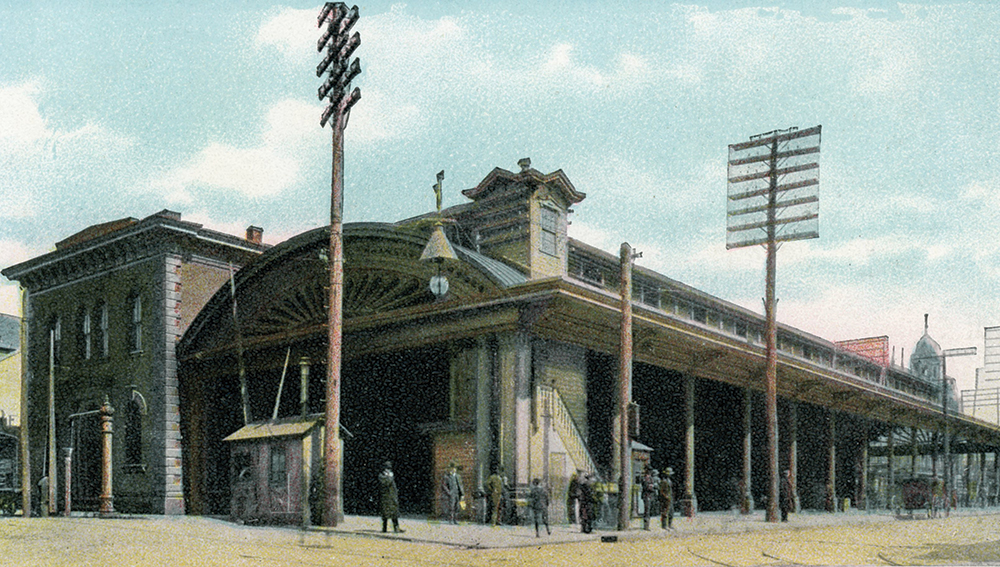
A pre-1906 postcard depicts the 1860 Pennsylvania Railroad station and trainshed at Queen and Chestnut streets in Lancaster.
Collection of Dan Cupper
Two months later, The Lancaster Intelligencer chimed in: “Lancaster wants a new Pennsylvania passenger station, which is what everyone says. It is too evident to be denied.”
Once the Cutoff was opened, the city line got the leftovers—lesser passenger runs and local way freights. Although some long-distance trains still called at the downtown depot, they became fewer in number as time went on. Many travelers, for example, found that they had to take a local train to Harrisburg and change to the prestigious long-haul flyers that no longer stopped in Lancaster, as they were all now routed via the Cutoff.
All the first-class trains sailed right on by, including the New York & Chicago Limited, the Pennsylvania Special, the Pennsylvania Limited, the Chicago Special, the Pittsburgh Day Express, the Manhattan Limited, the Iron City Express and, later, the Broadway Limited.
In the meantime, the trains that did stop in Lancaster blocked increasingly busy city streets at several grade crossings. Always a nuisance, they now posed a safety hazard, too. Although guarded by watchmen, they became frequent scenes of accidents and close calls. City population was growing and along with it an expanding network of trolley cars to nearby neighborhoods and towns. And of course, automobile use was on the upswing, too.
Location is Everything
By 1900 community leaders were desperately aware that they needed a new station, but where? PRR management made its position clear. It would gladly build a new station, but not in the crowded city, only out on the Cutoff. Citizens, civic leaders and business interests grew deeply divided.
Although only 10 blocks from downtown, the Cutoff ran through then-rural Manheim Township, not the city, and therefore, to some, might as well have been on the moon. It would be not only an inconvenience but also a hardship, they said, to force city residents to travel out of the city to catch a train.
Again and again, city leaders appointed delegations to go to PRR’s Philadelphia Broad Street Station headquarters to plead for a new depot. Each time, PRR officials took the same stance: “Tell us what the community wants. If you want to keep the downtown location, we’re fine with that, but we’re not investing money there. We can promise a new station, but only on the Cutoff.”
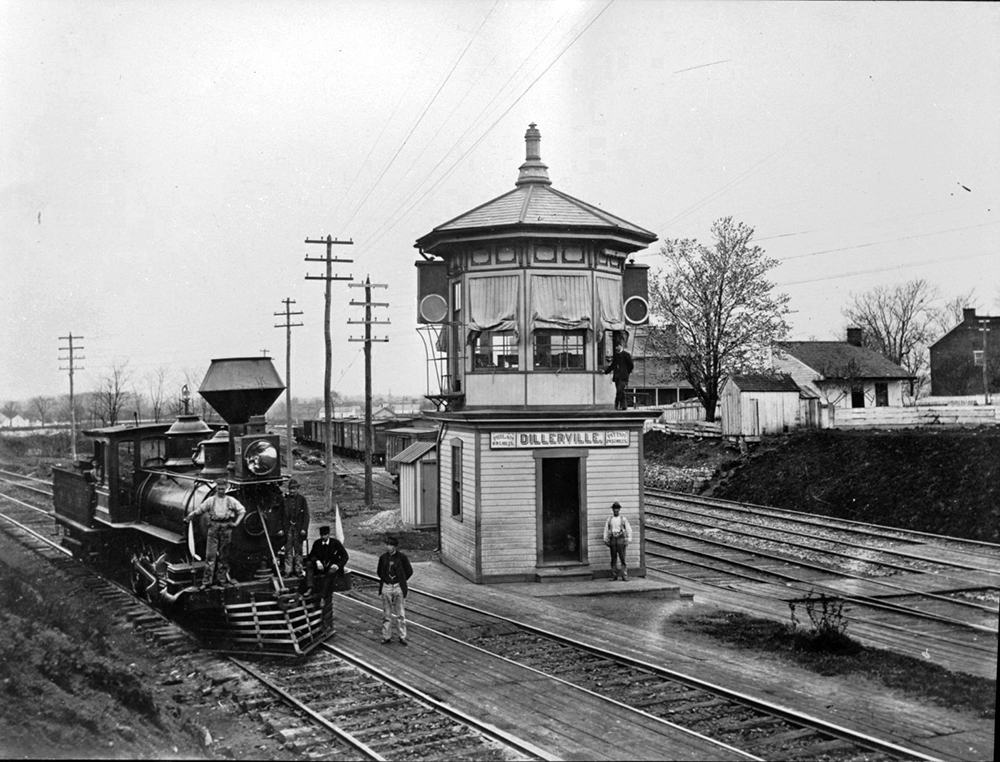
Dillerville Tower, where operators in a classic Pennsylvania Railroad octagonal-topped switch tower kept movement flowing smoothly at the junction of the straight-line Cutoff and the original 1834 main line through downtown Lancaster. The engine appears to be PRR No. 113, a Class H1 2-8-0-type freight locomotive, one of a fleet of 545 such locomotives. Built in 1875, it was scrapped in 1890.
Courtesy of LancasterHistory, Lancaster, Pennsylvania
By this point, the railroad’s 11,000-mile network linked 13 states, so it was serving thousands of on-line stations and communities, each with a depot. But with Lancaster being only 60 miles from PRR headquarters, and with many railroad officials having been from Lancaster or worked there, it was never far from officials’ minds. For example, Lancaster native William Henry Brown served as PRR’s chief engineer from 1881 to his retirement in 1906, and he was succeeded by Alexander C. Shand (1858–1930), a brother of James Shand, founder of Lancaster’s Watt & Shand department store.
Decade after decade, the impasse persisted, frustrating several mayoral administrations and successive leaders of city council, merchants, the Board of Trade (later, Chamber of Commerce), and industrialists. These parties were not always on the same page. Those who sought the growth of industry, employment and tax base pointed out that prospective new businesses turned their nose up at the idea of locating in a town with poor passenger-train service and an eyesore for a station. Sentimentalists favored keeping the downtown site, reminding all about the city’s $60,000 investment made nearly a century earlier.
Some in the business world sought a compromise, asking PRR to put a small flag-stop station on the Cutoff in addition to continuing the downtown station. Nothing doing, PRR said: If we’re going to build out there, it’ll be a completely new station to replace the 1860 depot.
The debate reached a peak in 1916 with heated mass public meetings, outraged newspaper editorials, editorial cartoons mocking PRR, and . . . no action for another decade.
New Stations Elsewhere
Meanwhile, the Golden Age of railroading was in full swing. Hopelessly divided Lancastrians could only watch as PRR built new stations around the state and elsewhere: Philadelphia (1881), Harrisburg (1887), Jersey City, New Jersey (1891), Pittsburgh (1901), Washington, D.C. (1907), Wilmington, Delaware (1908), New York City (1910), and Baltimore (1911).
Closer to home, Atglen, Conewago, East Earl, Gap, Gordonville, Hempfield, New Holland, Mount Joy, Pomeroy and Ronks had already seen new PRR stations go up in the 1880s and 1890s, as did Christiana in 1900, Middletown in 1903, Rheems in 1908, and Elizabethtown in 1915. Moreover, on the cargo-handling side of the business, PRR was spending $19 million to build a new “low-grade” double-track freight-only line across southern Lancaster County, opened in 1906, part of a grand strategy to speed east-west freight movement while freeing up overburdened passenger lines.
Thus, Lancaster was surrounded by PRR construction projects on every side. It was painfully clear: The wealthy Pennsy was spending millions of dollars everywhere except Lancaster.
In 1907 the other railroad in town, the Philadelphia & Reading, had opened a new brick station at Prince and Frederick streets. But on the Reading, Lancaster was at the stub end of a meandering, single-track rural branch, the complete opposite of the steel boulevard represented by the four-track, high-speed PRR main line that connected eight of the 10 largest cities in America.
If you took the Reading, your destinations were largely limited to Columbia, Manheim, Lititz, Ephrata, Reading, Pottsville, Shamokin and, only in a roundabout way, Philadelphia. PRR took you directly to not only bustling Philadelphia but also to New York, Chicago, St. Louis, Baltimore and Washington.
A Change of Strategy
As the teens turned into the 1920s, area population continued to grow. The fight over a downtown depot site faded away. It became clearer than ever that a location on the Cutoff was the only answer. Now it was time for civic leaders to pivot their strategy, concentrating their campaign on calling the Pennsy’s bluff, demanding that it make good on its decades of promises.
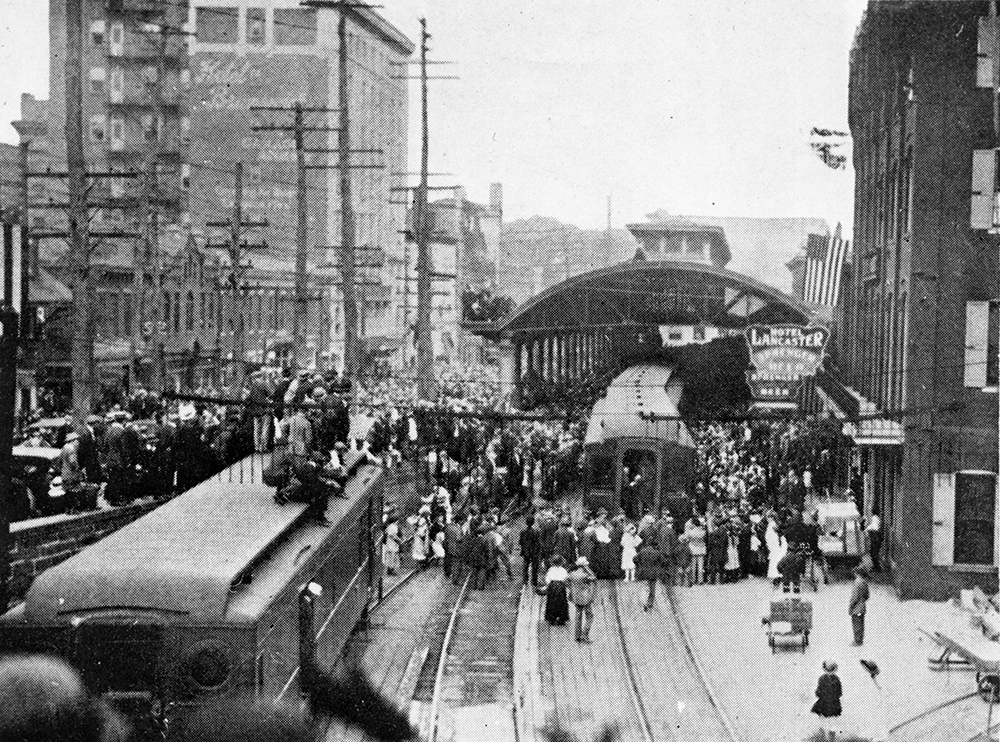
On May 25, 1918, hundreds of draftees marched from City Hall and the Lancaster County Courthouse to the station, surrounded by thousands of well-wishers. In all, 367 men from the city and county boarded a westbound train for Fort Meade, Maryland, departing about 10 a.m. en route to military training for World War I.
Courtesy of LancasterHistory, Lancaster, Pennsylvania
And that would prove to be more difficult than they imagined. PRR executives, while feigning sympathy, didn’t share the city’s sense of urgency.
Meanwhile, pressure was mounting. Trolley lines now reached in all directions to connect with mushrooming suburbs and nearby towns such as Columbia, Elizabethtown, Manheim, Ephrata and Strasburg. On city streets, automobiles and filling stations had replaced horse-drawn wagons and stables.
A 1920 timetable shows that a dozen trains each way stopped at the old station every weekday, but none of them was a featured express “name” train. Plenty of local trains originated or terminated at the old station, but these were all-stops milk runs that plodded along to Philadelphia or Harrisburg via the main line or via branches to Columbia, Quarryville or New Holland. Equipped with day coaches but no diners, sleepers, buffet cars, lounge cars or observation cars like those on the luxury flyers, they were unlikely to attract either leisure or business travelers.
Day and night, as 50 trains rolled through the city every 24 hours, the noise from whistles and engine boiler safety valves popping off woke both sleeping residents and scores of hotel patrons such as traveling salespeople. Locomotive engineers and firemen were trained to tend the fires in their steam engines in such a way as to avoid making black smoke. But it was unavoidable at times, often depending on the quality of coal being burned. In any case, it was noxious and unsightly.
More Appeals to PRR Management
The city’s image to business leaders was at risk, as well. In 1924 industrialist Andrew Gump told the Chamber of Commerce that he was considering locating a “new mirror and hairbrush plant” in Lancaster. The presence of the outmoded 1860 station was a hindrance, he wrote, adding, “A new Pennsylvania Station along the cutoff will help clinch [our] location.”
Two years earlier, the Chamber of Commerce polled 508 members, finding that nearly 90 percent favored a new station located on the Cutoff. The group immediately formed a committee to step up appeals to PRR, this time with a unified goal. The Lancaster Manufacturers Association also appointed a committee, joining forces with the chamber’s panel.
Delegates met with PRR Chief Engineer A.C. Shand — as noted, a Lancaster native — early in 1923 and again that fall with a bevy of top PRR executives, including President Samuel Rea (1855–1929), Shand, vice presidents C.S. Krick (1866–1943) and Elisha Lee (1870–1933), and the road’s general manager and its general superintendent.
The group met repeatedly with the two vice presidents through mid-1924. In August, members thought they were on the verge of a breakthrough after Krick showed them blueprints and track diagrams and began asking about such details as utilities and street paving. At another meeting in November, Krick said no money would be spent that year, but agreed to ask the PRR board to consider either funding it out of a surplus of unspent 1924 monies or putting it in the 1925 budget. Neither happened.
Once again, the city sent a seven-member delegation, including Mayor Frank Musser (1872–1933), a Progressive, to Philadelphia on January 23, 1925. Following an hour-long meeting with Rea, Krick, Lee and General Manager (and soon to be PRR President) William Wallace Atterbury (1866–1935), the Lancaster Intelligencer trumpeted this page-one headline: “CITY ASSURED OF NEW P.R.R. STATION IN 1925.” The men, it said, emerged confident that they’d reached an agreement.
But it was wrong. A completely different account appeared in the News Journal: “There was a distinct feeling of disappointment betrayed by the committee on its return to Lancaster yesterday afternoon. They had sacrificed their personal business duties for the day in an endeavor to obtain a definite promise. . . . But once again the railroad heads . . . toyed with their visitors and attempted to humor them as other officials have done in former meetings.”
Caught Off Guard
The details emerged: After the committee had made its pitch, Atterbury “clear[ed] his throat and suggest[ed] that the railroad draw up plans as the next step.” But the group reminded him “that the plans had been drawn for some months” and that PRR officials had already estimated the cost at $1.3 million.
Atterbury, “much surprised and taken off his guard,” answered awkwardly, “Well, I never heard of this before.” He then countered, asking how PRR could expect to recoup an investment of $1.3 million.
Industrialist Joseph C. Budding answered that between a growing population and industrial expansion, Lancaster would solidify its role as a “shipping and transportation center” and that PRR should expect a 20 percent return.
Although the group had tried to stay diplomatic to the meeting’s end, Musser declared upon returning to Lancaster that this would “likely be his final visit” to PRR headquarters, because the trips were a waste of time.
The only concession they could squeeze from Rea and Atterbury was a weak assurance that “the matter would receive earnest attention.”
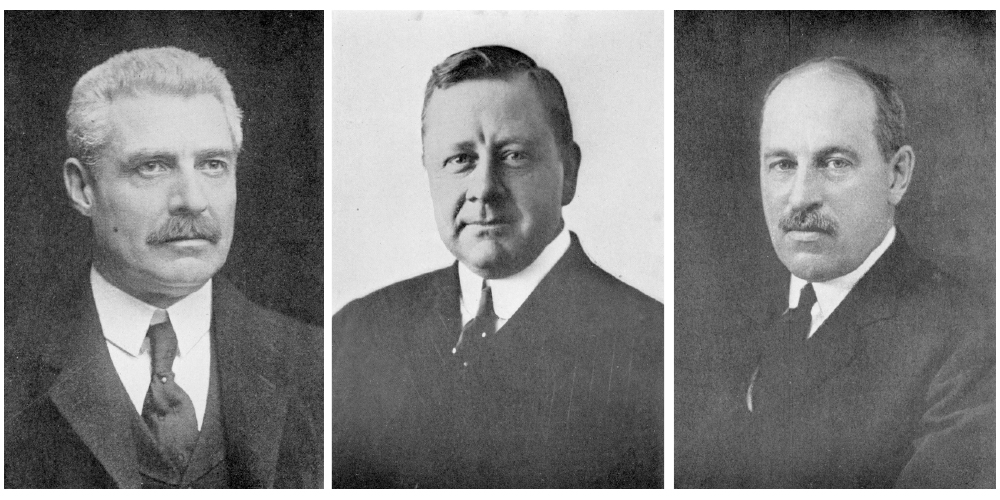
Pennsylvania Railroad officials, from left to right: Samuel Rea, president, 1913–25; Elisha Lee, vice president, 1924–33; and William Wallace Atterbury, president 1925–35.
Collection of Dan Cupper
Approaching retirement, Rea was known as a down-to-earth type who’d worked his way up from a start as a surveyor. The Yale-educated Atterbury, who would succeed Rea within the year, was a practical, iron-fisted leader who’d served in PRR management during the bitter Pullman Strike of 1894. As a brigadier general in World War I, he’d run the Allied railroads in France, earning him the title of “General” Atterbury. A member of the Republican National Committee, he was especially contemptuous of unions.
On the other hand, Atterbury was also the visionary who spent $250 million to electrify PRR’s New York–Philadelphia–Baltimore–Washington main line — what is today’s Amtrak Northeast Corridor with its high-speed 135-mph Acela trains.
PRR officials said they would give the committee a yes-or-no answer after the railroad’s February board meeting, but the date came and went without a word.
Again, two committee members traveled to Philadelphia on April 27 to try to wring a commitment out of PRR. They were deeply disappointed.
Throwing in the Towel
Upon returning, they delivered the news that PRR’s position was that owing to poor business conditions and a lack of finances, a new station “was not being considered” and that “no promise of any kind could, or would, be made that the work would be done this year or in the next few years.”
The entire committee quit. “The Scribbler,” a columnist for the New Era, satirized PRR’s tactic of dangling hopes as “Yes, We Will Have No Station in Lancaster.”
Musser, however, realizing that the issue wasn’t going away, formed a new committee. The old depot, long the butt of jokes, now became even more so. In January 1926, someone hung a large white muslin banner on a building opposite the 1860 station. In 18-inch-high letters, it read: “Don’t judge our city by our railroad station.”
The Lancaster New Era published a half-page photo gallery of six dangerous grade crossings in the city at North Queen Street (west end of the 1860 station’s trainshed), Franklin Street, Plum Street, Walnut Street, Lemon Street and Harrisburg Avenue.
A few days later, the paper editorialized: “When the agitation for a new station first started some 20 or 30 years ago, the question of grade crossings was not of the same importance. The automobile was a curiosity at the time, and the amount of vehicular traffic very light. It is probably safe to say that traffic has increased 20 times in the last 20 years, and the hazard accordingly is 20 times greater than it was then.”
A Busy Telegraph Office
Despite the string of failed talks, the year 1926 brought new resolve and fresh hope for a breakthrough. It started with a coordinated campaign that prompted a dozen civic, retail, industrial, trade, service and social clubs to write letters of support to Atterbury, who had just succeeded Rea as president. But this was just the warm-up.
The city commissioners (as council members then were known) urged Musser to proclaim a “New Station Day” to heighten awareness on all sides. Their resolution called attention to “the tremendous profits earned by the Pennsylvania railroad last year, and to the 1926 budget set aside for improvements at other points on the system.” It noted that PRR had boasted a profit of $100 million for 1925, “leading every other railroad in the country and breaking the best records for all time.” It was also blunt, calling the old depot “inadequate, dangerous and extremely obsolete.”
Musser decreed that Friday, February 5, would be New Station Day. Atterbury could hardly have expected what came next. On that date, businesses, groups, clubs and citizens showered him with more than 800 telegrams demanding action.
At Last, a Plan
It must have worked. By June, the new committee and PRR officials had settled on a plan for the city to act as a broker for private real estate interests to buy the old station and adjacent grade crossings for $400,000. Fine-tuning of details took place over the rest of the summer. The PRR Board of Directors gave its assent to the project if the city commissioners would agree. And then came the final meeting.
Gathering at Lancaster’s Hamilton Club, PRR and city officials signed the agreement on September 17. The session took only a half-hour, but it capped off a long string of “almost weekly” meetings.
“Where now are corn fields will rise a magnificent structure, the equal of any along the vast lines of the Pennsylvania Railroad,” the New Era told its readers.
The state Public Service Commission held a hearing on the issue in Harrisburg on January 6, 1927, and within weeks gave its official blessing.
Contract Awarded
The Pennsy advertised for bids and on August 11, 1927, awarded a $1.25 million contract to a local builder, D.F. Warfel, and announced that work would begin within 10 days. Promising that “as much of the material and supplies as is practicable will be purchased from local Lancaster dealers,” PRR gave this description: “The new station will be built after the Colonial design, with walls of Colonial brick and Indiana limestone. It will be finished in marble wainscoting and marble will be used extensively in interior ornamentation. The structure will measure 160 feet along the front with a depth of 90 feet. An imposing entrance, with three large limestone columns above the doors, will greet travelers, while an artistically designed marquee, placed at the base of the column, will afford protection from the elements to passengers arriving in vehicles.”
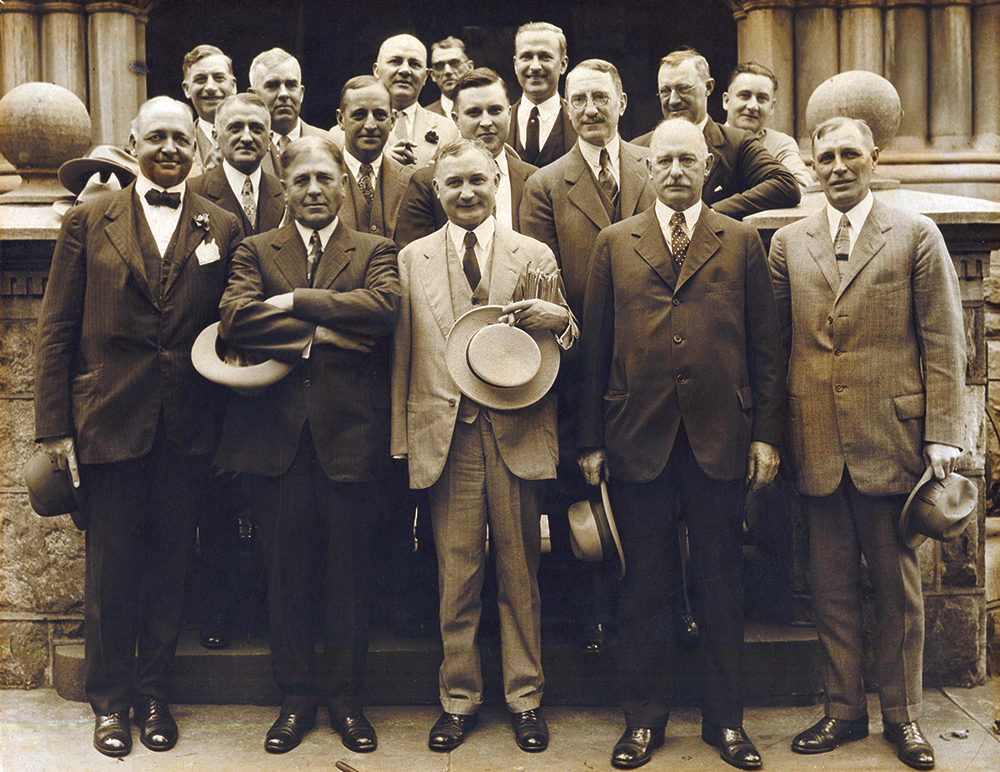
Mayor Frank C. Musser, front, in a light-colored suit, poses jubilantly with civic and PRR officials after the final September 17, 1926, meeting held at Lancaster’s Hamilton Club, at which everyone signed off on an agreement for a new station. Standing to the left of Musser (arms crossed) is PRR Vice President C.S. Krick, who, with the mayor, turned the first shovelful of earth at the groundbreaking.
Courtesy of LancasterHistory, Lancaster, Pennsylvania
It also promised “wide concrete driveways,” “adequate space for automobile parking,” and “direct trolley service.” The ground floor would hold baggage rooms, parcel checking rooms, express rooms, and a restaurant kitchen. The second floor would contain a 95-by-50-foot waiting room with ticket office, telegraph office, barber shop, smoking room and drugstore, as well as a “delightfully furnished” restaurant and lunchroom. From this area, passengers would reach trains via a 150-foot-long concourse over the tracks, with stairways descending to high-level island platforms, 1,000 to 1,200 feet long.
A Joyous Groundbreaking
On August 29, Mayor Musser wielded a silver spade to turn the first shovelful of earth at the groundbreaking. Several thousand onlookers watched as first Musser, then PRR Vice President Krick, took a turn. He was one of 40 PRR officials who had made the trip from Philadelphia headquarters.
At that moment, a PRR steam engine blew its whistle and was at once joined by sirens and factory whistles throughout the city in what the New Era described as a “wild concert.”
Excavation began that fall, and cement was poured for the first floor in January 1928. Steel girders began to rise by May, and by summer the contours of the building were taking shape. To control the maze of switches needed for the track complex, PRR commissioned a three-story, $15,000 interlocking plant tower, with materials and architecture to match the station. It, too, was built by contractor Warfel.
By this point, work was so advanced that large crowds gathered at the site every Sunday to observe the progress. Apparently, this included walking through the partly completed buildings. PRR official F.W. Heckle Jr. said the railroad was considering closing the site to visitors for fear that someone might get hurt in an active construction zone. “There were so many people out here last Sunday that it resembled a country fair,” he told a reporter.
By February 1929 the work was far enough along that PRR ran a train for members of the Chamber of Commerce from the old station to the new station for an inspection. The 13-car special carried 850 people, who sat down to a banquet in the waiting room and concourse before being led on tours. PRR Superintendent H. H. Garrigues announced that 52 trains a day would stop at the new facility, including some of the fast flyers that had bypassed the old depot.
In his speech, he praised the Chamber of Commerce for its persistence in working “hard and faithfully for many years.” Some chamber members must have rolled their eyes when another official, PRR Eastern Division Chief Engineer E. B. Temple, credited Mayor Musser’s drive, but blamed the decadeslong delay on the federal takeover of all American railroads during World War I.
But in the end, PRR had done its part, and all that remained was for the city and the state highway department to resolve a deadlock on street and road improvements in front of the building. A sea of mud existed there, just weeks before the planned opening. As that was being untangled, PRR posted closing notices at the 1860 depot and scheduled a dedication for Saturday, April 27, 1929.
Opening Day
Three thousand people attended the event, which one reporter called “an outpouring of civic pride, unparalleled in Lancaster’s two centuries of colorful history.” Representing PRR were vice presidents Krick and Elisha Lee, who had attended many of the up-and-down negotiations over the preceding decade. Krick called it a “fitting monument to the cooperation” between city and PRR fficials. Atterbury, the PRR president who was caught off guard by plans for the station in the 1925 meeting, did not attend.
Accepting the new building was Mayor Musser, who called it an inspiration and a “great public utility.” Since the decision to move the station was made, he said, real estate values north of the old station’s Chestnut Street location had doubled. The standing-room-only crowd milled around, inspecting every corner of the new building and listening to the PRR band, which had earlier given a concert at Penn Square downtown. Two guests given special recognition were 92-year-old William Blickenderfer, who had helped build the old depot, and 93-year-old H. B. Buch, who had taken part in its dedication. All in all, the Lancaster New Era proclaimed it a “Day of Rejoicing.”
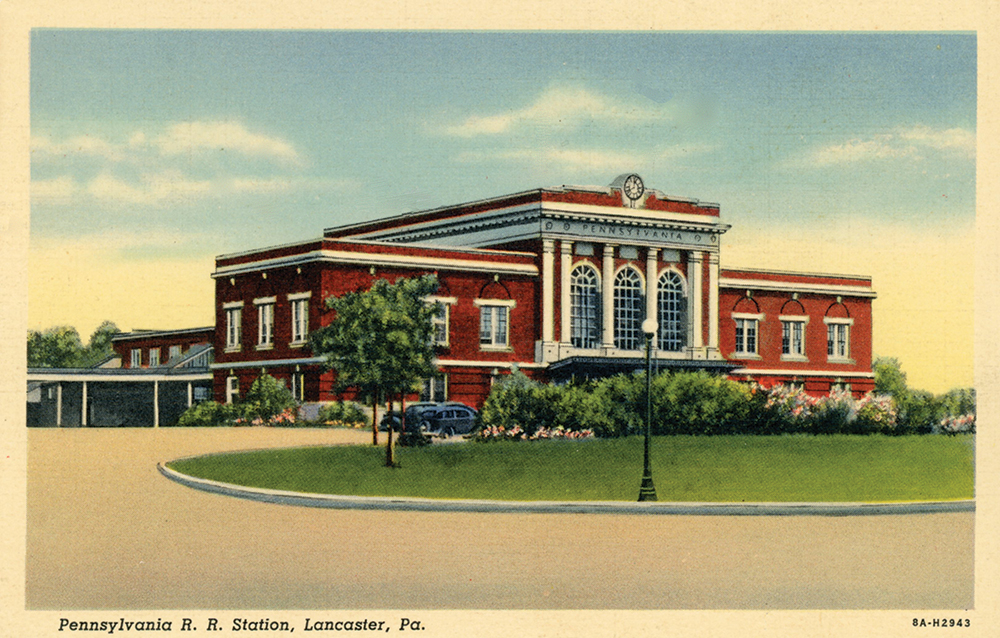
A 1938 Curt Teich postcard shows the facade of the 1929 Pennsylvania Railroad station in Lancaster.
Collection of Dan Cupper
Early the next morning, the last train left the old site at 1:04 a.m. to the cheers of onlookers as the train crew waved them goodbye. As the station closed, PRR workers at once began to rip up the downtown tracks. Chamber of Commerce Chairman Joseph Forney was on hand to pull the first spike.
Across town and an hour later, 2,000 people had stayed up late to greet the first train at the new location. Of those, “hundreds” stayed on for hours to soak in the excitement as more trains began to chuff in and out. By the end of the weekend, officials estimated that 20,000 people had visited the new station.
As for the 1860 depot, it was razed in 1930 and became a parking lot. Plans to build a theater there never materialized, and today the site is occupied by a modern office building and multistory parking garage.
Electric Trains on the Horizon
After the opening, railroad operations quickly settled into a routine, with long-haul, express, local and branch-line passenger trains coming and going at all hours. Economic trends soon joined to reduce their number, however, as the Great Depression dampened both business and leisure travel. Also, the public’s growing preference for the convenience of personal autos, accelerated by a national network of government-funded highways, hastened the decline.
But PRR had other ideas. Following Atterbury’s vision, articulated in the 1920s, the railroad electrified its Philadelphia–New York line in 1933, its Philadelphia–Washington line in 1935, and at a cost of nearly $50 million, several freight and passenger lines to Lancaster and Harrisburg in 1937–38.
It was the crowning jewel of PRR’s program to reduce its reliance on romantic but dirty and costly steam locomotives. This started in 1914 with electrification of the Main Line to Paoli for commuter trains. Much of the power to energize this 2,677-track-mile network came from hydroelectric dams on the Susquehanna at Safe Harbor near Columbia and at Conowingo, Maryland.
The first electric train through Lancaster arrived on January 15, 1938. It was the Metropolitan, a Philadelphia–Pittsburgh run that would change off to a steam engine at Harrisburg for the rest of its trip west. A restored GG1-class streamlined electric locomotive that is now on historical display in Amtrak’s Harrisburg station, No. 4859, inaugurated electric service on the line that day.
Wartime and After
During World War II, it was electrification that kept PRR fluid to handle unprecedented volumes of passenger, troop-train, and munitions movements. Hundreds of soldiers and sailors departed from Lancaster station for global battlefields. Those who gave all returned to the same station en route to burial.
Wartime rail travel spiked as a result of rationing of tires and gasoline. After hitting that peak, business went into a decline, accelerated by the cross-state completion of the Pennsylvania Turnpike in 1951. Further, commercial jet aviation put Chicago within two hours of flight time from the airport at Harrisburg, not 12 to 14 hours by train.
And in a footnote to the station’s location, Lancaster annexed part of Manheim Township in the early 1950s, so that the station now lay within city limits.
Epilogue
In 2023 Lancaster station is much the same building as it was when it opened in 1929, but with rooms and sections repurposed. PRR merged to become Penn Central in 1968, and in 1971 Amtrak took over U.S. intercity rail passenger service. Today, except for one daily New York–Pittsburgh train, the Pennsylvanian, long-haul service is extinct. But more than $140 million of state and federal investment has upgraded trains, track, stations and schedules on the 104-milelong Philadelphia–Lancaster–Harrisburg “Keystone Corridor.” Trains now speed along at 110 mph, and the station has undergone multiple renovations, the most recent being a $17 million facelift completed in 2013.
Now all trains stop in Lancaster — 28 each weekday — and in a remarkable irony, the city now ranks as Amtrak’s second-highest ridership (after Philadelphia) in Pennsylvania, eclipsing Harrisburg.
Apparently, nobody still thinks that the station out on the Lancaster Cutoff is inconvenient or remote.
Sidebars
Strasburg Was Left Off the Map
Civic leaders and merchants of Strasburg, Lancaster County, were disappointed when the Philadelphia & Columbia Railroad skipped their town and built it directly west via Leaman Place, adjacent to today’s town of Paradise. So in 1832, they laid their own 4½-mile spur — the Strasburg Rail Road—to carry produce, lumber and people to distant points by meeting the P&C trains at the junction.
For its part, nearby Lancaster city was not about to be bypassed and fought to ensure that the rails came directly through its streets. It was a decision that a later generation of Lancastrians would come to regret.
Across America, hundreds of short lines like the Strasburg grew up, blossomed and then failed with the coming of a 20th-century transportation revolution. Cheap, reliable automobiles and trucks, riding on taxpayer-funded all-weather paved roads, siphoned off business from these feeder railroads.
In this case, the railroad was about to wither up and die in 1958 when a group of local historians, business leaders and railfans breathed new life into it as a steam-powered tourist line. Now proudly bearing the title of America’s oldest short-line railroad, the Strasburg Rail Road carries about 300,000 passengers a year, one of the most successful such excursion railroads in the country.
But it’s the great exception. In the infant days of railroading, every town wanted a railroad, whether trunk line or short line, because they knew that rails meant prosperity.
Some Notable Trains and Visitors
Without benefit of microphone or loudspeakers, Teddy Roosevelt addresses a crowd from the rear of an open-platform observation car at the downtown Pennsylvania Railroad station.
Courtesy of LancasterHistory, Lancaster, Pennsylvania
In addition to the important long-haul trains calling at Lancaster, the station also was home to short-hop locals. The most notable was a Lancaster–Columbia–York gas-electric-car shuttle called the “dinky.” It lasted to 1954 before being replaced by buses. A yearly event was the summer charter train known as the Lancaster Grocers’ Special, which took from 2,000 to 8,000 excursionists on a day-long jaunt to Atlantic City, New Jersey. It was so popular that it sometimes ran in as many as eight sections, meaning eight separate trains traveling one after the other.
Formed in 1935, the Lancaster Chapter of the National Railway Historical Society for many years held meetings and displays in the new station. It also chartered many excursion trains to such places as Mystic Seaport in Connecticut, Altoona’s Horseshoe Curve, and the Grand Canyon of Pennsylvania in Wellsboro.
Both at the old and new stations, Lancaster has seen its share of presidential whistlestop and campaign trains. Among the earliest was Abraham Lincoln’s February 1861 visit on his way from Illinois to his inauguration in Washington. The most recent was in April 2008 when then Illinois state senator Barack Obama rode from Philadelphia to Harrisburg, stopping off at Lancaster during his campaign for the presidency.
Further Reading
Abendschein, Frederic H. “The Atglen & Susquehanna: Lancaster County’s Low Grade.” Journal of the Lancaster County Historical Society 95, no. 1 (1993): 2–19. / Bell, Kurt, and Jeremy Plant. The Strasburg Rail Road in Color. Kutztown, PA: Morning Sun Books, 2015. / Brubaker, Jack. Remembering Lancaster County: Stories from Pennsylvania Dutch Country. Mount Pleasant, SC: Arcadia, 2010. / Burgess, George, and Miles C. Kennedy. Centennial History of the Pennsylvania Railroad Company. Philadelphia: Coverdale & Colpitts, 1949. / Schotter, H.W. Growth and Development of the Pennsylvania Railroad Company, 1846-1926. Philadelphia: Allen, Lane & Scott, 1927. / Sipes, William B. Pennsylvania Railroad: Its Origins, Construction, Condition, and Connections. Philadelphia: [Pennsylvania Railroad] Passenger Department, 1875. / Wilson, William Bender. History of the Pennsylvania Railroad Company. Philadelphia: Henry T. Coates, 1899.
Dan Cupper is a transportation historian from Harrisburg and a retired locomotive engineer for Norfolk Southern Railroad. He has written numerous books and articles on railroad and highway history. His previous contributions to Pennsylvania Heritage include “The Early Days of the William Penn Highway: How Present-Day U.S. 22 Got Its Start” (Winter 2022) and “The Giant That Stumbled: Baldwin Locomotive Works Dominated Its Field for a Century, Then Vanished” (Spring 2021).