
The Barnes Then and Now, edited by Martha Lucy
Written by Deirdre Smith in the Book Review category and the Spring 2024 issue Topics in this article: Albert C. Barnes, art, Barnes Foundation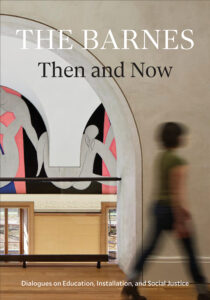 The Barnes Then and Now
Dialogues on Education, Installation, and Social Justice
edited by Martha Lucy
The Barnes Foundation, 304 pp., paperback $60
This volume offers a fresh, nuanced and substantial take on the history and current life of the storied collection of Dr. Albert C. Barnes and the broader legacy of Barnes himself. In The Barnes Then and Now, Barnes’ collecting and educational initiatives are contextualized and critiqued through the eponymous themes of Education, Installation, and Social Justice. Space is also devoted to his collaborators, like Violette De Mazia, and his interlocutors and critics, such as Alain Locke. Throughout the book, the difficulties of parsing and reconciling Barnes’ motives, actions and attitudes — especially with regard to the African art in his collection and the Black and African American workers, intellectuals, artists and academics that he interacted and collaborated with — are on full view.
Two essays by Alison Boyd attempt to hold space for the democratic, antiracist and iconoclastic vision of Barnes in his educational experiments at his pharmaceutical factory and in his galleries, and his inclusion of African art in his installations, while not sparing Barnes for his articulation of racialized, paternalistic ideas and his ultimate belief in a “primitive/modern” binary that in meaningful ways relegated the African art in his collection to demonstrating an influence on European modernism. Tatiana Flores and Rebecca Uchill potently argue that Barnes endorsed a harmful, colonialist version of Eurocentric modernity. Meanwhile, Barbara Anne Beaucar details Barnes’ years of commitment to supporting Black artists and intellectuals through scholarships and his partnership with Lincoln University. In the contemporary conversations that close each section of the book, Barnes the man tends to fall away and the opportunities and challenges of making his collection accessible and resonant today come to the fore. This multitude of voices and stories ultimately bar a reader from drawing any simple conclusions about Barnes and his foundation, and this complexity is the book’s greatest strength.
Deirdre M. Smith
University of Pittsburgh and Carnegie Museum of Natural History