The Artist and the President: Dwight D. Eisenhower’s Painting Impulse and the Andrew Wyeth Connection
Written by Michael Birkner in the Features category and the Summer 2024 issue Topics in this article: Andrew Wyeth, Dwight D. Eisenhower, Eisenhower National Historic Site, Gettysburg, painting, Time Magazine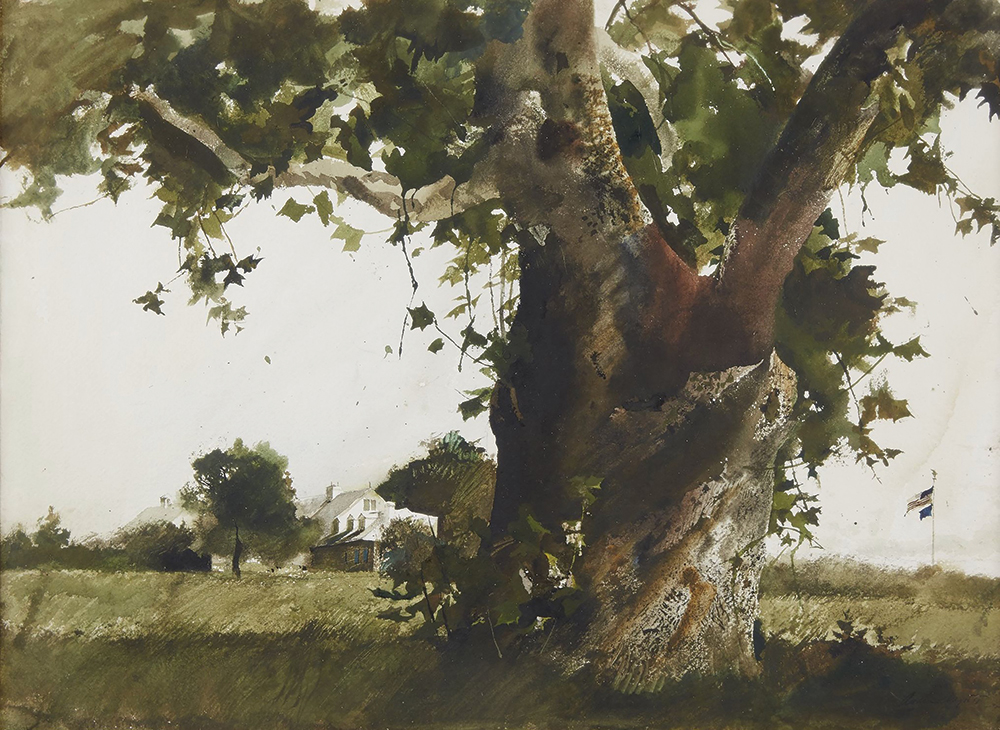
During his visit to Gettysburg to paint Eisenhower’s portrait, Wyeth created this watercolor-on-paper landscape, depicting an old sycamore at the Eisenhower farm with the house in the background. The artist gave the painting to the president as a gift and later recommended naming it At Home.
Private collection. ©2024 Wyeth Foundation for American Art / Artists Right Society (ARS)
After the popular Pennsylvania artist Andrew Wyeth (1917–2009) died at age 91 at his home in Chadds Ford, the New York Times obituary summed up his career, emphasizing key themes in his corpus and noting that he had both admirers and detractors. The former included British statesman Winston Churchill, himself an amateur painter of ability. To this list one could add President Dwight D. “Ike” Eisenhower (1890–1969), whose own adventures in art included an ongoing commitment to painting as well as appreciating a well-wrought canvas.
Eisenhower did not simply admire Andrew Wyeth from afar. The president had long appreciated Wyeth’s work, including one of his landscape paintings that Eisenhower media adviser Robert Montgomery secured to hang in the president’s office at the White House. Ike wrote Wyeth in 1955 that “the painting has excited the admiration of many of my visitors and I share — as only a complete amateur can — a great enthusiasm for your techniques and artistry.”
Four years later Eisenhower chose Wyeth’s painting Children’s Doctor to include in the American National Exhibition in Moscow in July 1959 — the very place where Vice President Richard Nixon engaged in his famous “Kitchen Debate” with Soviet Premier Nikita Khrushchev. It was, according to a writer for Time magazine, his “particular favorite” among American paintings on exhibition at Moscow.
Perhaps Eisenhower’s expressions of Wyeth’s appeal to Ike’s artistic sensibility had something to do with Time’s decision in the summer of 1959 to commission Wyeth to paint the president’s portrait for a cover. Time had first to receive permission for this enterprise, which the president granted after inviting Wyeth to meet with him to explain his plan for the portrait. “Had an hour and a half this morning with the President,” Wyeth wrote from Ike’s Gettysburg farm in August 1959. “Keeping my fingers crossed.”
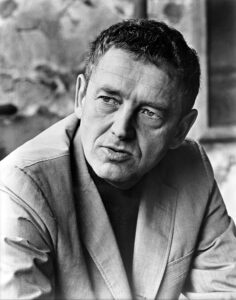
This photograph of Andrew Wyeth, circa 1960, by Robert Walker, captures the Pennsylvania artist as he appeared around the time that he painted the president’s portrait.
Archives of the Andrew & Betsy Wyeth Study Center
Evidently the crossed fingers worked, because Ike agreed to sit for Wyeth over three days, posing for 15 minutes to an hour each day for five days, with one break as Eisenhower returned to the White House to plan his forthcoming trip to Great Britain and West Germany, the subject of Time’s impending cover story about the president.
For the portrait, Ike wore his favorite jacket of straw-colored silk. “He sat unsmiling,” while Wyeth painted, “perhaps,” as Time’s James A. Linen put it, “as if alone with his thoughts.” At one point during his Gettysburg sojourn, Wyeth, writing to a friend, marked a drawing of the Eisenhower home with an “X” to show where he had set up his easel.
It did not take long for Wyeth to produce the portrait, a striking image in bright golds and muted browns that appeared on the front of Time’s September 7, 1959, issue. Prominently signed “AW,” the portrait captures a contemplative president in a side view, his bright blue eyes matching his light blue tie. Eisenhower comes across not as a grandfatherly benign monarch but as the thoughtful, in-charge chief executive he was. (The original is now housed in the Los Angeles County Museum of Art.)
During breaks in the sittings for the Time cover art, including August 17 when Eisenhower spent the day in Washington, Wyeth carried his easel several hundred feet from the home. Placing it just beyond a handsome old sycamore, Wyeth captured the tree, the house and surrounding property in an evocative landscape. He made this work a gift to Eisenhower in appreciation for the president’s hospitality.
Eisenhower was delighted with Wyeth’s craft. As he put it in a note on August 24, “Mrs. Eisenhower and I are proud as the proverbial peacocks of our original Wyeth. The fact that it depicts in the background the home we so love doesn’t detract at all from our delight.” Ike added, “I enjoyed our sessions together, even though I fear I was not too cooperative a subject.”
Wyeth’s gift of that painting, which was passed down through the Eisenhower family until it was recently put on auction and purchased by an Adams County Eisenhower admirer, did not mark the end of the Eisenhower–Wyeth connection. Wyeth arranged for his gallery, Knoedler & Co. of New York City, to mount and frame the farm painting. He suggested a title for it, too: At Home.
On October 7 Wyeth wrote to the president noting, “Here along the coast of New England one always knows when the captain is home by the flag flying. That is one of the things I clearly remember as I sat painting your farm — the flapping of the flags as they blew in the wind. Would the title ‘At Home’ be agreeable to you?”
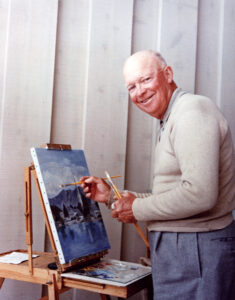
Eisenhower painted more than 260 pictures including many landscapes and buildings.
Courtesy of the National Archives and Records Administration, Eisenhower Presidential Library, Abilene, Kansas
On October 12, 1959, Eisenhower’s secretary Ann Whitman responded that the president and Mamie “are prouder, if possible, than ever of their Wyeth.” Ike himself wrote Wyeth to assure him that the entire Eisenhower family “will remember your kindness as long as we treasure the painting.”
Wyeth received further validation from a friend, who observed that it was “beyond me how you did a tempora [tempera] in so short a time—under the hit-or-miss conditions [at the Eisenhower farm] and of course under the mental pressure you no doubt were experiencing.” “Andy,” the writer continued, “I think you caught something in Ike’s face — which probably only a few of his close friends see — the tremendous man he is — the serious and profound thinker. And with it all, the great human warmth.”
It was no coincidence that two years before Eisenhower sat for the 0 portrait, he extended an invitation to Wyeth to attend one of his periodic “stag” dinners — opportunities for meeting over drinks and a meal at the White House with different sets of Americans who had in some way made a mark in their respective fields. By happenstance, Wyeth was seated at the dinner adjacent to a former speaker of the New Hampshire House of Representatives, Richard Upton, whose invitation had been generated by his friend Sherman Adams, Eisenhower’s reputed “right hand man” as a presidential assistant. Upton recalled many years after the event that as he was departing for the evening, just behind Wyeth, Ike whispered to him, “Do you know who you were sitting next to? That’s Andrew Wyeth, and he makes a mint on his paintings!”
While Eisenhower may have been impressed by Wyeth’s appeal on the art market, his own engagement with painting was strictly unmercenary. Over the course of his roughly two-decade-long adventure with brushes and oils, Eisenhower produced more than 260 paintings, many of which he gave away to friends, relatives and members of his presidential administration as tokens of appreciation.
Contrary to critics who likened Ike’s artwork to the “paint by numbers” phenomenon in the 1950s, Eisenhower took his craft seriously, even as he made no claims for his paintings’ artistic merit, calling them “daubs, born of my love of color and in my pleasure in experimenting, nothing else.”
Those daubs, historian Jack Holl has observed, were “vehicles for confirming and conveying affection to his family, friends, country, and his God.” Giving away his paintings was a means of expressing a connection with others. It is worth adding that Ike was satisfied enough with his own work that for six of the eight years he was president, his paintings were imprinted on the presidential Christmas cards he sent out each year.
According to the supervisory museum curator at the Eisenhower Presidential Library in Abilene, Kansas, William D. Snyder, Eisenhower “painted because he felt that if he was able to put himself in a relaxed mood that would allow his mind to concentrate on more important things as he painted. Meetings with world leaders, questions of policy.” In Snyder’s view, painting served as a calming mechanism for the president.
Yet, it is also possible to see Eisenhower’s painting hobby as something different than his other pastimes, among them bridge, skeet shooting, fishing and golf, each of which entailed some kind of competition. With painting, as historian Holl has argued, Eisenhower was on his own, to say what he wanted to say with paints (he did not care for watercolor) and to capture subject matter that interested him in the form that he found most comfortable and conducive to expressing himself. The only competition involved was with himself, to do better, using his paint and brushes. Like Churchill, Eisenhower found painting not only a release from pressure but also a journey of discovery. It was the journey and not the arrival that mattered.
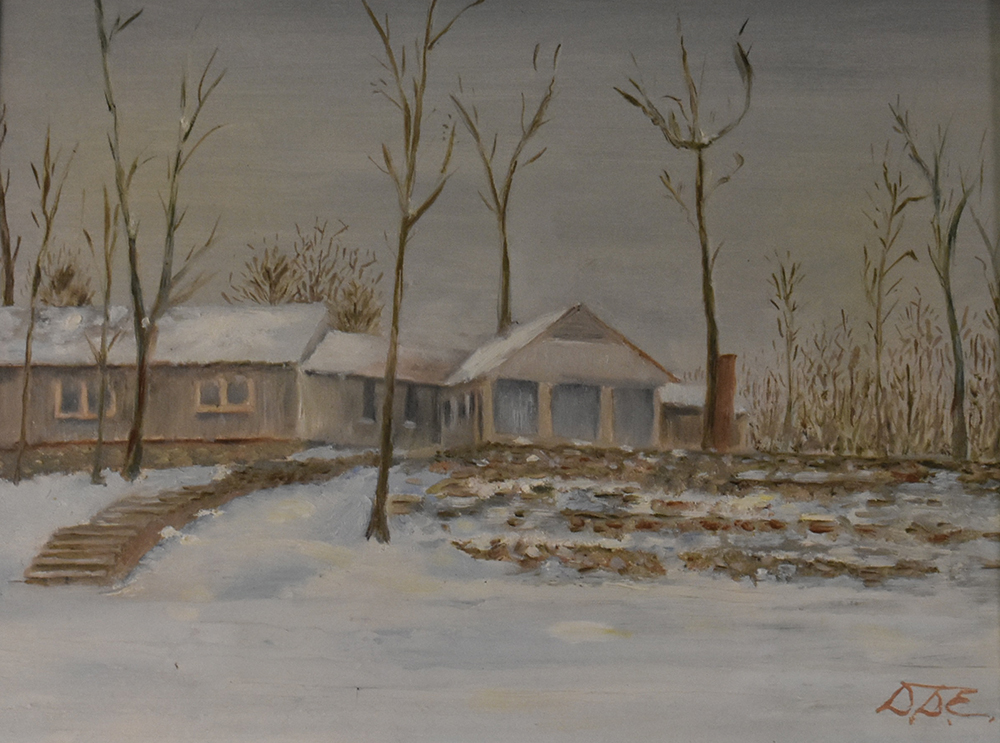
Ike also painted scenes from his daily life, such as this view of the buildings at Camp David in winter.
Courtesy of the National Archives and Records Administration, Eisenhower Presidential Library, Abilene, Kansas
Ike never sold his artwork, but he did continue to paint once he moved to Gettysburg for good upon retiring from the presidency in January 1961. His canvases depicted landscapes and buildings, as well as portraits of people living and dead — even a portrait of Winston Churchill, a color photograph of which he sent on to his old friend. There is no evidence Churchill commented on it, although after Eisenhower told of his plans to paint Churchill’s portrait, Churchill replied, “I warn you I will claim full rights of retaliation.” Eisenhower continued to give his artwork away throughout his life and continued to downplay any merit attached to it.
After departing Washington, Ike kept in touch with Pennsylvania’s most distinguished artist. In 1963 Wyeth sent Eisenhower the catalog of an exhibition of his work at the Albright-Knox Art Gallery in Buffalo with a personal inscription. Ike responded with warm thanks and this observation: “As I have told many people your work — every piece I am privileged to see — provides me with inspiration. I wish I had the words to express the true measure of my appreciation. Your water color of our farm hangs in my [Gettysburg College] office. Every visitor here finds himself impelled to expressed admiration of it.”
Two years later, Eisenhower wrote a “Dear Andrew” letter thanking him for his Christmas card. “I think it is not necessary,” Ike added, “for me to tell you again what great respect and admiration I have for your talent. Feeling this way, you can imagine how diffident I felt when I sent off to you some time back our little Christmas card with a reproduction of my own painting of Lincoln. In spite of this I hope you will enjoy the reproduction of the Gettysburg Address in Mr. Lincoln’s own handwriting.” Once again, Eisenhower was deliberately modest about his artistic creations. Yet the avocational painter did share his work with Wyeth, a master in the field. Perhaps, in the end, the “dabbler” was a bit prouder of his handiwork than he let on to friends and the broader public.
The author gives special thanks to the following individuals for providing valuable assistance: Robert McIlhenny, Daun Van Ee, Carol Hegeman, Karen Baumgartner at the Brandywine Museum of Art, and Michelle Kopfer at the Dwight D. Eisenhower Presidential Library.
Michael J. Birkner is professor of history at Gettysburg College, where he has taught since 1989. He has published widely on 19th- and 20th-century American political history, including three edited volumes on Pennsylvania’s only president, James Buchanan.