
The Arrival of Thomas Paine and the Publication of Common Sense
Written by Richard Saylor in the Our Documentary Heritage category and the Fall 2024 issue Topics in this article: American Revolution, Benjamin Franklin, Benjamin Rush, Common Sense, King George III, Pennsylvania State Archives, Philadelphia, Second Continental Congress, Thomas Paine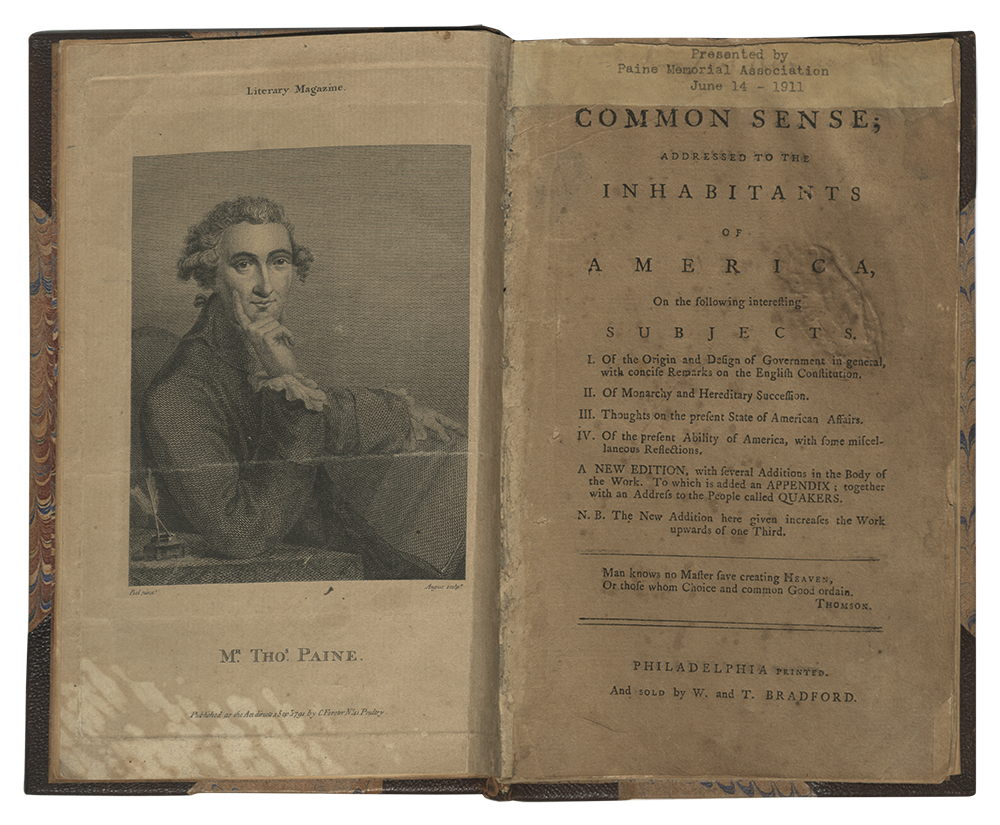
Two hundred fifty years ago, on November 30, 1774, Thomas Paine (1737–1809) arrived in America from England. By early 1776 his inflammatory pamphlet, Common Sense — urging the American Colonies to declare independence from imperial Britain — had been published and widely read, accelerating the momentum of the American Revolution.
Born in Norfolk, England, Paine displayed a talent for debating in political clubs. Benjamin Franklin (1706–90), whom he later met in Europe, described him as “an ingenious, worthy young man.”
Paine first settled in Philadelphia with letters of introduction from Franklin. In March 1775 Paine found work as the editor of Pennsylvania Magazine. Dr. Benjamin Rush (1745–1813) met him there and admired his social ideas but disapproved of his “desultory life, his intemperate habits.” Rush later encouraged Paine to write an essay justifying the notion of America’s independence from Britain, and it was also Rush who recommended to Robert Bell of Philadelphia that he publish Paine’s essay as a pamphlet.
Paine’s radical ideas had widespread influence after Common Sense was originally released anonymously in Philadelphia on January 10, 1776. The pamphlet was a sensation, selling 120,000 copies throughout the colonies in its first three months, according to Paine. Written in an easily understandable style, it advocated for independence rather than reconciliation with Great Britain. Before then, the idea of total independence from Britain was rarely discussed in public.
In Common Sense, Paine challenged the divine hereditary rights of kings and called George III the “Royal Brute.” Paine wrote, “As the exalting one man so greatly above the rest cannot be justified on the equal rights of nature, so neither can it be defended on the authority of scripture; for the will of the Almighty as declared by Gideon, and the prophet Samuel, expressly disapproves of government by Kings.”
In the pamphlet, Paine called for a republican government in America, with powers vested in the people. This view appealed to the Second Continental Congress, meeting in Philadelphia since 1775, and spurred the efforts of the anti-British forces. “By referring the matter from argument to arms, a new era for politics is struck — a new method of thinking hath arisen,” Paine wrote. “Until an independence is declared, the Continent will feel itself like a man who continues putting off some unpleasant business from day to day, yet knows it must be done, hates to set about it, wishes it over, and is continually haunted with the thoughts of its necessity.”
Common Sense also espoused the economic advantages of independence. Besides eliminating odious British taxes on the colonies, Paine wrote “any submission to, or dependance on, Great Britain, tends directly to involve this Continent in European wars and quarrels, and set us at variance with nations who would otherwise seek our friendship, and against whom we have neither anger nor complaint. As Europe is our market for trade, we ought to form no partial connection with any part of it.”
This early copy of Common Sense, above, published on February 14, 1776, was donated by the Thomas Paine Memorial Association to Valley Forge State Park in 1911. It was transferred to the Pennsylvania State Archives in the 1970s, before Pennsylvania gave the park to the nation (to become a National Historical Park) for the U.S. Bicentennial in 1976. The pamphlet is preserved in the State Archives’ Manuscript Group 8: Pennsylvania Collection.
Richard C. Saylor is an archivist for the Pennsylvania State Archives and author of the award-winning book Soldiers to Governors and numerous articles on military, political and sports history.