
The Arrest of Philip Skene
Written by Richard Saylor in the Our Documentary Heritage category and the Spring 2025 issue Topics in this article: American Revolution, John Adams, Pennsylvania State Archives, Philadelphia, Philip Skene, Second Continental Congress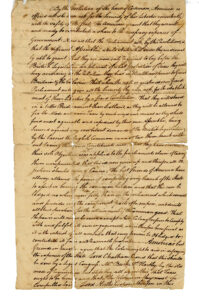 The British ship Sally entered the port of Philadelphia on June 7, 1775, after leaving London weeks before. Aboard the ship was a British officer who was also a land speculator in the colony of New York and a soon to be suspected spy — Maj. Philip Wharton Skene (1725–1810).
The Revolutionary War had just begun and already intrigue, speculation and suspicion were spreading wildly throughout Philadelphia. No one knew for sure who were loyalists or who were revolutionaries.
At the time of Skene’s arrival, the Second Continental Congress was in session at the Pennsylvania State House and had been made aware that Skene was disembarking from the British ship. After hearing that Skene had been imprudently discussing some of his plans to the captain and other passengers of the Sally, a wary Congress sent a three-man committee that evening to meet Skene and to examine “in the presence of said Skene and lieutenant, all the papers in his possession.” The committee was comprised of John Adams, Thomas Mifflin and Silas Deane.
“We have an infernal scoundrel here, a certain Col. S—, who comes over full of plans and machinations of mischief,” Adams wrote. “He has had the most unreserved and unlimited confidence of Lord Dartmouth, during whole of this past winter, and it seems for some time before; and together with a contemptible puppy of a parson, V—, has been contriving to debauch, seduce, and corrupt New York.”
Skene was paroled a few days later and was told to remain within 5 miles of Philadelphia. He was later sent under guard to Middletown, Connecticut, where he was confined on parole.
A former British Army officer, Philip Skene had enlisted in 1739 and saw significant action in British battles against the Spanish in Panama and Colombia, the French in Belgium, and a Jacobite army near Derby in 1746. Ten years later, he arrived in North America with British troops, and in 1757 was promoted to command an infantry regiment. Wounded in 1758 during the attack of Fort Ticonderoga, Skene was appointed as a brigade major the following year and was left to command the fortifications at Crown Point. He helped start a settlement at the head of Lake Champlain and in 1769 sold his commission in the British Army, returning to New York to take charge of a large tract of land that he was granted near modern-day Whitehall.
Shortly before the Revolution began, Ethan Allen and other men from New Hampshire came up with a plan to obtain a royal charter comprising the New Hampshire Grants and land on the New York side of Lake Champlain. As part of this plan, Skene traveled back to England and was appointed lieutenant governor of Ticonderoga and Crown Point and royal surveyor of the woods around Lake Champlain.
Skene also, according to a “letter from a Gentleman in London to his Friend in New York,” had “deceived the Ministry, in persuading them that he can bribe all the Members of the Continental Congress, for which purpose he has been sent off to Philadelphia.” The unknown gentleman warned: “The ministerial plan is undoubtedly to reduce every American to the most degraded state of absolute bondage and servitude. The two modes by which they hope to accomplish their end, are, using force and violence in New England; and with bribery and other artifices, to divide the rest of the Colonies from their common cause.”
Among the papers seized from Skene when he arrived in Philadelphia was a resolution from the British House of Commons detailing a plan for reconciliation between Britain and the Colonies, pictured here.
In October 1776, Skene was exchanged in a prisoner swap for James Lovell, who would go on to serve as a Massachusetts delegate to the Continental Congress. Skene returned to England and enlisted with Gen. John Burgoyne’s expedition as a colonel. He surrendered with Burgoyne’s army at Saratoga in 1777.
In 1779, due to traitorous acts, Skene was attainted as a loyalist by the state of New York and all his property was seized. Beginning in 1784, he received a pension from the British government.
The Exposition of the Resolution of the House of Commons, proposed in February 1775, was found in the pocket of Skeene after his arrest in Philadelphia. It was donated to the Pennsylvania State Archives in July 1989 and is preserved in Manuscript Group 423.4, the Lucy Robbins Collection.
Richard C. Saylor is an archivist for the Pennsylvania State Archives and author of the award-winning book Soldiers to Governors and numerous articles on military, political and sports history.