
Summering at the Cottage: Camp Meetings, Chautauquas and Other Retreats in Pennsylvania
Written by Peter Seibert in the Features category and the Summer 2023 issue Topics in this article: camp meetings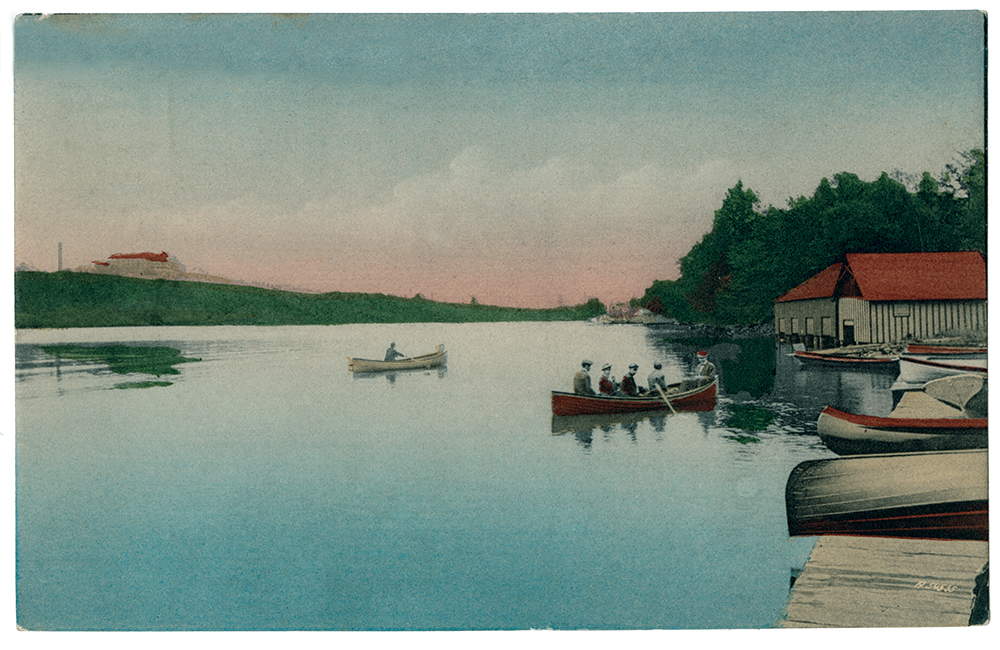
The natural spring-fed Eagles Mere Lake is the center of the Allegheny Mountain cottage resort founded in the late 19th century. This circa 1913 postcard view shows the south side of the lake.
Pennsylvania State Archives, MG-213
For more than a century and a half, Pennsylvania wayfarers have left their homes after Memorial Day to vacation at their summer cottages. Whether by horse, train or automobile, the trip to the summer cottage has been an established part of the season for urban, rural and suburban families. Escaping the heat for the bucolic mountains or sunny beach was, of course, a primary reason for owning a summer home — then and now. For many 19th- and 20th-century Pennsylvanians, however, summer cottages were also about connecting to their religious faith or following intellectual or artistic pursuits. This idea of both learning and relaxing, although perhaps strange to us today, was the reason that most cottage communities were originally created.
So, when did Americans start to go on vacation? For the rich, travel was part of daily life, as was owning large and expansive summer homes. In the 18th century, Philadelphians seeking to escape the heat and smell of the city in summer built opulent summer properties outside of the city along the banks of the Schuylkill River. As steamboats provided reliable service to Philadelphia, affluent families looked northward along the Delaware into Bucks County to construct riverside summer residences. Period accounts describe vacationing husbands racing to get to the steamer for Philadelphia to arrive at work on time. In Lights Along the Delaware, a book that includes interviews with people who owned estates along the river, one expectant father boarding the steamer was told by a messenger that his son had been born. The man responded, “Please present my compliments to my new son and tell him I look forward to meeting him with his mother on my return on the two o’clock boat.”
For the middle class, summer vacations were a positive result of the economic and societal changes that occurred with the rise of American business and industry following the Civil War. Having more leisure time to get away, people would need a place to go. For Pennsylvanians living in the eastern part of the state, one of the closest choices was a beach along the Atlantic Coast; for those in the central and western portions of the commonwealth, the mountains would become a popular spot.
Beginning with Henry David Thoreau, followed by a host of authors, architects and conservationists, there arose a sense that the woods presented the best place to relax. One’s own Walden Pond could be found if one ventured far enough from home. Similarly, like conservationists John Muir or Joseph Grinnell, one could go into the woods to explore nature, albeit from the safety of a cottage porch.
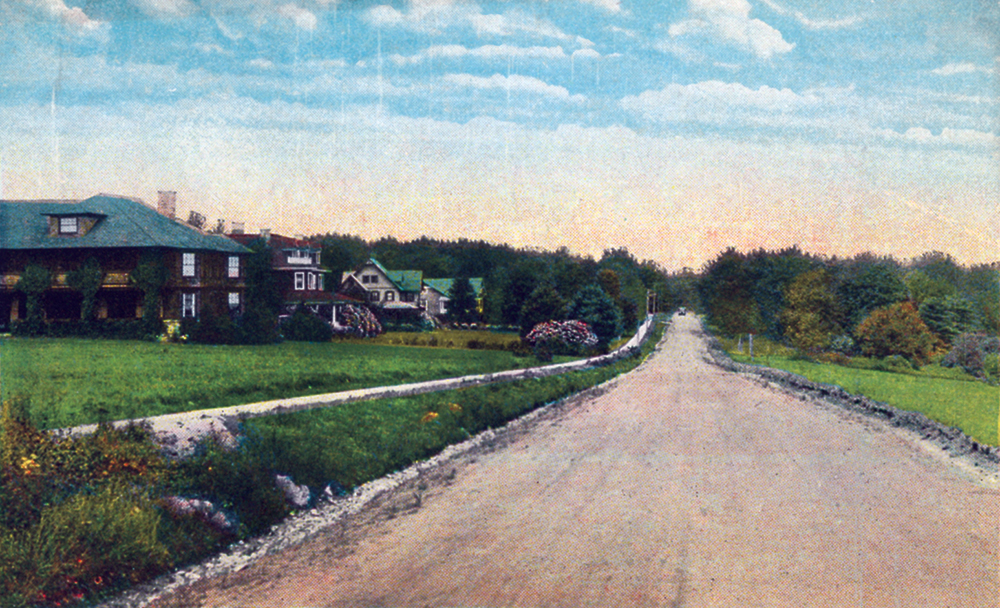
Eagles Mere cottages, many dating to the late-19th century, survive today as part of the Eagles Mere Historic District, listed in the National Register of Historic Places.
Collection of Peter S. Seibert
Perhaps the most notable of the early summer cottage communities in Pennsylvania is Eagles Mere, established in the 1870s and located in the mountains of Sullivan County. The Eagles Mere Land Co. and Eagles Mere Boat Co. eventually became developers of many of the area’s cottages, inns and recreational facilities. Eagles Mere was intended to accommodate families from Harrisburg and Philadelphia looking to escape those cities.
In 1944 noted conservationist J. Horace McFarland (1859–1948) wrote the history of Eagles Mere, in which he focuses primarily on Pennsylvania’s unique natural wonder — the mountain lake — and other geological features such as waterfalls. He concluded this work with a personal remembrance of his family’s first time there: “Added years and changing seasons have served only to strengthen our love for the lake, the beach, the walks, the forests, the glens and waterfalls which make Eagles Mere and the Sullivan Highlands outstanding among the vacation resorts of eastern America.”
Eagles Mere was not alone, however, as other summer and second-home communities grew up in other parts of Pennsylvania. Scalp Level, located in Cambria County, became an artist’s colony for painters like George Heztel (1826–99) and Albert Francis King (1854–1945). There they found untouched landscapes to paint. As the artists moved into the region, so did many of the affluent families from Pittsburgh, such as the Mellons, who constructed homes near Ligonier. Today, there is still a strong Pittsburgh presence, albeit more year-round, in this portion of western Pennsylvania.
The Camp Meeting
The pursuit of nature, however, was not the only reason to go away during the summer. For a large number of Pennsylvanians, there were religious and spiritual purposes for vacations. There is still a deep-seated tradition, with roots back to at least 1734, for outdoor public religious meetings. Such meetings were originally sponsored by Presbyterian, Methodist and Baptist churches but later became more widely associated with independent evangelical movements.
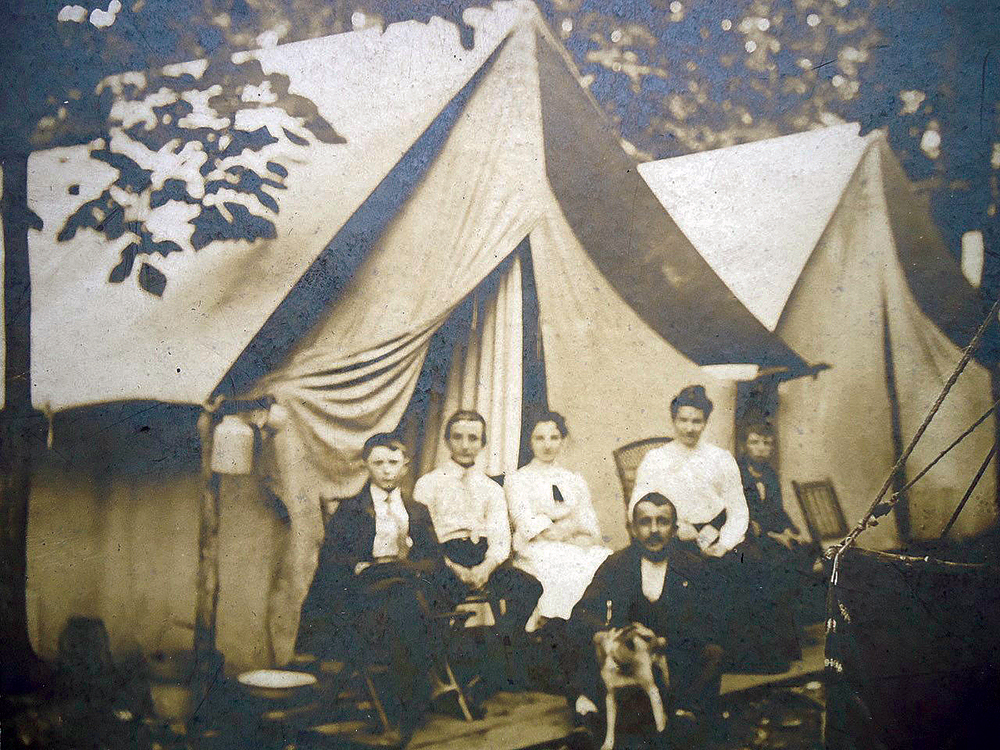
A family gathers in front of their tent at Mount Lebanon Campmeeting in the early 20th century. Notice the makeshift cistern on the left side of the tent.
Courtesy of Mount Lebanon Campmeeting
From Landisville Camp Meeting in Perry County (founded in 1870) to Mount Lebanon in Lebanon County (founded in 1892), there were more than a dozen formal camp meetings established across Pennsylvania in the post–Civil War period. The oldest in Pennsylvania, still in use, may be Brandywine Summit near Chadds Ford, Chester County, founded in 1865.
Pennsylvania camp meetings came in all sizes, from small ones in Conneautville in Crawford County and Herndon in Northumberland County to large ones, such as Highland Park Camp Meeting in Bucks County, which attracted more than 8,000 attendees in 1900. Some were founded by small groups of dedicated churchgoers, while others, such as Highland Park, were established as a result of a split within an existing camp meeting. These camp meetings were configured in a common way with a central tent for meetings surrounded by smaller tents erected by families who came to attend the services. Because of the limitations of horse transportation, camp meetings also required pastures for grazing and staff to muck out the manure.
All this changed during the second half of the 19th century with the expansion of railroad services. Families could now leave Philadelphia, Lancaster or Pittsburgh and ride the train, albeit often with more than a few stops along the way to their destination. To better facilitate access, some camp meetings added shortline rail service to their facilities, thus ensuring that guests could arrive there with a minimum of fuss. To attract members, Mount Lebanon Campmeeting made use of a trolley that Milton Hershey installed to transport rural workers to his chocolate factory. Concurrent with the addition of train service, many camp meeting associations also began to build auditoriums. And with new permanent meeting spaces, families soon began to construct their own cottages.
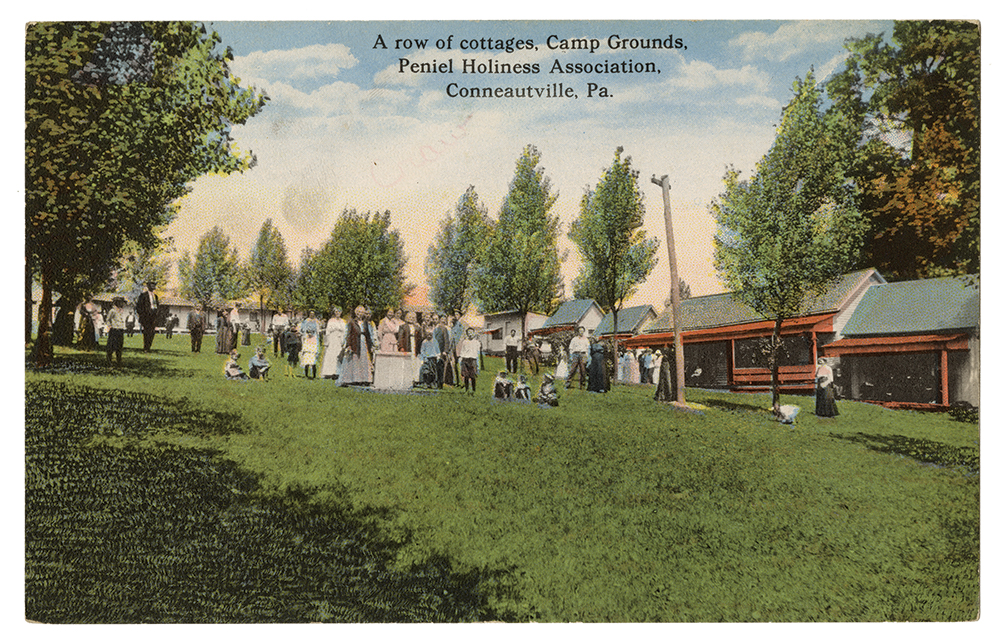
The Peniel Holiness Camp in Conneautville, Crawford County, established in the 1890s, continues to hold its camp meetings in the present. This postcard shows campers outside of their cottages, circa 1913.
Pennsylvania State Archives, MG-213
Architectural style became a question as families constructed their summer cottages. In the first years, the Gothic Revival designs of Andrew Jackson Downing (1815–52) were popular. Using pointed spires and elaborate gingerbread loosely patterned on medieval designs, this style fit in well with the religious nature of the camp meeting movement; however, the high-pitched gables meant that Gothic Revival houses put limitations on the number and size of bedrooms. Thus, for larger families, the later Victorian shingle style became popular. And then by the first decades of the 20th century, the practical Arts and Crafts style came to dominate camp meeting architecture. Whether an Adirondack cottage or a redwood bungalow, this style ultimately came to be the most popular for cottage communities in the 20th century. The best density of all three styles of cottage architecture can be found at Mount Gretna Campmeeting in Lebanon County. Despite upgrades to many of the houses reflecting shifts to year-round occupancy, the community retains a significant number of homes that exhibit original features.
Life in a camp meeting was built around the schedule of religious services that could often be intensive. At Mount Lebanon, there were seven services on the concluding Sunday of the annual season. A charismatic clergyman was retained usually for the entire season, although local pastors often would be called upon to provide additional services. Historically, the two largest Protestant denominations in Pennsylvania to embrace camp meetings were the Evangelical United Brethren and Methodist churches. This changed in 1968 with the merger of these two denominations into the United Methodist Church. Today, UMC continues its involvement with many camp meetings.
Ownership of the cottages varies among camp meetings. Some have allowed for the private ownership of both land and cottages, but most have followed the model of the land belonging to the camp meeting association and private ownership only of the cottage buildings.
The Chautauqua
An interesting parallel movement to the religious camp meeting was the Chautauqua. The first Chautauqua was established in 1874 along the shores of Lake Chautauqua in western New York as a training camp for Sunday school teachers. The founders, Lewis Miller (1829–99) and John Heyl Vincent (1832–1920), had a bigger vision for the community. They saw the need for a summer program based around adult learners who took classes on such topics as conservation, modern art, and what was then described as moral philosophy. It was to be patterned on an outdoor university with classes taught by leading scholars and thinkers of the era. Their idea of a program of expanded learning began slowly but then gathered steam thanks to the highly visible participation of President Ulysses S. Grant.
There were two types of Chautauquas. First were the permanent communities based on the mother community in New York of which the Pennsylvania Chautauqua at Mount Gretna was the state’s largest. Then there were the tent Chautauquas, at which a promoter would bring a fixed bill of lecturers, musicians and stump speakers to a town for a week during the summer. Working with a local committee, the tent Chautauquas had the merits of being easily adjustable for timing, weather and speaker availability. As a result, the tent Chautauquas were far more common in towns across Pennsylvania, from Swarthmore in Delaware County to Westfield in Tioga County.
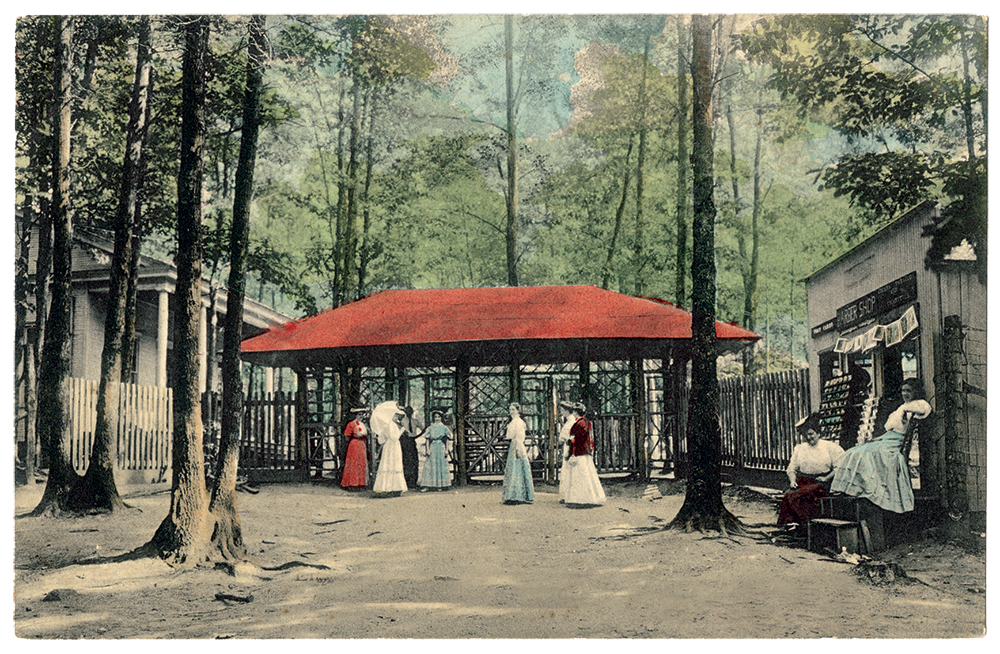
The Pennsylvania Chautauqua, adjacent to the Campmeeting grounds at Mount Gretna, was established in the 1890s and continues today with programs on art, education, recreation and religion.
Pennsylvania State Archives, MG-213
The Pennsylvania Chautauqua was founded at Mount Gretna, adjacent to the large parade ground that was used by the Pennsylvania National Guard for its summer maneuvers. Families from Harrisburg and Lancaster took the train to their cottages, spending the summer among the pine trees taking classes in art and attending theatrical productions and concerts.
The Pennsylvania Chautauqua abuts the Mount Gretna Campmeeting. This may be the only instance in the United States where a camp meeting and a Chautauqua have developed parallel to each other with similar but not identical goals and audiences.
For many communities, building a Chautauqua that would attract national-caliber speakers was too costly. For those towns, there was the tent Chautauqua. A paid talent agency would first retain speakers and musicians who then would be dispatched to small towns to provide a week’s worth of educational programming and entertainment. The local Chautauqua committee would put up tents, advertise the programs, and then wait for the community to attend. Fees were collected and both the talent agency and the local committee would make some money.
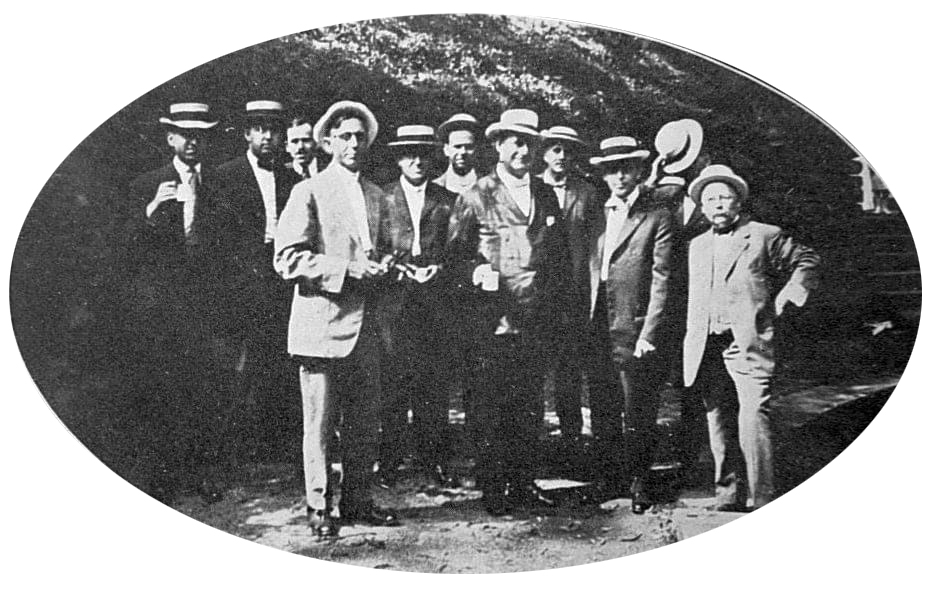
Orator, lawyer and politician William Jennings Bryan was one of the most popular lecturers on the Chautauqua circuit. Here the Lititz Chautauqua Committee greets Bryan, as he arrives in the borough to speak on July 25, 1914.
Lititz Historical Foundation
Arguably, the most famous of the speakers was William Jennings Bryan (1860–1925), who presented his famous lecture “The Prince of Peace” more than 3,000 times at tent Chautauquas across the United States. Bryan made a national reputation for himself as one of the greatest orators of his time, eventually becoming a threetime Democratic presidential nominee. To promoters, he was considered an easy speaker to manage because he did not use notes — and thus there was no risk for him losing them—and he only required good food and three pitchers of water.
In Pennsylvania, the Swarthmore Chautauqua Association was one of several dozen talent agencies that recruited and then dispatched speakers and musicians to tent or traveling Chautauquas. In 1920 the association provided more than 547 programs in 14 states and Canada.
As an example of a tent program, the Redpath Chautauqua Bureau promoted a wide range of speakers for its August 16–22, 1918, tent Chautauqua in Waynesburg, Greene County. Spurred on by the war raging in Europe, there was a strong patriotic flavor to the program. The keynote address was by William Rainey Bennett, whose style was described as full of “punch” and couched as “practical in his patriotism.” Another speaker was Capt. Martin D. Hardin, of the U.S. Army and the Red Cross, who spoke about the “German terrorism in sea, air and land.” Finally, there was a host of musicians, including Scottish tenor James Elcho Fiddes, Native American soprano Watahwaso of the Penobscot tribe, and the “Bohemian” Bohumir Kryl and his band.
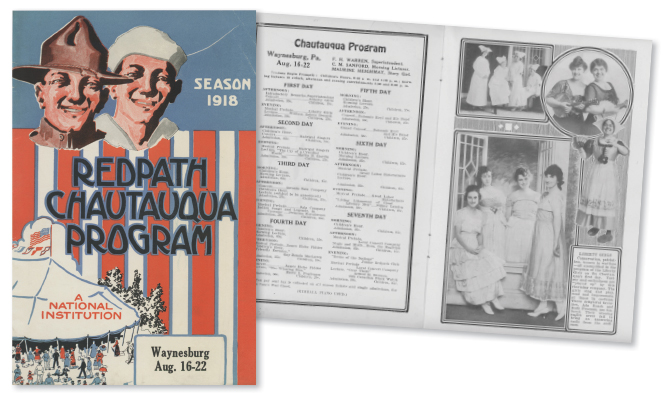
The Redpath Chautauqua Bureau published this program for the tent Chautauqua in Waynesburg, Greene County, August 16–22, 1918. Many of the lectures and performances were related to patriotism and America’s fight in World War I.
Collection of Peter S. Seibert
By the end of the 19th century, the Chautauqua movement was so successful that a commercial printing house was established in Meadville, in Pennsylvania’s Crawford County, to supply books and educational materials across the United States. Its most popular publication was the monthly magazine The Chautauquan, which contained both updates on summer programs around the country as well as reading for various classes. The only Pennsylvania Chautauqua to receive regular mention was the one held at Mount Gretna. For example, in October 1898, the editors reported that there were more than 1,000 concerts, lectures and entertainments held at Mount Gretna in the prior season. Notable programming included the keynote address by the Honorable Henry Houck, Pennsylvania’s secretary of internal affairs, and musical entertainment by the Mozart Symphony Club and Lignante’s Neapolitan Band. In that same issue, articles for iscussion in Chautauqua reading groups included the role of the czar in Russia, American woman in science, and the recent campaign in the Philippines.
The tent Chautauquas were so popular that numerous program bureaus and associations were established to provide speakers, musicians and other entertainment. Pennsylvania was home to several firms that provided speakers and talent. An issue of the trade paper The Lyceum lists the following bureaus: the Labadie Bureau on Chestnut Street in Philadelphia that provided Jeannette Turner Broomell, a reader and impersonator performing Madame Butterfly; the Antrim Bureau of Philadelphia that represented Elizabeth de Barrie Gill, singer, reader and harpiste; and the Brockway Lecture Bureau of Pittsburgh that offered more than three dozen performers covering all manner of current topics.
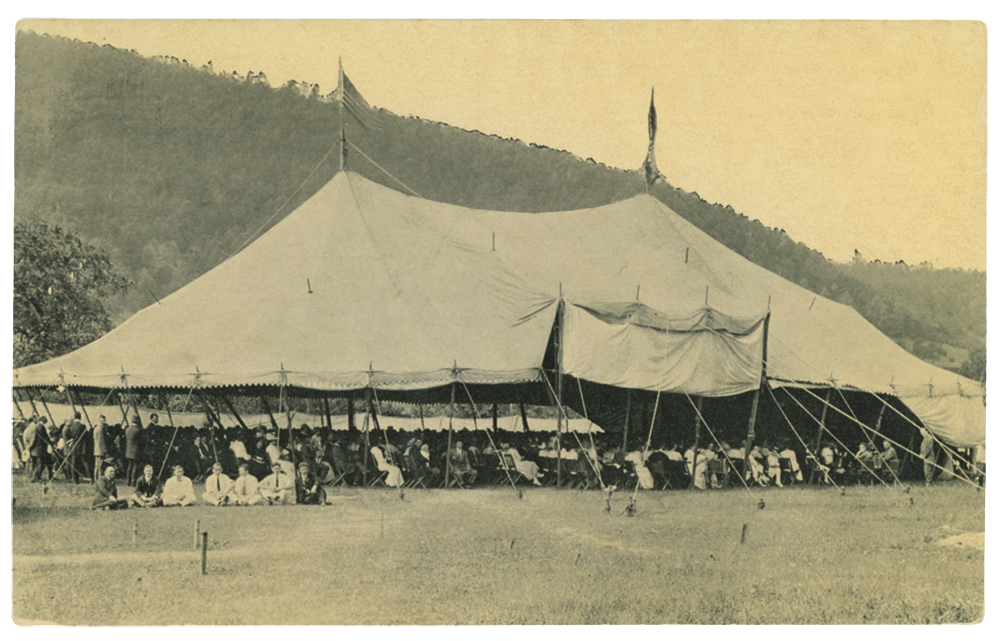
Tent, or circuit, Chautauquas traveled to rural areas. Organizers pitched tents, presented a roster of lecturers and performers for a few days, and then moved on to the next town. The tent Chautauqua pictured here took place in Westfield, Tioga County, in July 1913.
Collection of Peter S. Seibert
The popularity of the radio, the expansion of public highways, and ultimately the Great Depression took their toll on the movement. Audiences were changing and while most wanted traditional topics, others clamored for more relevant discussion, on subjects such as the Scopes Monkey Trial. Such controversial topics as evolution or temperance frequently caused issues for the agencies who were unable to predict a community’s interest. The world was changing and the Chautauquas had a hard time adapting. Keith Vawter of the Chicago Redpath Bureau — one of the leading providers of tent Chautauquas — found that his net proceeds for 1926 were only $345. Used to a much higher margin, Vawter quickly sold his tents and cancelled his contracts presciently realizing that the movement was dying. By the post–World War II era, the tent Chautauqua was dead, although the larger Chautauquas — such as Mount Gretna — were able to continue. Theater replaced the lecture hall, allowing more established communities to thrive.
The Spiritualist Camp
An interesting and much smaller iteration of both the Chautauqua and the camp meeting movements was the spiritualist camp. A product of a late-Victorian fascination with life after death, the spiritualist movement attracted widespread attention thanks to the interest of author Arthur Conan Doyle. As a result, summer spiritualist camps were founded based on the model of the Chautauqua, albeit with topics that might include a lecture on the Kabbalah or a demonstration of table rapping during a séance.
Today, the most famous surviving spiritualist camp is located in Lily Dale, New York, just a few miles from the original Chautauqua. Founded in 1879, the community functioned structurally like many of the camp meetings.
Pennsylvania had several spiritualist camps, including one at Willett’s Station in Bucks County. The most famous, however, was Camp Silver Belle, located in Ephrata, Lancaster County, at the former Mountain Springs Hotel. Founded in 1930 by Ethel Post-Parrish (d.1960) and similar to Lily Dale, the camp provided a summer program consisting of lectures and séances.
Centered on Post-Parrish’s mediumship, the camp attracted widespread regional attention. Post-Parrish had been a noted medium who gained a following because of the purported full-body manifestations of her spirit guide, Princess Silver Belle. The publication of photographs showing that the spirit was in fact a cardboard cutout led to her being discredited by some. The power of belief remained strong with others, though, and she retained a following who annually made pilgrimages to Ephrata to visit her summer camp.
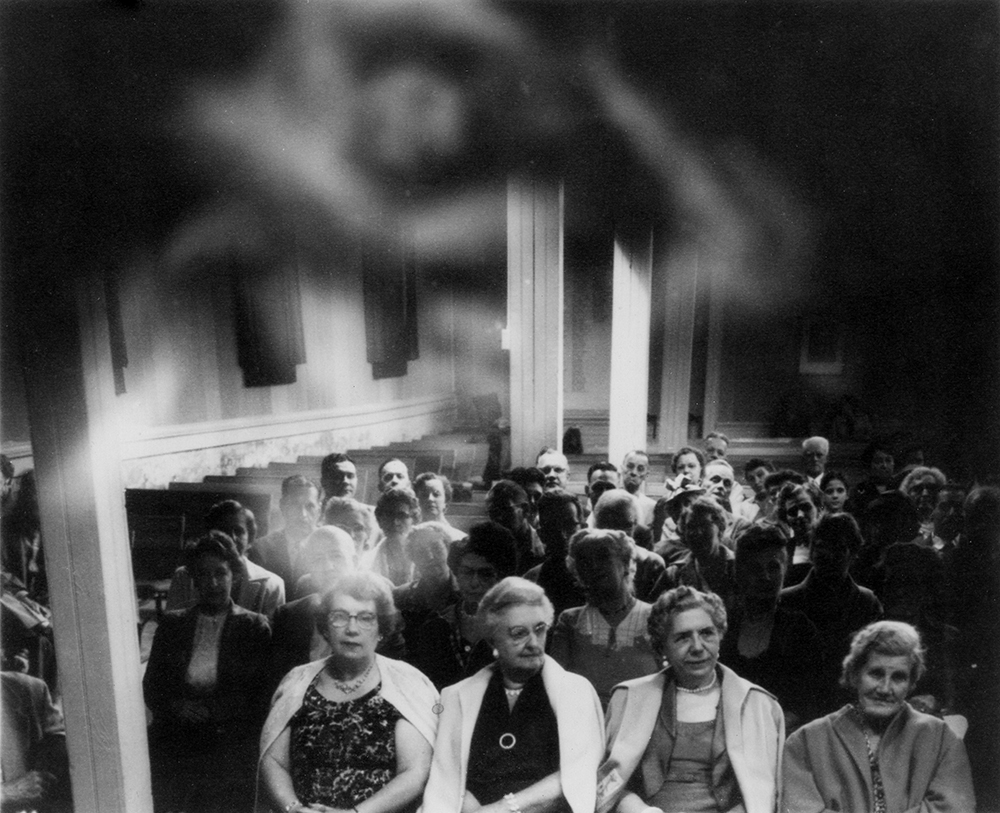
At Camp Silver Belle, visitors posed for photographs that when printed revealed spirits in close proximity to the sitters. In this mid-20th-century spirit photograph, several camp visitors sit in an auditorium as a ghostly ectoplasm circles above.
Collection of Alan E. Mays
One of the interesting options for those attending Camp Silver Belle was to sit for and purchase a spirit photograph taken by Jack Edwards. The photographs frequently showed a ghostly head floating in a mist over the subject. Some years ago, I was given access to Edwards’ photography kit, then in the property of a collector who acquired it when the hotel’s contents were sold. The kit consisted of a box of heads cut from mid-19th-century cartes de visite, a box of commercial-grade wool batting, and a large box of negatives. The accompanying boxes of negatives gave away the secret. Each subject had two photographic negatives — the first just of the person — and the second with the addition of a cut-out head and batting. Despite the campiness of the image to a modern eye, the sheer quantity of photographs suggests that there was quite a following for the images.
Located within 30 miles of Mount Gretna and Mount Lebanon, Camp Silver Belle was far quieter and more in the background than its camp meeting or Chautauqua neighbors. The reason for the low-key approach was because of the long-lasting impact among the public of the debunking of the spiritualist movement by magician Harry Houdini in the 1920s. During this time, there was a substantial public outcry about the more outlandish actions of some spiritualists who were shown to be frauds. Congressional hearings were held and as a result, spiritualist camps took an introspective approach to keep their work below the media’s horizon of interest. An informant told me that locals frequently visited the hotel dining room because it had a reputation for good food. He noted that most were unaware or turned a blind eye to the spiritualist aspects of Silver Belle.
Over time, the costs associated with operating the wooden hotel building as well as a declining national interest in spiritualism led to the closing of the camp in the 1990s. It was a unique phenomenon catering to a group of people whose summer passions were driven by the power of spiritualism.
The Future
Today, going to the summer cottage evokes images of canoes on a lake, walks among the ferns, and family meals at a table lit by oil or gas lamps. Such images would not have been out of place in the 19th century, when most of the summer cottage communities were established. The difference today is the shift toward a more secular story than hose in the past that were built around faith or learning.
Predicting the future of cottage communities is challenging. A brief review of websites from around the state shows that many are struggling to attract new and younger audiences. The families who founded these communities have died out or moved on in their interests. The result has been tensions within some communities where new and old do not always mix. In the end, however, most of the communities appear to retain a dedicated core that loves both the mission and the place. For them, getting in the car and going to open the cottage is part of their DNA and something that they can never give up.
Further Reading
Bitner, Jack. Mount Gretna: A Coleman Legacy. Bloomington, IN: AuthorHouse, 2011. / Gould, Joseph E. The Chautauqua Movement: An Episode in the Continuing American Revolution. Albany: SUNY Press, 1961. / Harrison, Harry P., as told to Karl Etzer. Culture Under Canvas: The Story of Tent Chautauqua. New York: Hastings House, 1958. / Bush, Barbara, and James Bush. ’Mere Reflections: A Unique Journey Though Historic Eagles Mere. Montoursville, PA: Paulhamus Litho, 1988. / Hines, Sara N. Cottage Communities: The American Camp Meeting Movement. Ashland, MA: Hines Art Press, 2015. / McFarland, J. Horace, and Robert B. McFarland. Eagles Mere and the Sullivan Highlands: Origin and History of the Region. Harrisburg, PA: McFarland, 1944. / O’Hara, Gerald. Ethel Post Parrish: Mediumship in America. New York: KDP Amazon, 2020. / Rivinus, Marion Willis, and Katharine Hansell Biddle. Lights Along the Delaware. Philadelphia: Dorrance, 1965. / Smith, Jeanne Jacoby. An Altar in the Forest: A History of Mount Lebanon Campmeeting, 1892–1992. Lebanon, PA: Mount Lebanon Campmeeting Assoc., 1990. / Vincent, John H. The Chautauqua Movement. Boston: Chautauqua Press, 1886. / Wicker, Christine. Lily Dale: The True Story of the Town that Talks to the Dead. San Francisco: HarperSanFrancisco, 2003.
Peter S. Seibert is president and CEO of Independence Seaport Museum. He is a public historian who has worked as an executive director, educator, curator, archivist, faculty member, author and board member.