
St. Michael’s Ukrainian Catholic Church in Shenandoah
Written by Pamela Reilly in the Wish You Were Here category and the Summer 2024 issue Topics in this article: anthracite, Anthracite Strike 1902, churches, coal mining, Eastern Orthodox Church, Pennsylvania Historical Marker Program, postcards, Schuylkill County, Shenandoah, St. Michael's Ukrainian Catholic Church (Shenandoah), Ukrainians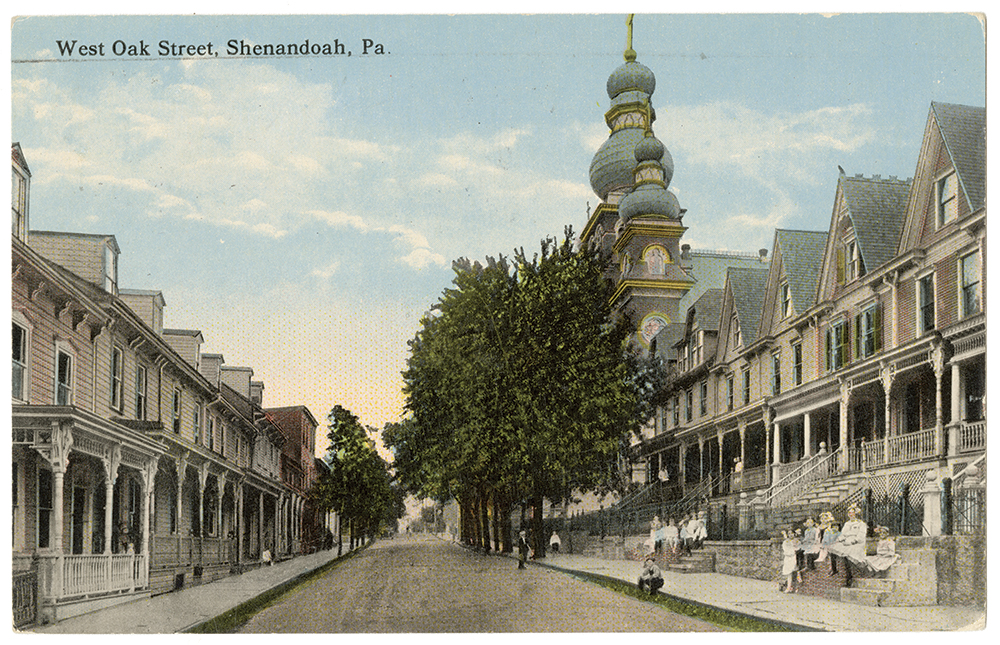
Since 1884 the onion domes of St. Michael’s Ukrainian Catholic Church on West Oak Street in Shenandoah, Schuylkill County, as seen in this circa 1914 postcard, have marked the presence of Eastern Europeans in this anthracite coal mining community.
St. Michael the Archangel in Shenandoah was the first Greek Orthodox Catholic church built in the United States. Ukrainian families raised money to bring Father John Woliansky to town to become the first Greek Orthodox priest in the country. As the Ukrainian community grew, a larger church was constructed in 1908 adjacent to the original, retaining the first building as a hall for the Brotherhood of St. Nicholas, founded in 1885.
Churches played an important role in the lives of immigrants, providing them with aid and support and serving as cultural centers to preserve their native language and customs. As the population of Shenandoah grew to almost 30,000 in 1930, other Eastern European ethnic parishes built their own churches, including St. Casimir (later St. George) Lithuanian Catholic Church and St. Stanislaus Polish Catholic Church. A Pennsylvania Historical Marker, erected in 2013 in Shenandoah, honors the Lithuanian community in Schuylkill County as the oldest concentration of that immigrant group in the country.
Many people from Eastern Europe were drawn to the abundant manual labor jobs in the anthracite coal region of northeastern Pennsylvania in the late 19th century. Polish, Ukrainian, Slovak, Czech, Hungarian, Lithuanian, Serbian, Croation, Romanian and Russian immigrants joined the Irish, Welsh, Scottish and Germans already working in the region. United States immigration records show that many Eastern Europeans chose Pennsylvania as their destination and nearly 50 percent of Ukrainians, sometimes listed as Ruthenians, Rusyns, Rusnaks or Galicians, settled in Pennsylvania in the peak migration years of 1877–1930. Coal mine operators recruited Eastern and Southern Europeans as cheap labor for their mines in response to working coal miners’ demands for shorter hours, better wages and safer conditions through strikes and unionization.
The first Ukrainian immigrants arrived in Shenandoah and Shamokin in the 1870s and 1880s, unwittingly serving as strike breakers amid often violent labor unrest. A Pennsylvania Historical Marker in Shenandoah notes the six-month anthracite coal miners’ strike of 1902, which led to rioting and violence, resulting in the governor ordering the National Guard to the coalfields. The strike continued despite military presence, and the federal government urged settlement, marking an important event in the labor movement.
While many Eastern Europeans stayed in northeast Pennsylvania, others moved west to work in bituminous coal mines or major industries in Pittsburgh, McKeesport, Homestead, Ambridge, Butler and New Castle. Although work in the coal mines was dangerous and the wages were poor, the immigrant labor force put down roots in Pennsylvania, establishing churches, schools and social clubs to support their communities and provide better opportunities for their children.
The golden onion domes of Eastern Orthodox churches can be found in many coal mining communities in Pennsylvania. The first Orthodox churches built in the late 19th century by local craftsmen were often small wood buildings of traditional form. As the church congregations grew, larger churches, often of brick, replaced the earlier buildings, but still incorporated the distinctive onion domes and highly decorative interior architectural details. Even Eastern Orthodox churches built in the late 20th century, such as the 1969 Holy Trinity Orthodox Church in Wilkes-Barre, show traditional Byzantine design influence with golden domes topped with crosses. Orthodox churches of the late 1800s and early 1900s can be found throughout the anthracite and bituminous coal regions, maintaining the faith and traditions of Pennsylvania’s Eastern European immigrants.
A Pennsylvania Historical Marker was placed at St. Michael’s Ukrainian Catholic Church, recognizing its place in history and noting its 1983 rebuilding in the Byzantine style after a fire destroyed the earlier church.
Pamela W. Reilly is a historic preservation specialist in the Pennsylvania State Historic Preservation Office.