
Six-Shooters in Somerset: The Curious Tale of a Northeastern Western
Written by Ryan Sopich in the Features category and the Winter 2024 issue Topics in this article: Adolfas Mekas, Baker-Whitely, coal patch, David C. Stone, Double-Barrelled Detective Story, film and filmmakers, Greta Thyssen, Hurd Hatfield, Jeff Siggins, Johnstown, Jonas Mekas, Karl Bissinger, Leonard Kiser, Mark Twain, Paul Benedict, Somerset County, Tanneryville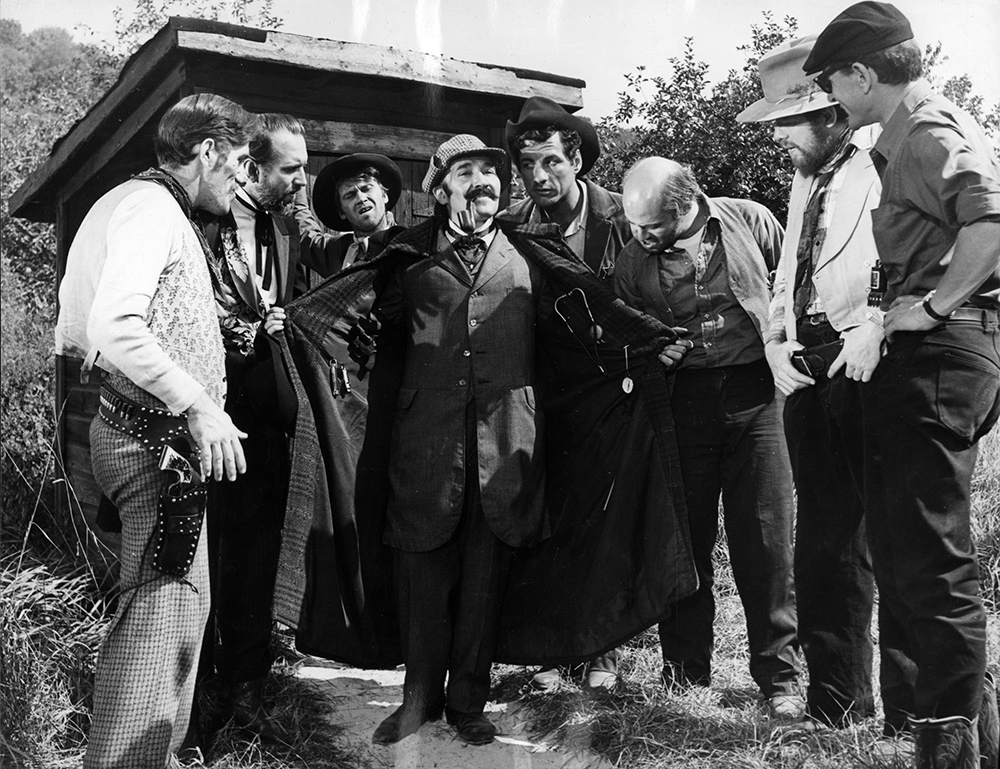
Sherlock Holmes pulls one over on the residents of Hope Canyon in this scene from The Double-Barrelled Detective Story. The characters, from left, are Wells Fargo Ferguson (Paul Benedict), Judge Parker (Ray Reinhardt), Shadbelly Higgins (Louis Waldon), Sherlock Holmes (Jerome Raphael), Sheriff Fairfax (Robert Winston), Byrne Piven (Bill Stone), and H.S. Stevens (Severn Darden). Director Adolfas Mekas is on the far right.
Karl Bissinger Papers, University of Delaware Library
Nestled among the hills of Somerset County, the one-street village of Baker-Whiteley epitomizes the many small-scale coal company towns that proliferated throughout southwestern Pennsylvania at the turn of the 20th century. Eclipsed by the grandeur of the region’s more imposing operations, these humble communities toiled in anonymity to unearth the fuel essential to the nation’s growing industrial empire. When the coal industry’s fortunes turned for the worse in the span of only a few decades, they were left behind to languish in their rural isolation.
In 1964 Baker-Whiteley was just such a place. Established in 1911 by the Baker-Whiteley Coal Co. of Baltimore, it at one time employed upwards of 250 workers and sported a company store, recreation hall, schoolhouse and baseball team. With its mines abandoned by the company in 1952, it had become a town without a future, seemingly destined to fade away with little evidence to mark its passage. Unbeknownst to its dwindling population, however, the very qualities that seemed to spell its demise had drawn a peculiar group of sightseers to its vicinity. Stricken by an unlikely love at first sight, they would immortalize Baker-Whiteley in Somerset County’s first feature film production, an eccentric cowboy comedy that, with some hitches along the way, brought the little town to the screens of Paris, Brussels, Sydney and beyond.
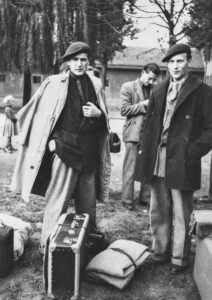
Adolfas and Jonas Mekas in Bremerhaven, Germany, awaiting their departure for the United States in 1949.
Estate of Jonas Mekas
The impetus for the project was Lithuanian immigrant Adolfas Mekas (1925–2011), whose arrival in the United States with his older brother Jonas (1922–2019) was preceded by a chaotic journey through war-torn Europe. While fleeing their rural village of Semeniškiai in 1944, the brothers were captured at the German border and imprisoned in a labor camp, from which they escaped shortly before the war’s end. After the liberation, they were resettled among Allied displaced persons camps before obtaining passage to New York City in 1949. From there, they would chart a staggering course through American cinema, jointly founding the influential magazine Film Culture in 1954 and finding themselves at the forefront of the country’s burgeoning independent film movement. While supporting each other’s projects, they embarked on radically different approaches to filmmaking — Jonas creating sprawling personal chronicles from the everyday footage he shot with a 16 mm camera and Adolfas discovering a vitality in silent film comedy that he harnessed for his own purposes. His 1963 film Hallelujah the Hills, an exuberant slapstick adventure filmed amid a frigid Vermont winter, was an unexpected hit that drew attention to the fledgling director nationally and abroad.
Riding high on the success of this low-budget comedy and the offers of financial backing it engendered from executive producers Zev Braun and Irving White, Adolfas and his producer, David C. Stone (1932–2011), went to work on an ambitious new project, an adaptation of Mark Twain’s novella A Double Barrelled Detective Story. The choice was far from arbitrary. To familiarize himself with the language, culture and history of his new nation, Adolfas had pursued a voracious reading program throughout the 1950s, acquainting himself with the bulk of the country’s classic literature, and along the way finding a spiritual kinship in the anarchic humor of Twain.
A Double Barrelled Detective Story, set in the late 1800s and among the author’s most obscure works, tells the tale of the treacherous Jacob Fuller. Vexed by insults received from his disapproving father-in-law, Fuller tortures his newlywed wife over the course of several months, finally tying her to a tree, calling forth bloodhounds to tear apart her clothes, and leaving her to be found there the next morning. Fuller disappears, his father-in-law dies of shame, and a few months later, the scoundrel’s abandoned wife gives birth to a son, Archy. Born with a bloodhound’s sense of smell, Archy comes of age and is directed by his mother to seek out Fuller and take revenge in a worldwide quest that eventually lands him in the silver mining town of Hope Canyon, California. There, he witnesses the chance arrival of Sherlock Holmes and the death of the sadistic Flint Buckner, a shack-dwelling prospector whose young apprentice, Fetlock Jones, is the victim of his constant abuse. When the con artist Holmes — who “can’t detect a crime, except when he plans it all out beforehand” — makes a false accusation, Archy uses his talents to solve the case, finding Jones guilty of the murder. He also discovers, alas too late, that Buckner was the false identity of his own father.
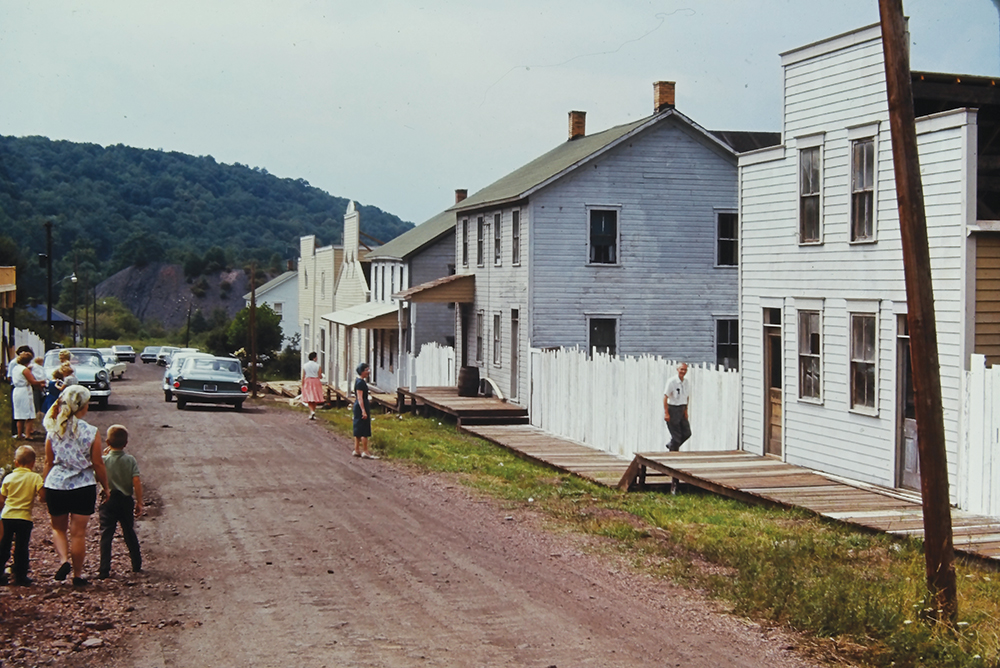
Baker-Whiteley on its way to becoming Hope Canyon.
Historical and Genealogical Society of Somerset County
Mekas adapted the novella to a film script in 1963, following the plot closely while giving greater breadth to the town of Hope Canyon and its residents. A minor character in Twain’s story, Shadbelly Higgins would become a fixture throughout the film, gunning down everyone from the town piano player to the near entirety of the Women’s Christian Temperance Union, but the most noticeable change was in the addition of the blonde vixen La Belle, a saloon singer who becomes Archy’s love interest by the story’s conclusion.
Envisioning Hope Canyon as an Old West town in the Hollywood style but still working within a tight budget, Mekas and Stone were attracted to the former coal mining regions of Somerset and Cambria counties for their proximity to New York City and their potential to offer a near-abandoned town suitable for a makeover. In the spring of 1964, the team went on a location scouting trip that, whether by chance or an extremely thorough itinerary, brought them to Baker-Whiteley, about 15 miles from Johnstown. More a mild declivity than a canyon, the locale nonetheless fit their purposes, as well as one facet of Twain’s description of Hope Canyon: “The world is ignorant of its name and place.”
Their Hope Canyon having been discovered and filming permissions obtained, the Mekas brothers (Jonas acting as Adolfas’ assistant throughout the shoot) and Stone became regular visitors to the area as the film entered its preliminary stages of production in the summer of 1964. Beyond offering a pragmatic solution to the search for a location, Baker-Whiteley, and the county as a whole, would serve as a much-needed connection to the pastoral landscape that the brothers had been forced to flee 20 years earlier. This exile and the attempts to find some vicarious attachment to the world of their childhood was described succinctly by Jonas: “The minute we left, we started going home.”
In one of the many letters written to his mother in these years of absence that continued until 1971, Adolfas expressed his joy at their rural sojourn, and while describing the nature of the film underway with a touch of hyperbole, he made explicit the area’s position as a surrogate homeland through another, more reverential layer to the film’s geographic playfulness: “The film is huge, and it will cost a lot of money. But I have a good producer who is wealthy — he is paying for everything. . . . At the start of the film one actor has to travel around the whole world: he goes through Australia, Italy, Africa, India and other lands. Among all these travels I will also show one episode from Semeniškiai and it will say on the screen: SEMENIŠKIAI! You see, I never forget our beautiful village. And I will mention its name whenever I can. . . . The film is so big that we will need 100 actors, horses, elephants, trains and other peculiar things. . . . I spend two days in the state of Pennsylvania every week. It is beautiful there: forests, greenery, little towns, delicious milk!”
With these weekly visits the transformation of the dying patch town into a rough and tumble silver mining outpost would begin. Obtrusive telephone poles were removed, boardwalks were constructed, and the facades of a saloon, opera house and bank disguised clapboard company houses. The services of local laborers were essential at this stage of production, and of the roughly $60,000 contributed to the area economy by the film, a considerable portion was paid to the carpenters, electricians and other workers employed in bringing Hope Canyon to life.
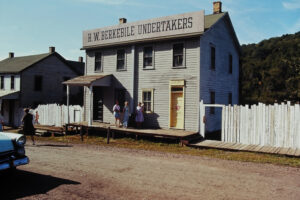
H.W. Berkebile Undertakers, named in honor of the film’s production foreman, another county resident.
Historical and Genealogical Society of Somerset County
Harold W. Berkebile of nearby Stoystown functioned as the production foreman, and his assistance was rewarded with not only a small role in the film but also his name emblazoned across one of the town’s fictional businesses, H.W. Berkebile Undertakers. Not content to remain at a distance, Adolfas and Jonas busied themselves among the working crew, lending a hand as needed and endearing themselves to set photographer Karl Bissinger in their manner of addressing everyone, from technician to garbageman, as “sir.”
It was not long before local media caught wind of the bizarre changes taking place at Baker-Whiteley, and as construction progressed into August, the town became a regional tourist destination, with a mile of parked cars stretching into nearby Hooversville and weekend sightseers thronging the town’s lone street. This burst of activity, the last the town would ever see, was captured by Jonas and later incorporated into his 1978 film In Between. The footage, a brief 30 seconds of couples strolling the make-believe town hand in hand with their children, set to a longing 1920s pop song titled “Paradise Lost,” is a testament to the transfiguring power of Jonas’ approach to filmmaking — the very act of pointing the camera, imbuing his subject with a significance and dignity all its own.
As August drew to a close, Baker-Whiteley’s makeover had been completed and the film’s cast, lodged at the Fort Stanwix Hotel in Johnstown, could at last step in front of the camera. Hurd Hatfield, in the dual role of Archy’s conniving father turned cantankerous miner Flint Buckner, was the standout among a cast largely composed of newcomers and undistinguished players; he had been immortalized playing the title role in Albert Lewin’s 1945 film adaptation of Oscar Wilde’s novel The Picture of Dorian Gray and appeared in major Hollywood productions of the early 1960s like King of Kings and El Cid.
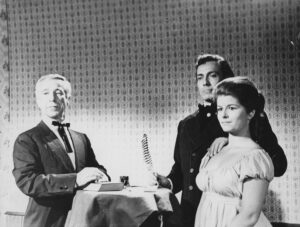
Hurd Hatfield and Flora Elkins, as Archy’s parents in the film, sign their marriage documents.
Karl Bissinger Papers, University of Delaware Library
In the role of Archy was fresh-faced Jeff Siggins, a Warren, Pennsylvania, native whose training under an aged Buster Keaton caught Mekas’ attention (he would direct Siggins to imitate one of Keaton’s signature pratfalls upon the receipt of a buckshot greeting from Hatfield).
Greta Thyssen, last among the film’s headliners, played Mekas’ creation, La Belle. The Danish actress, once a body double for Marilyn Monroe and a victim of the antics of the Three Stooges in three of their later 1950s shorts, had made her way to The Double- Barrelled Detective Story through a career largely confined to B-movies and television productions. She provided an amusing cattiness to the proceedings, reacting with shock at the sight of her 5-foot, 7-inch, 115-pound leading man and referring to Stone as a “25-cent producer” for accidentally leaving her behind at the Fort Stanwix on a filming day.
Among the film’s supporting roles, first-timer Paul Benedict is undoubtedly the most recognizable. Described by Bissinger as “an ugly [Jean-Paul] Belmondo [who] could play Cyrano without makeup,” Benedict would carve out his niche in television history as Harry Bentley on The Jeffersons and the Mad Painter on Sesame Street. Playing the role of Wells Fargo Ferguson, Benedict was placed in the good company of prolific actors Ray Reinhardt and Severn Darden; the trio’s wildly exaggerated expressions more than once monopolized the camera’s attention. Other Hope Canyon residents included Robert Winston (Sheriff Fairfax), an obscure actor in a handful of low-budget films, and Louis Waldon (Shadbelly Higgins), a future member of the Andy Warhol entourage whose tenure in the western comedy field would continue with 1968’s low-budget Lonesome Cowboys, an overtly gay spoof of the genre. Jerome Raphael, the only actor returning from Mekas’ previous film, embodies Twain’s Sherlock Holmes as con artist.
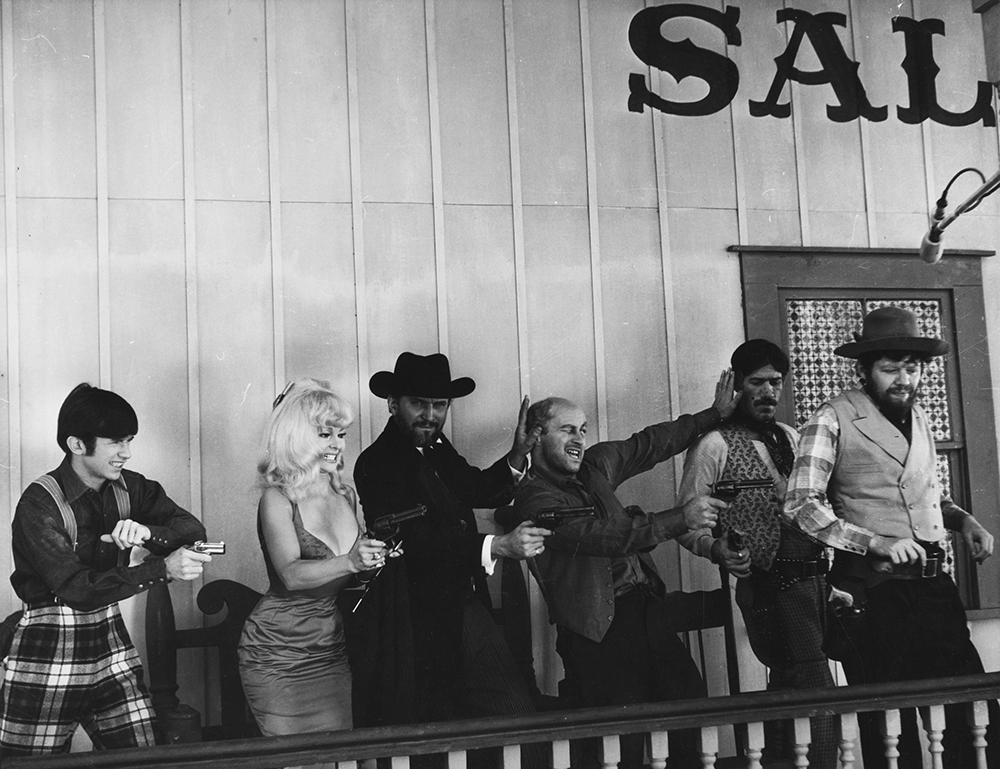
Archy (Jeff Siggins), LaBelle (Greta Thyssen), Judge Parker (Ray Reinhardt), Byrne Piven (Bill Stone), Wells Fargo Ferguson (Paul Benedict) and H.S. Stevens (Severn Darden) open fire on a bank robber.
Karl Bissinger Papers, University of Delaware Library
The cast was rounded out with regional performers, particularly from the Penn Wood Players, a community theater group based in Johnstown, who would later play a crucial part in screening the film locally. Several members of the Duquesne University Tamburitzans were also recruited to appear as cancan dancers at the Hope Canyon Saloon. Extras were gathered from among area residents and bystanders (including a house cat, a few bloodhounds, and a stagecoach), and according to Siggins, locals in the film can easily be picked out by their freshly store-bought cowboy hats.
The most curious local figure attached to the film, however, appeared on screen only through a familiar. Leonard Kiser, big game hunter, showman and proprietor of nearby Central City’s Kiser Wildlife Ranch, a full-blown zoo of which area residents’ descriptions border on the surreal, provided animals and technical assistance on the film. Alas, the most dramatic sequence planned with one of Kiser’s animals culminated in disaster. In a scene planned to heighten the majesty of Greta Thyssen’s arrival at Hope Canyon, the actress was to descend from a stagecoach preceded by her leashed pet, Kiser’s trained mountain lion, Jackson. After an initial rehearsal resulted in little more than mutual snarling, an attempt was made to film the actress and lion separately, with Bissinger’s hand holding the leash in a closeup that would allow editing to give the illusion of Thyssen controlling Jackson.
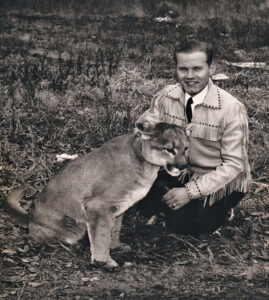
Animal trainer Leonard Kiser with his mountain lion, Jackson.
Courtesy of the Shade-Central City Historical Society
When the effect proved unsatisfactory, one last effort was made to capture the sequence. With Jackson partially sedated, a rehearsal of the scene was performed without issue, but Adolfas neglected to consider that the real take would be accompanied by a pistol-fire salute from the townsfolk. Spooked by the sudden racket, Jackson latched onto Thyssen’s leg, sending her to the Johnstown Hospital for stitches and forfeiting his own chances at international fame. All was not lost for Kiser, however, as his pet black bear, not quite a cub but far from intimidating, would make the final cut. As for Kiser himself, he would appear a decade later as an actor and animal coordinator in another obscurity of Somerset cinema, Pittsburgh filmmaker David Allen Greene’s 1975 adventure film Panic in the Wilderness, shot partially in the woods around Central City.
Beyond the lion incident, the filming of Detective Story proved fairly uneventful, much to the sorrow of Johnstown Tribune-Democrat reporter Thomas H. Russell, who lamented after baking in the September heat for several hours of monotonous rehearsals, “There’s too much nothing between somethings.”
During off-hours, the cast and crew explored Somerset and Johnstown, and Siggins was given Baker-Whiteley’s VIP treatment in the form of a tour through one of the town’s abandoned coal mines. Friends and family were also invited to drop by the film shoot turned rural retreat, some of them even appearing in brief cameo roles, like film critic P. Adams Sitney, who can be seen gawking in the wake of Greta Thyssen, or Adolfas’ future wife, Pola Chapelle, who also sang the film’s theme song. Several filming trips were made to locations outside of Baker-Whiteley as well, including to the nearby town of Hollsopple, an elaborate mansion in the vicinity of Johnstown, and the Quemahoning Dam, the last of which did not appear in the final cut. The interior of the Hope Canyon Saloon, a prominent location throughout the film, was shot on the premises of the Jonel Construction Co. in Tanneryville.
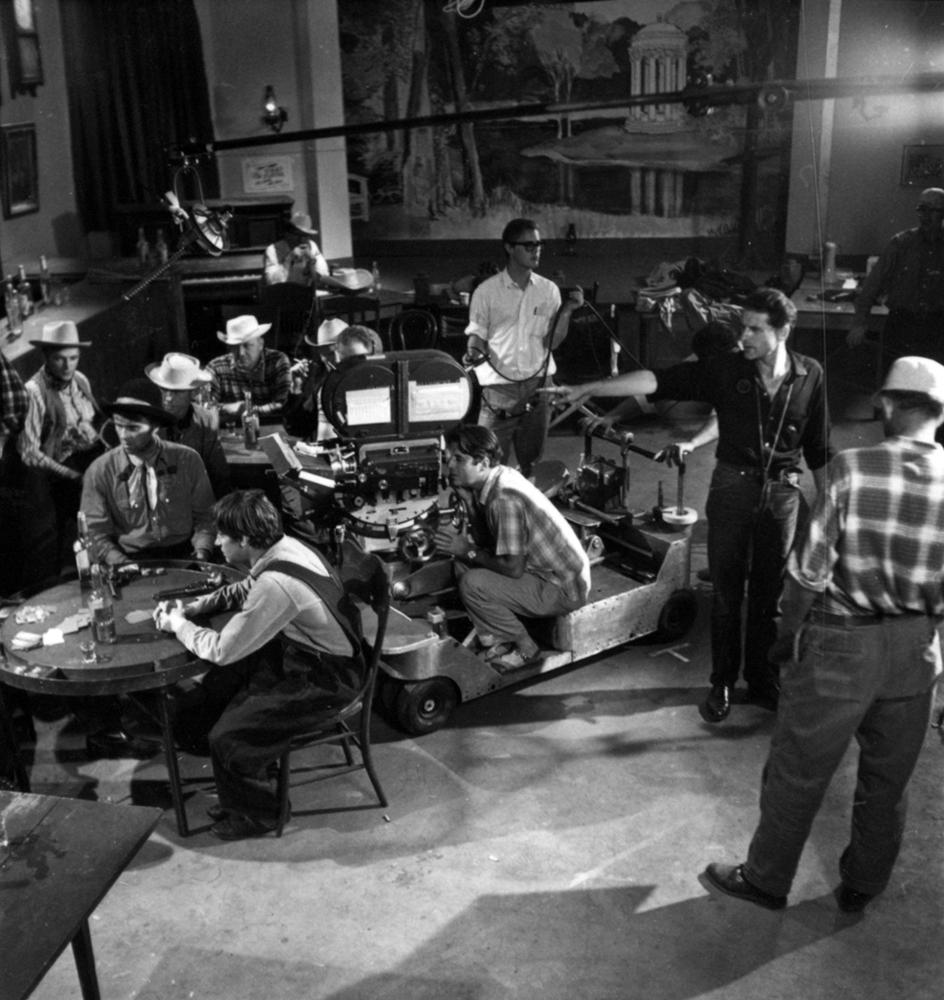
The set of the Hope Canyon Saloon was constructed on the premises of the Jonel Construction Co. in Tanneryville.
Karl Bissinger Papers, University of Delaware Library
After seven weeks and 20 hours of material filmed, the shoot drew to a close on October 15. On that day, Jonas wrote his mother from Johnstown, informing her of the shoot’s conclusion, Adolfas’ weight gain of “five kilograms,” and their mutual feelings of refreshment despite a grueling schedule that spared only four or five hours of sleep per night. Interviewed by the Tribune-Democrat, David Stone expressed his gratitude towards the people of Baker-Whiteley and the surrounding area, as well as his interest in potentially screening the film in Johnstown after it made the rounds of European film festivals. For the present, however, the film still required editing, dubbing, music and other post-production additions. Its soundtrack was recorded by a symphony orchestra in Germany and editing occupied Adolfas into May 1965. Upon completion, the film was given a last-minute recommendation to the International Critics’ Week section of the 1965 Cannes Film Festival.
To the disappointment of Stone, Mekas and their colleagues in the New York City film scene, Detective Story was rejected at Cannes on the basis that Mekas had already been represented in Critics’ Week with the appearance of Hallelujah the Hills two years prior. Thus, far from the prestigious screens of the European festival circuit, the film returned homeward much faster than anticipated. Its world premiere occurred on May 19, 1965, at Johnstown’s Lyric Theatre, colloquially known as “The Bug House” for its less than ideal sanitary conditions. The special one-night presentation was sponsored by the Penn Wood Players and drew an audience of 500 spectators, a lucky few enjoying the novelty of catching a glimpse of themselves on the big screen. Ever faithful to Hope Canyon, Adolfas and Stone were present for the Wednesday night screening.
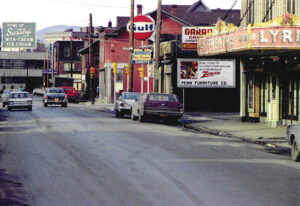
The Double-Barrelled Detective Story premiered at The Lyric Theatre, or “Bug House,” at 513 Franklin Street in Johnstown. The building is long gone, having been demolished to make way for the Route 56 overpass.
The Artique Gallery, Johnstown
Some degree of confusion remains with respect to the events that followed the film’s premiere in Johnstown, and there is reason to believe that the version of the film shown in early screenings differs from the print that survives today. The film shown in Johnstown was described by the Tribune-Democrat as a “2-hour spoof on westerns” — a duration that corresponds with an earlier estimate from Stone that the film would run 95 to 115 minutes — and an August screening in Spain accompanying a program on American independent cinema listed the film’s duration at 93 minutes; however, the extant copy of Detective Story held at the Royal Belgian Film Archive clocks in at a brief 80 minutes, a time that first appears in ads for a screening in Chicago in December. Based on a letter written by Jonas to his mother dated May 15, 1965, in which he stated, “Adolfas has just finished editing his film — the one we were shooting near Pittsburgh last fall,” it would appear that a longer “director’s cut” of the film was prepared immediately prior to the Johnstown premiere, but at some point between August and December 1965, the film was reedited to a shorter length. This 80-minute cut also exhibits a sloppiness at odds with Adolfas’ previous work: sequences are rendered incomprehensible or unresolved by the omission of connecting scenes, and set photographs attest to a considerable amount of material filmed but not included. In light of these details, later statements from Adolfas that dissatisfied executive producers had tampered with the film appear to be valid.
After the Spanish screening, between late August and early September, the film — presumably in its longer cut — made its way to the Venice Film Festival, where it received a positive review in Variety. The issues with producers and the reediting of the film likely arose upon its return stateside, and for reasons again unclear, it was ultimately decided that the film would not receive commercial distribution. With assistance from his friends, Mekas was able to acquire the truncated print of the film and opted to distribute it himself, beginning with the aforementioned Chicago screening in December 1965. The film received an unremarkable welcome from Chicago critics, and it does not appear that it was screened again domestically until a New York City outing in 1969. In the meantime, the film went to France in 1967, where it was bizarrely retitled Mekas Western (in a few instances, it was also released as La Belle du canyon de l’espoir, as well as under the novella’s French title, Plus fort que Sherlock Holmes). Reception again ranged from lukewarm to negative, the film magazine Positif summing up the general attitude in its review: “A titillating ad for the film shows a scantily clad damsel tied to a tree, shouting, ‘I like Mekas Western!’ After the agony she must have already endured, who can blame her!”
These largely negative reactions can be explained not only by the film’s compromised presentation but also by a misunderstanding of its intentions. Reviewers repeatedly referred to the film in terms of “spoof” or “parody,” but the essence of Detective Story was best characterized by Mekas’ wife years later, describing it as “[Adolfas’] salute to Twain and his decidedly 19th century humor.” Indeed, the film strikes one less as a parody subverting well-worn cliches than a gleeful immersion in an American pop mythology — inherently playful because unsullied by the solemnity of high culture — among which the director found a sense of belonging. Much as Archy would rather shoot the breeze with newfound friends than continue the pursuit of his dastardly father, Mekas is content to use the shaggy dog nature of the story’s central plot as an excuse to stop at Hope Canyon and bask among the folklore of his adopted nation, quoting Twain, evoking Mike Fink or “carpetbagging Yankees,” and savoring the eccentricities of the language’s idioms often lost upon its native speakers: “Hardly room enough to swing a cat,” remarks one character in reference to Buckner’s desolate lodgings — cut to the interior of his shack, where Buckner demonstrates that, actually, there is enough room to swing a cat, several times in fact. Mekas’ cinematic points of reference draw from the iconography of the silent era: Iris shots and intertitles abound, sped-up frame rates serve a series of slapstick gags, and an absurd reinterpretation of the classic ride-to-the-rescue ending favored by D.W. Griffith brings the film to its conclusion. Yet these moments are humorous, not so much as identifiable targets of spoofing, but in their conscious relishing of an early American cinema not yet unmoored from its 19th-century roots.
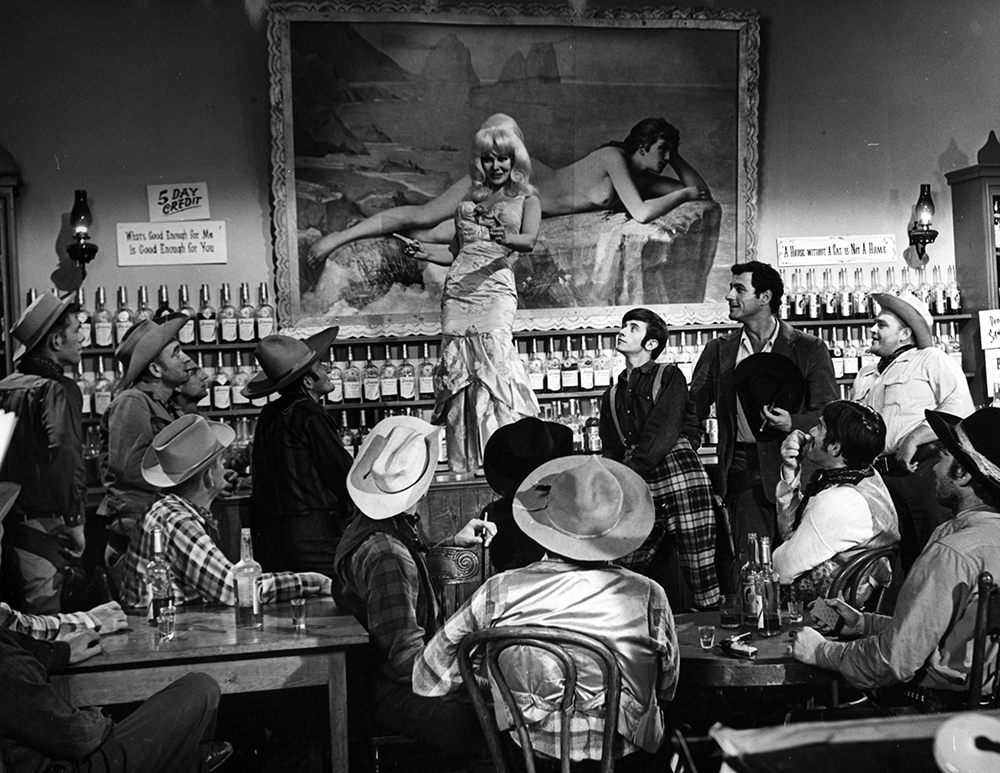
La Belle (Greta Thyssen) wows a tough crowd in Hope Canyon. The majority of the men wearing cowboy hats were local extras.
Karl Bissinger Papers, University of Delaware Library
The film is most interesting to the historian, however, in ways likely unintended by its creator. The side-effect of any location shoot, no matter how “made-up” it may be, is documentary in nature. Whether the Johnstown of Slap Shot, the Braddock of George Romero’s Martin, or the Baker-Whiteley of The Double-Barrelled Detective Story, low and midbudget filmmaking based in southwestern Pennsylvania during the 1960s and ’70s created a vital document of the places left behind by the withdrawal of the region’s coal and steel industries and in the specific case of a small town like Baker-Whiteley offers a detailed visual record of a locale otherwise neglected by more official forms of documentation. To an audience in the know, this secondary layer of meaning can also provide as much humor as any of the film’s intended effects: The gunslingers of the Hope Canyon Saloon turn out to be familiar steel mill workers playing dress-up, the former Calvert Supply Co. Store slouches behind the imperious entrance of a stagecoach, and a well-remembered local butcher is seen standing unfazed under a hail of bullets. And, with a poignancy belied by its surface silliness, the film freezes in time a declining town as it appeared for one last hurrah.
After the failure to properly launch Detective Story, Mekas’ career as a director floundered, and the film remained mostly unseen, though it reappeared at least once for a screening in Australia in 1974. As the story so often goes, the film would only widely resurface after Mekas’ passing in 2011, screening at retrospectives in New York City, Paris and his home country of Lithuania. Its crowning moment, however, was as the grand finale to the 2014 L’age d’or Festival in Brussels, Belgium, a week-long celebration of experimental cinema for which the film received a complete digital restoration from the Royal Film Archive of Belgium. Thus, while Baker-Whiteley today verges on disappearance, its image has nonetheless traveled far beyond the confines of Somerset County and even into the digital age.
Unfortunately, the film remains unreleased on home video or streaming, and this lack of availability has resulted in Detective Story’s neglect in overviews of the cinematic history of southwestern Pennsylvania. Beyond its curiosity value to the people of Somerset and Cambria counties, the film and its history attest to the cultural and economic benefits of local, small-scale film production undertaken in a spirit of mutual cooperation. Drawing personal comfort and artistic inspiration from the landscape and people of the region, Adolfas Mekas in turn immortalized them in an offbeat, ramshackle tribute to the cultural heritage of the nation as a whole.
The author would like to thank Jeff Siggins, David Allen Greene, the Shade-Central City Historical Society, the University of Delaware Library, the Cambria County Library, and CINEMATEK/Royal Belgian Film Archive.
Ryan M. Sopich is a Somerset County native with an interest in the history and culture of the region’s coal company towns. He is the author of Gray, Pennsylvania: The History of a Company Town.