
“Scenes of War Are Not Forgotten” The Civil War Drawings of Anthony Goldsmith
Written by Kristin Lapos in the Hands-On History category and the Winter 2026 issue Topics in this article: American Civil War, Anthony Goldsmith, Bucks County Historical Society, Civil War scouts, clocks and clockmaking, diaries, Gladys Goldsmith, Philadelphia, Quakertown, sketches, William Anthony Goldsmith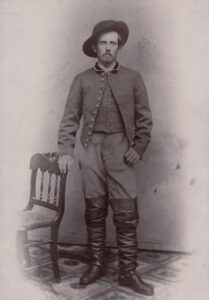
Anthony Goldsmith, pictured here in the 1860s, enlisted in Philadelphia in April 1861 and served in Company I of the 22nd Regiment of the Pennsylvania Volunteers and Company A of the 113th Pennsylvania Volunteers, also known as the 12th Pennsylvania Cavalry.
Collection of the Mercer Museum Research Library of the Bucks County Historical Society
“The scenes of war have long since past and the Ex Soldiers have long since settled down to peaceful vocations of life yet the scenes of war are not forgotten,” a Civil War veteran wrote in an 1889 letter to his former comrade-in-arms Anthony Goldsmith (1839–99). “The picket[,] the Skirmish line[,] the Battles[,] the Raids and night marches are all fresh in our memories, yet there are many who like myself are and have been for years suffering with disabilities Contracted while in the line and Discharge of duty while Soldiering for the United States.”
Goldsmith had reason to sympathize with his correspondent’s plight. He, too, had been suffering from an old war wound — a fateful kick of a horse’s leg while in Bolivar Heights, Virginia, in 1864 that left him with lifelong health woes. That an errant horse would be the cause of Goldsmith’s troubles is not surprising, given his duties. Goldsmith served as a cavalry scout, often advancing behind enemy lines to retrieve intelligence and documenting the positions of Confederate and Union troops.
In the course of these duties, he created — and later preserved — a remarkable archive of “the scenes of war” as he saw them, in the form of more than a dozen handmade drawings showing troop positions and lines of battle. Thanks to the work of the staff in the Mercer Museum Research Library of the Bucks County Historical Society, these fragile drawings have now been digitized and are available for public access. The drawings are part of a large collection that documents the lives of Goldsmith and two generations of his descendants. Together, what they left behind tells a fascinating story of one family across two centuries.
Clockmaker and Soldier
Goldsmith’s journey to the battlefields of America was a long one. Anthony William Goldsmith was born Anton Goldschmidt on April 6, 1839, near Baden, Germany. He immigrated to Philadelphia in 1852 and began working as a clockmaker under the tutelage of his half-brother, Sigmund Naudascher, who had himself learned the trade in Germany. A handwritten document in the Goldsmith collection notes that Naudascher made a complete clock as part of his apprenticeship that was still in the family’s possession in the early 20th century.
In a different world, Goldsmith might have settled permanently in Philadelphia, eventually joining the bustling ranks of the city’s small businessmen; however, destiny would intervene. He likely could not have imagined as he made his way through a new country that he would soon be fighting for it. The first shots fired at Fort Sumter on April 12, 1861, would change his life.
At age 22, Anton left Naudascher’s employ and enlisted in April 1861, almost as soon as the fighting began. Before his final discharge in July 1865, he would serve in Company I of the 22nd Regiment of the Pennsylvania Volunteers and Company A of the 113th Pennsylvania Volunteers, also known as the 12th Pennsylvania Cavalry. Goldsmith reenlisted several times and rose through the ranks as fifth sergeant, first sergeant, first lieutenant, and finally captain of Company A.
Larry B. Meier, in his history of the 12th, initially paints an unflattering picture of the unit: “The Regiment participated in only one of the truly major battles of the war, Antietam, and then only on the periphery.” The unit also “labored under a bad reputation, wrapped in suspicion, while branded with a stigma. The numerous ‘Dutchmen’ who originally manned the Regiment brought with them the usual stereotypical prejudices which seem to always attach to minorities with poor English and strange manners and customs.”
The unit’s poor reputation is undeserved, Meier writes, noting that they often manned dangerous scouting expeditions into the Shenandoah Valley. As a scout, Goldsmith participated in these expeditions, and they were the origin of his remarkable archive of drawings and recollections.
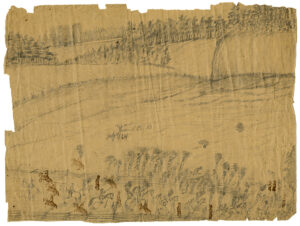
Goldsmith made this drawing, showing a landscape near Frederick City, Maryland, on July 9, 1864. Stamped cavalry and infantry are visible in various locations.
Collection of the Mercer Museum Research Library of the Bucks County Historical Society
The Drawings
Goldsmith’s drawings, made in the field, are a mixture of landscape sketches showing camp life, including one depicting a line of tents, and more formal drawings showing the positions of troops. Some of the drawings were featured in an article in the Bucks County Traveler magazine in June 1955, where the author noted that “The scout was provided with small lead stamps, one to print infantry and the other for mounted troops.” One such drawing, penciled with the location “near Frederick City, MD” and dated July 9, 1864, depicts a vast landscape with hills, trees and fence and, in the foreground, stamped cavalry and infantry. Another drawing, noted as “Winchester, 1863 June 15th — 3rd day” includes stamped soldiers and small, freehand drawings of cannons.
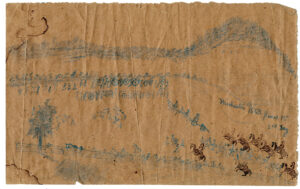
Goldsmith made this drawing, including stamped soldiers and small freehand drawings of cannons, on June 15, 1863, at Winchester.
Collection of the Mercer Museum Research Library of the Bucks County Historical Society
The reverse of some of the drawings include notations, likely made later by Goldsmith’s son William, that relate some of Goldsmith’s experiences on that particular scout. One drawing, dated 1862 and labeled “Manassas near Bristow,” shows a number of troops — labeled “Rebs” — in the distance. On the back of the drawing, William Goldsmith recorded his father’s experience: “12th Penna. up on hill, Rebs down in the valley, Stuart’s cavalry in rear, all were for themselves so all would have been gobbled up . . . A. Goldsmith crawled into cupboard, although chased by Rebs. Rebs did not find Father. He heard them make the remark, Could not see what’s become of that damned Yankee.”
Did William record this story as his father told it in front of him or did he jot it down years later, maybe even after his father’s death, from twice-told childhood tales? Indeed, Goldsmith’s obituary in the August 31, 1899, edition of the Quakertown Times notes that “in later years he often related his experiences of his close calls to his many friends.”
Sadly, many of the drawings are badly deteriorating, from both time and from old tape repairs. The drawings are now fully digitized and available upon request, with access to the originals highly restricted due to their condition. Efforts to raise funds for conservation of the original drawings are ongoing.
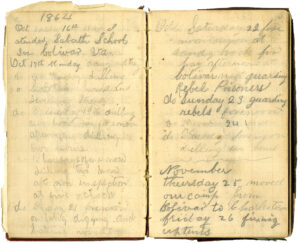
These pages from one of several short diaries kept by Anthony Goldsmith during his Civil War service include entries from the fall of 1864, when he was “Guarding Rebel Prisoners” and finding time to attend “Sabath School.”
Collection of the Mercer Museum Research Library of the Bucks County Historical Society
Life in the Field
Scouting was not Goldsmith’s only job in the service. Several journals, also preserved in this collection, document the mundanity of army life. He “attended Sabath [sic] School” in Bolivar, Virginia, on October 16, 1864; only a few days later, on October 22–23, 1864, Goldsmith was “guarding Rebel prisoners,” and on October 28, he was “doing little things round the tent afternoon picket.” Other entries are more somber, including lists of soldiers “missing in action” and presumed deserters. The two small “journals” are typical for their time and short, but were clearly done in the field, on the go. Two handmade lead tags listing Goldsmith’s name, unit and some of the campaigns he participated in also arrived with the collection, though whether they were made in the field or after the war is unknown.
Goldsmith may have had more personal attachments on his mind in the field. A well-worn letter from an unknown woman in Philadelphia who was not happy with his enlistment is one of the more amusing parts of the collection. Beginning her letter, “Friend Anthony,” she writes that “I all ways loved you very Much But Times you have been Gone I have keep company with Another young man For I never Wanted you to go But you wood [sic] And so you see the consequences.” Though the name of the woman is unclear, the letter was not written by his future wife, Mary, and the woman’s identity and fate are unknown.
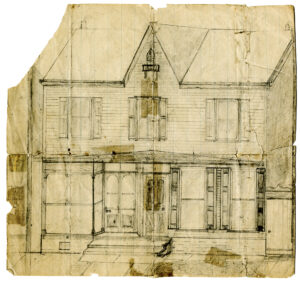
This “Plan for Front Store and Residence,” sketched by Goldsmith in the 1880s, shows the A. Goldsmith Jeweler watch and clock shop he founded after his war service at 242 and 244 Broad Street in Quakertown, Bucks County.
Collection of the Mercer Museum Research Library of the Bucks County Historical Society
Civilian Life: A. Goldsmith Jeweler
After the war, Goldsmith returned to Philadelphia to resume his career as a clockmaker and jeweler. He then relocated to Quakertown, Bucks County, in 1866 where he opened his own jewelry store, A. Goldsmith Jeweler. Goldsmith’s jewelry store was at several locations in Quakertown but endured longest at 242 West Broad Street. There, Goldsmith repaired and sold watches, clocks, jewelry and other household goods. Ledgers from the store during Anthony’s tenure, largely from 1872 to 1886, show a thriving business serving many local families.
Goldsmith also continued to sketch scenes from his everyday life just as he had during his war service, and several of these drawings are also preserved in his papers. These later drawings include watch and clock designs, as well as the exterior of the jewelry store as it stood at 242 West Broad Street in Quakertown, sketched in 1885. Photographs of the interior of the store and of Anthony’s son William behind the counter of the store are also preserved. As of 2025, the storefront of the old jewelry store still exists in Quakertown, recognizable even today from Goldsmith’s 19th century drawings.
Although business was good, Goldsmith’s health was shaky, in part because of the injury from the horse’s kick during the war. In an undated “Affidavit of Disability” found among his papers, a captain in the 12th, John Johnson, testified to Goldsmith’s injury in the field on June 15, 1864, when the horse kicked him “in the upper part of the bowels, on the right side, seriously injuring him” and possibly causing chronic liver or spleen disease that would contribute to his death on August 26, 1899. In a letter to her son William in 1892, Goldsmith’s wife Mary recounts how Anthony “was sick all day” after carrying lumber and pears to their home in Quakertown. These bouts of illness became more common in his later years.
Like many war veterans, Goldsmith applied for and received a pension from the federal government for his service, and some of his pension documents — as well as letters from others hoping for support from Goldsmith for their own pension applications — are among his papers. Goldsmith had married Mary Breisch Strycker (b. 1843) soon after the war, and the certificate noting her widow’s pension — $12 each month after his death — was also found among the family papers.
Goldsmith and his wife had two children who survived to adulthood: William Anthony Goldsmith and Clara Amelia Goldsmith. Anthony’s children and grandchildren would play important parts in preserving his legacy over the next 140 years.
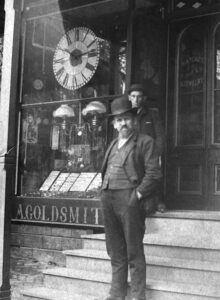
Anthony Goldsmith stands in front of his jewelry shop in Quakertown, Bucks County, in 1887.
Collection of the Mercer Museum Research Library of the Bucks County Historical Society
Preserving Anthony Goldsmith’s Legacy
Anthony’s son, William Anthony Goldsmith (1870–1948) took over the jewelry store and operated it with his family after Anthony’s death, changing the name to A. Goldsmith Son & Co. In a handwritten document found among his papers, William recalls — writing in the third person — that he “does not recall when he started in working at the bench, but thinks his actual work started at about the age of 12 or 14. While still attending school [he was] put to work during afterhours cleaning Yankee and Grandfather clocks and after leaving school, started in at the bench on watch, clock, and jewelry repairing.”
This long experience set him up for success in the small community of Quakertown, and business boomed. William was a meticulous recordkeeper. A “Record of Watches Sold” from 1899 to 1902, the first years of his tenure at the store, show a greatly expanded customer base that included local families like the Flucks, Louxes, Butzes and many others. Like his father, William repaired watches, clocks, and sundials. In addition to his work in the shop, he was an avid photographer. A large collection of his photographs and glass plate negatives showing people and places in Bucks County and beyond are preserved in the collection.
William was also interested in preserving the legacy of his father’s Civil War service. As noted above, he was the likely transcriber of stories and histories that appear on the reverse of his father’s wartime drawings, and he was also active in the Sons of Union Veterans organization. In 1905, he was instrumental in having his local chapter named “Captain Anthony Goldsmith,” No. 81, Division of Pennsylvania. According to its letterhead, the organization met each Monday evening at the Quakertown National Bank Building.
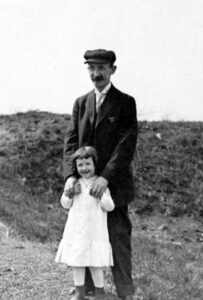
Gladys Goldsmith is seen here in the spring of 1912 with her father, William Goldsmith. Gladys and her sister Jeanne were dedicated family historians who preserved their grandfather’s Civil War sketches and documents about the history of their family’s jewelry store in Quakertown, Bucks County. Gladys eventually took over the jewelry store after her father’s death.
Collection of the Mercer Museum Research Library of the Bucks County Historical Society
William and his wife Jean had two daughters, Gladys and Jeanne, and Gladys (1908–98) took a special interest in both the jewelry business and Anthony Goldsmith’s Civil War materials.
Several handwritten notes in the collection, written by William, reveal that Gladys helped in the store from an early age and showed promise with the work. In the writings William agonizes over how to keep Gladys in his employ as she grew older, writing that “Gladys attained her 21st Birthday on Sat. Nov 2nd she has been a faithful worker and interested in her work[,] without her I would have been stuck. At her age she has been able to draw quite a few of the young folks.” Gladys was receiving other job offers, William was nearing retirement age, and “I can’t expect to hold her if she decides to go elsewhere.” Eventually, Gladys took over the business and operated it until her retirement in 1976.
Gladys married Russell Allison on March 7, 1959, at age 51. The Bell Telephone Co. helped to “phone” her wedding to her sister in Colorado. One wonders if young Anthony Goldsmith, enlisting in his adopted country’s war in 1861, could have imagined that his granddaughter’s wedding would be broadcast hundreds of miles to a state that had yet to enter the Union.
Gladys also shared her father’s dedication in preserving Anthony’s legacy. The ultimate survival of the drawings, the documents, and the photographs fell upon her — a third-generation descendant of a veteran from a distant war who carried her grandfather’s living memory to the very end of the 20th century and beyond. The collection she helped to preserve keeps “The picket[,] the Skirmish line[,] the Battles[,] the Raids and night marches” as “fresh in our memories” as they were for Anthony and his comrades for the rest of their lives.
Further Reading
Anthony Goldsmith collection, 1839–2002 (MSC 873), from the Collection of the Mercer Museum Research Library of the Bucks County Historical Society. / Maier, Larry B. Leather & Steel: The 12th Pennsylvania Cavalry in the Civil War. Shippensburg, PA: Burd Street Press, 2001. / Ryan, Thomas J. Spies, Scouts, and Secrets in the Gettysburg Campaign: How the Critical Role of Intelligence Impacted the Outcome of Lee’s Invasion of the North, June–July 1863. El Dorado Hills, CA: Savas Beatie LLC, 2015.
Kristin Lapos has been the collections manager at the Mercer Museum & Fonthill Castle since 2018. She is a former archaeological field worker with a lifelong love of writing, history and museums. She wishes to acknowledge the staff of the Mercer Museum Research Library for their work in processing, digitizing and caring for the archival materials in the Anthony Goldsmith Collection, including Annie Halliday, director of Library and Archives; Alexandra DeAngelis, head librarian and archivist; Emma Falcon, assistant collections manager and digital services; and Rayna Polsky, library and research assistant. The acquisition of the collection by the Mercer Museum & Fonthill Castle was made possible by generous contributions from the Cascade Foundation and the Argus Fund.