
Pittsburgh Rising by Edward K. Muller and Rob Ruck
Written by Kenneth Heineman in the Book Review category and the Spring 2024 issue Topics in this article: David L. Lawrence, Edward K. Muller, James Guffey, Joseph F. Guffey, Pittsburgh, Rob Ruck, Thomas Mellon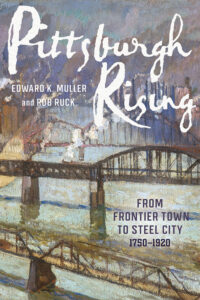 Pittsburgh Rising
From Frontier Town to Steel City, 1750–1920
by Edward K. Muller and Rob Ruck
University of Pittsburgh Press, 290 pp., hardcover $29
To historians Edward Muller and Rob Ruck, class and cultural conflict are central to the Pittsburgh story in its early decades. There is no shortage of examples to support such an interpretation. Their villains are the Scots Irish Presbyterian business leaders of the 19th and early 20th centuries. Among the worst, they write, “No one better personified their dour Presbyterian emphasis on accumulating material wealth than Thomas Mellon.”
From humble roots, Thomas Mellon founded an empire that encompassed aluminum, aviation, coal, finance and oil. Mellon famously observed, “Work where you live, live where you work.” Where other industrialists turned their homes into environmental wastelands and then fled, most of Pittsburgh’s millionaires and billionaires remained in the city they loved. As Kathleen Buechel wrote in A Gift of Belief, Pittsburgh’s wealthy often drew upon a Presbyterian spirit of “stewardship.” They founded orphanages, libraries, hospitals, universities, parks, theaters and symphonies. Pittsburgh had a charitable and cultural network that surpassed its larger East Coast contemporaries prior to 1920.
In discussing the origins of Irish Catholic Democratic machine leader David Lawrence, the authors failed to credit his mentors — the Scots Irish Presbyterian Guffey family. James Guffey was among the western Pennsylvanian oilmen who launched the Texas petroleum boom at Spindletop in 1901. He left his nephew, Joe Guffey, his millions, as well as his clout in the Pennsylvania and Texas Democratic parties. Joe Guffey took Lawrence on as his secretary and prepared him for leadership in the Keystone State when Guffey became U.S. senator and a stalwart of the New Deal.
The Mellon and Guffy stories underscore that while class and cultural conflict is a prism through which to view Pittsburgh, there are other more nuanced and fascinating angles to consider.
Kenneth J. Heineman
Angelo State University