
Philadelphia: A Narrative History by Paul Kahan
Written by Isabel Steven in the Book Review category and the Spring 2025 issue Topics in this article: Paul Kahan, Philadelphia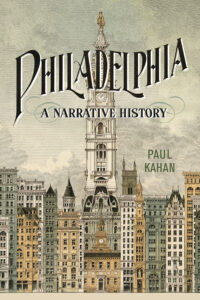 Philadelphia
A Narrative History
by Paul Kahan
University of Pennsylvania Press, 424 pp., hardcover $39.95
Ambitious in scope, Philadelphia: A Narrative History delivers a deft and accessible narrative of one of America’s oldest cities, and one that, according to Paul Kahan, “does a terrible job remembering most of its own history.” De-centering the traditional narrative that focuses on colonial and revolutionary history, often to the exclusion of other time periods, Kahan weaves well-known stories, figures, locations and artifacts within a longer, more cohesive narrative of the city’s development. Covering more than 300 years of social, cultural and political history, Kahan illuminates how immigration patterns, technological changes and innovations, and larger political histories have shaped and influenced the lives of Philadelphians, paying particular attention to socioeconomic class and religious, ethnic and racial identity.
Kahan sets out several major themes of Philadelphia’s development: the ethnic, racial and religious diversity that has made up the city since its origins; that this very diversity has impacted political and social conflict throughout the city’s history; the pervasive anti-urbanist bias that has shaped policy and attitude; and the push and pull between organic and planned urban planning, architectural development, and geographic expansion; and the way that public space has been used to shape and influence citizens’ behavior and values. Aided by maps that chart the city’s expansion over the decades, Kahan deftly moves
the reader from a street-level view of the city to one that gives scope to Philadelphia as a regional, national and international actor. Residents of Philadelphia will be sure to not only delight in the many references to specific street corners, parks and neighborhoods they recognize but also come to a deeper understanding of how those pockets of the city came to be. And for those who wish to learn more about the city that, as Kahan notes, has often been used as a symbol rather than seen as a place, Philadelphia: A Narrative History offers a clearsighted, critical and sharp introduction to “The City of Brotherly Love.”
Isabel Steven
Mid-Atlantic Regional Center for the Humanities