
Perkasie Park Camp Meeting
Written by Benjamin Harvey in the A Place in Time category and the Summer 2023 issue Topics in this article: Bucks County, camp meetings, Evangelical Association, Perkasie Park Camp Meeting, Quakertown and Inland Traction Co., religion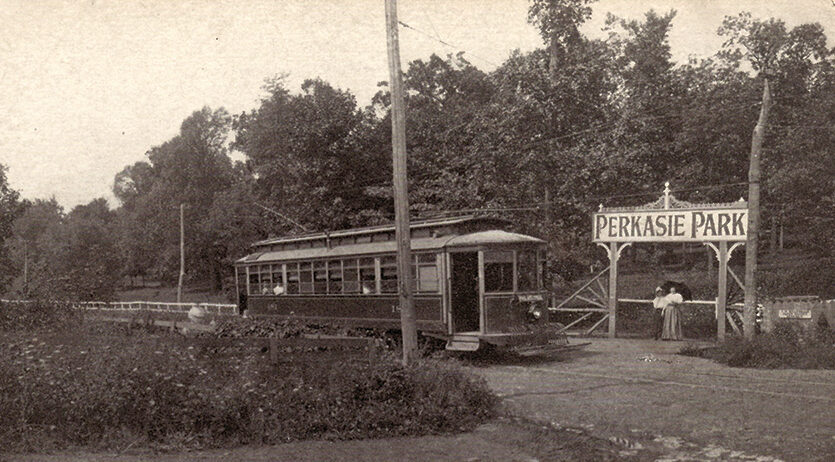
Due to the popularity of Perkasie Park, a stop was created on the Quakertown & Inland Traction Co. trolley line to provide regular access to campers.
Courtesy of Perkasie Park Historical Foundation
Pennsylvania’s religious groups have long sought peace in gatherings away from the commonwealth’s bustling cities. In the 19th century, this led to a rise in camp meetings across the state, especially among the pietist sects. Located in Bucks County, the Perkasie Park Camp Meeting was founded in 1882, when nine investors agreed to purchase property and form a camp meeting association. The first Evangelical Association camp meeting at Perkasie Park was held that summer.
Like many of its contemporaries, Perkasie Park began preparing for permanent construction quickly, with plans for an auditorium. The Perkasie Central News reported in July 1886 that an “immense auditorium” had been built with 1,000 sofa chairs for the year’s camp meeting. By September 1887, the camp contained a cluster of 25 privately built cottages in a rectangular pattern around the auditorium built by the association. Attendance was said to be more than 30,000 people over the course of the week at a time when Perkasie Borough had only 1,000 residents. Most came by railroad and carriage from Philadelphia and the Berks and Lehigh valley regions, with 300 people staying in the park in tents. The largest one-day attendance for the camp meeting was in 1890, when the Doylestown Daily Intelligencer put the Sunday attendance at 23,000 people.
Perkasie Park’s popularity led to a second wave of construction between 1888 and 1893. Newspapers reported about 60 cottages by 1891, and in 1893 the association added a dining hall and a refreshment stand.
During the summertime, Perkasie Park hosted large meetings of all types. The camp also benefited from the proximity of Menlo Park, a nearby tourist attraction on the new Quakertown & Inland Traction Co. trolley line. Trolley service was integral for entry to Perkasie Park, so in 1911 the association granted the trolley company access through its property, and a trolley shelter was constructed on the grounds.
Although the Evangelical Association was founded by German speakers, the use of English increased as the 19th century progressed. By 1911 one day was still set aside as “old folk’s day,” when services were held in German. By World War I, all services were held in English.
In 1922 the Evangelical Association leadership decided to consolidate the annual camp meeting to Sellersville. For the next 23 years, the camp held regular activities, hosting both religious and secular organizations, but the large crowds from the turn of the century were no longer in attendance.
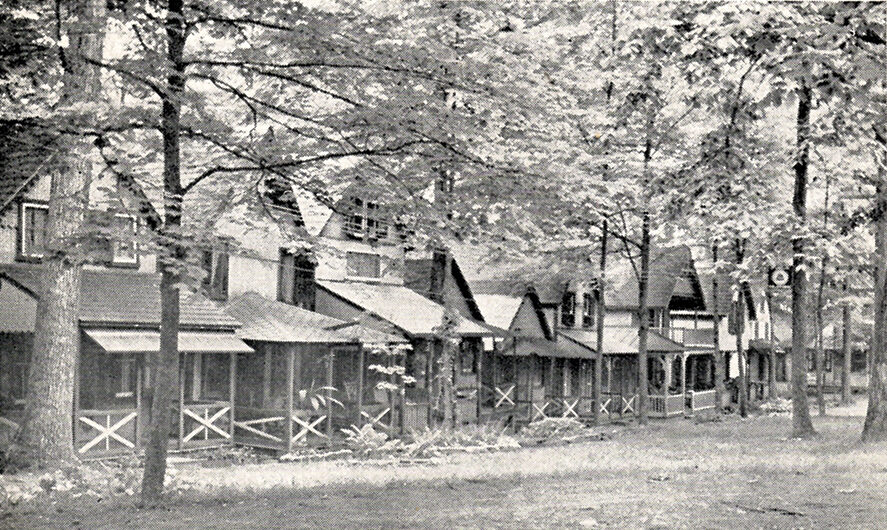
This postcard view of the south side of Perkasie Park’s campground square depicts a row of simple gablefront cottages with porches and relatively modest ornamentation.
Courtesy of Perkasie Park Historical Foundation
In the postwar period, the amusement park at Menlo Park closed, and with it the end of trolley service. The Evangelical United Brethren (EUB) Church (successor to the Evangelical Association) decided to end its summer camps at Perkasie Park by the mid-1960s, which meant an end to its financial support. After that time, cottagers who wanted to stay in the camp had to find a way to maintain it. Fortunately, most had a deep commitment to its survival.
Perkasie Park remained open and thrived for the next 56 years through responsible fiscal management, volunteer work, and a strong community. In 1982 the camp celebrated its 100th anniversary, and in 2007 it marked its 125th anniversary.
Currently, Perkasie Park has 60 cottages, all owned by Perkasie Park Association members, and the historic auditorium is used regularly for summer religious services. The cottager experience of earlier decades survives in a slightly modified form in the original setting of the camp meeting. It continues to be a quiet, ecumenical-based retreat that welcomes cottagers and visitors every summer.
The Perkasie Park Camp Meeting with its remaining cottages was listed in the National Register of Historic Places for its significance to the history of religion in the commonwealth from 1882 to 1960 and for the intact design of the camp meeting layout.
Recent listings in the National Register of Historic Places include Fort Pittston School, Pittston, Luzerne County; Henry Koerner House, Pittsburgh, Allegheny County; and Marsh Creek Advent Church, Bellefonte, Centre County.
Benjamin Harvey is the National Register coordinator for the Pennsylvania State Historic Preservation Office.