
Pennsylvania’s Fossil Record
Written by Tyler Stump in the Picturing PA category and the Spring 2024 issue Topics in this article: Adams County, Anchisauripus, dinosaur tracks, New Oxford Formation, paleontology, Pennsylvania State Archives, State Museum of Pennsylvania, York Springs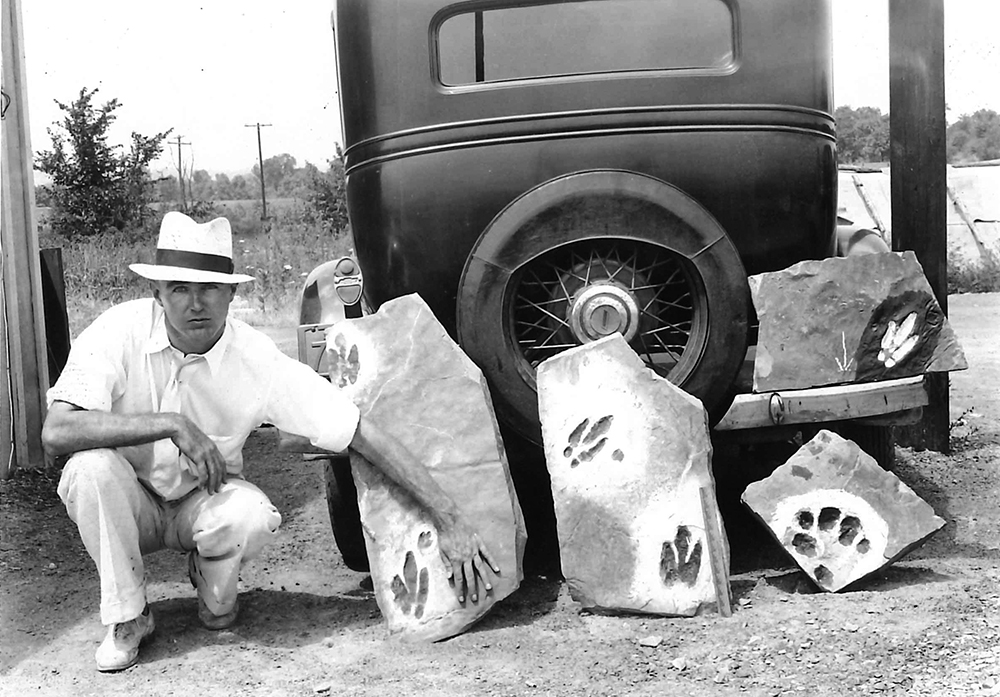
One of Pennsylvania’s most incredible dinosaur discoveries happened by accident — and almost became building material for a bridge in Adams County.
In 1937 a team of men were digging in a quarry near York Springs. The sandstone blocks they were excavating were needed for a series of new bridges at the nearby Gettysburg National Military Park. As they chiseled away at a steep cliff wall, they were astonished to find strange-looking footprints in the stone slabs. Word of the exciting discovery quickly spread through the quarry and, before long, an inquisitive engineer determined that the 6-inch, three-toed footprints might belong to a dinosaur.
Quarry superintendent J.L. Thomas, pictured here, halted all work and invited paleontologists from The State Museum of Pennsylvania to investigate the prints. Later that week state paleontologist Arthur Cleaves (1905–85) arrived and quickly confirmed their hunch: These footprints were those of a dinosaur that roamed the land millions of years ago. Calling the fossilized footprints the “finest collection ever found in Pennsylvania,” Cleaves worked with the quarry employees to carefully remove the fossils from the cliffside. Precariously hanging from long ropes, the men cut a 10-by-6-foot slab of rock and gingerly lowered it to the ground.
Cleaves determined the footprints belonged to an Anchisauripus, a small dinosaur of the early Jurassic Period, about 175 million years ago. Roughly 6 feet long and weighing around 60 pounds, it was an herbivore that lived throughout what is today the northeastern United States.
Millions of years ago, the land that now makes up Adams County was a swampy woodland. Footprints and the remains of plants and animals that lived here fossilized and over time became embedded in the hard red shale and sandstone rock common to the area today.
The bedrock of south-central Pennsylvania, known as the “New Oxford Formation,” is one of the rare places in the state where evidence of dinosaurs has been discovered. Most rock layers found in the rest of Pennsylvania are many millions of years older and contain fossils of ancient fish and other creatures that lived before the dinosaurs.
The 1937 discovery of Anchisauripus footprints at York Springs was one of several notable paleontological discoveries in south-central Pennsylvania in the early 20th century. In 1934 a single footprint from a Grallator, a small Triassic three-toed dinosaur, was discovered near New Cumberland by a surveyor during a road widening project. Earlier in 1909 physician Robert Stahle discovered a trove of fossilized Triassic-era bones in the streambed of Little Conewago Creek, north of York. To his great disappointment, the ancient bones did not belong to a dinosaur but were identified as part of a phytosaur, a semiaquatic reptile that lived alongside dinosaurs and resembled a crocodile.
Many of these fossils were discovered by inquisitive locals, who played an oversized role in uncovering the geology of Pennsylvania, rather than professional paleontologists. In the 1880s and 1890s York school principal Atreus Wanner (1852–1938) published his discoveries of dinosaur footprints in Goldsboro and fossilized plants in York Haven, which were later named Ctenophyllum wannerianum after him. Wanner also assisted federal paleontologists and geologists in conducting survey work in York and Adams counties, leading them to significant rock outcrops and lesser-known areas where he successfully predicted fossils would be present. Several other ancient plants and animals have been named in his honor, including the bird-like dinosaur Atreipus (Latin for “Atreus’ foot”).
Materials pertaining to fossil discoveries in Pennsylvania can be found in the Pennsylvania State Archives in RG-13: Records of the Pennsylvania Historical & Museum Commission and RG-65: Records of the Department of Conservation & Natural Resources. Some of the original footprint fossils discovered in York Springs can be seen at The State Museum of Pennsylvania in the exhibit Life Through Time.
Tyler Stump is an archivist at the Pennsylvania State Archives.